Search best restaurants near me in Los Angeles and you get the same forty names in a different order every time, most of them impossible to sit in this month. The more useful sort is by access. LA restaurants fall into three tiers: the ones you can walk into on a weeknight, the ones you can get within a week if you are flexible about the hour, and the handful where you set an alarm for the exact minute the calendar opens. The food quality does not track those tiers cleanly — some of the hardest tables are hard because they seat thirty people, not because they cook better than a strip-mall counter in Glendale.
The gap between a great restaurant and a great Tuesday is usually the booking system, not the food. Tell Karpo the night you have free, the part of town you can reach, and how long you are willing to wait, and it will work the list backwards from there — including the places that hold back counter seats for walk-ins.
Tier one: rooms you can still walk into
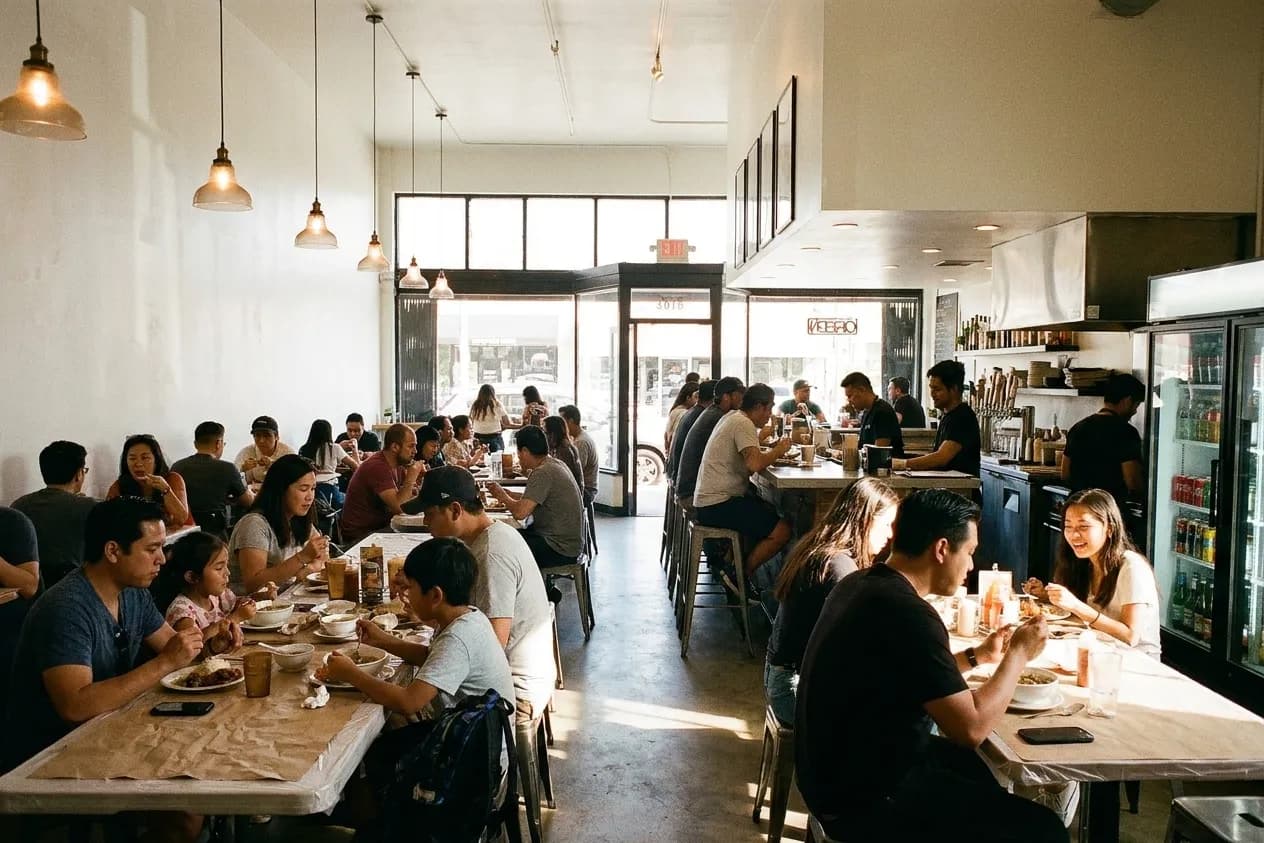
This is the tier that gets left off best-of lists because it is unglamorous, and it is the one most people actually need. In Thai Town, the stretch of Hollywood Boulevard east of Normandie runs on turnover rather than reservations, and a two-top on a Wednesday is rarely a problem. The same is true of most of Sawtelle Japantown's ramen and izakaya rooms, where the wait is a paper list at the door rather than a booking you made in advance. Koreatown's late kitchens work on the same principle: a party of two at 10 p.m. is an easier ask than the same party at 7.
A rule that holds across the city: counter seats are the loophole. Restaurants that look fully booked online frequently hold their bar and chef's counter for walk-ins, because a solo diner or a pair at the bar is easier to seat than a four-top. If a place you want shows nothing on Resy, the useful question at the door is not whether there is a table but whether there are two stools.
Tier two: bookable within the week if you move the hour
Most of the restaurants people actually rank live here — Bavel and Bestia in the Arts District, Kato in the West Adams complex, Gjelina in Venice, République on La Brea. The trap is assuming they are impossible. They are impossible at 7:30 p.m. on a Saturday, which is roughly four percent of the seatings in a week. Move to 5:15 or 9:30, or move to a Monday, and the same rooms open up on a few days' notice. Résy's notify list works better in LA than in most cities because the no-show rate rises with traffic; tables shed in the two hours before service more often than you would expect.
Geography is the other lever. The Arts District, Downtown and Hollywood absorb most of the demand. Equivalent kitchens in Highland Park, Glassell Park, Culver City and the South Bay run at half the booking pressure for reasons that have nothing to do with cooking and everything to do with where people are willing to drive at 7 p.m.
Tier three: the calendar-alarm restaurants
A small number of rooms genuinely require planning: tasting-menu counters with a dozen or twenty seats, where every service is one seating and the entire month releases at once. Providence in Hollywood, n/naka in Palms and the smallest omakase counters in Little Tokyo behave this way. The mechanics matter more than the hype — find the day of the month the calendar drops, be in the queue at that minute, and take whatever time you are offered, because the 5 p.m. seating at a twenty-seat counter is the same meal as the 8 p.m. one.
This tier is also where cancellation policies bite. A missed booking at a tasting counter is a real charge, often the full price of the menu, and it is enforced. If your plans are soft, this is the wrong tier to book.
How the tiers change by night of the week
Los Angeles empties out on Sunday and Monday in a way that a lot of visitors never notice, and a surprising number of the best kitchens are closed one or both of those days. That has two consequences. First, Sunday and Monday demand compresses onto the restaurants that do open, so those nights are not automatically easy. Second, Tuesday is the softest genuinely-full-service night in the city — the whole map is open and nobody is competing for it.
Friday is the worst night to try anything spontaneous, and not because of the restaurants. Crossing town between 4 and 7 p.m. on a Friday can double your travel time, which means a 7 p.m. booking on the other side of the city is a two-hour commitment before you sit down. Pick the neighbourhood first on a Friday and the restaurant second.
Practical notes
Call the restaurant if the platform says nothing is available; a meaningful share of LA rooms keep a few tables off the booking system entirely. Check the day the venue is dark before you plan around it, since Monday and Tuesday closures are common and seasonal. Assume valet or a paid lot in the Arts District, Hollywood and most of Beverly Grove, and budget the time for it. If you are booking for four or more, book earlier than you think — the constraint is table size, not covers, and a lot of these rooms have only two or three tables that seat six.
The neighbourhoods that reward a shorter drive
Access is partly a map problem. The same money and the same evening buys a much easier table in Highland Park, Glassell Park, Frogtown, Culver City, Inglewood or the South Bay than it does in the Arts District, and the cooking in those areas has caught up entirely over the last five years. The reason the booking pressure has not followed is inertia — people book where they have always booked.
If you are new to the city and want a strategy rather than a list, pick the good neighbourhood nearest to where you live and work through it, rather than driving forty minutes each way to eat at the places with the longest waiting lists. You will eat better more often, which is the actual goal.
Tags: #LosAngeles #LARestaurants #WhereToEatLA #LADining #ArtsDistrict #Koreatown #SawtelleJapantown #HighlandPark #LAFoodie #DinnerInLA #Resy #LAEats #BestRestaurantsLA #LANightOut
Sources consulted: resy.com · opentable.com · discoverlosangeles.com
All trademarks are the property of their respective owners.
Ask Karpo first
Booking windows, dark days and walk-in policies shift constantly across a city this big, and no list keeps up. Ask Karpo which rooms near you are actually seating tonight, which ones hold counter seats back for walk-ins, and how long the drive really takes at the hour you want to eat.