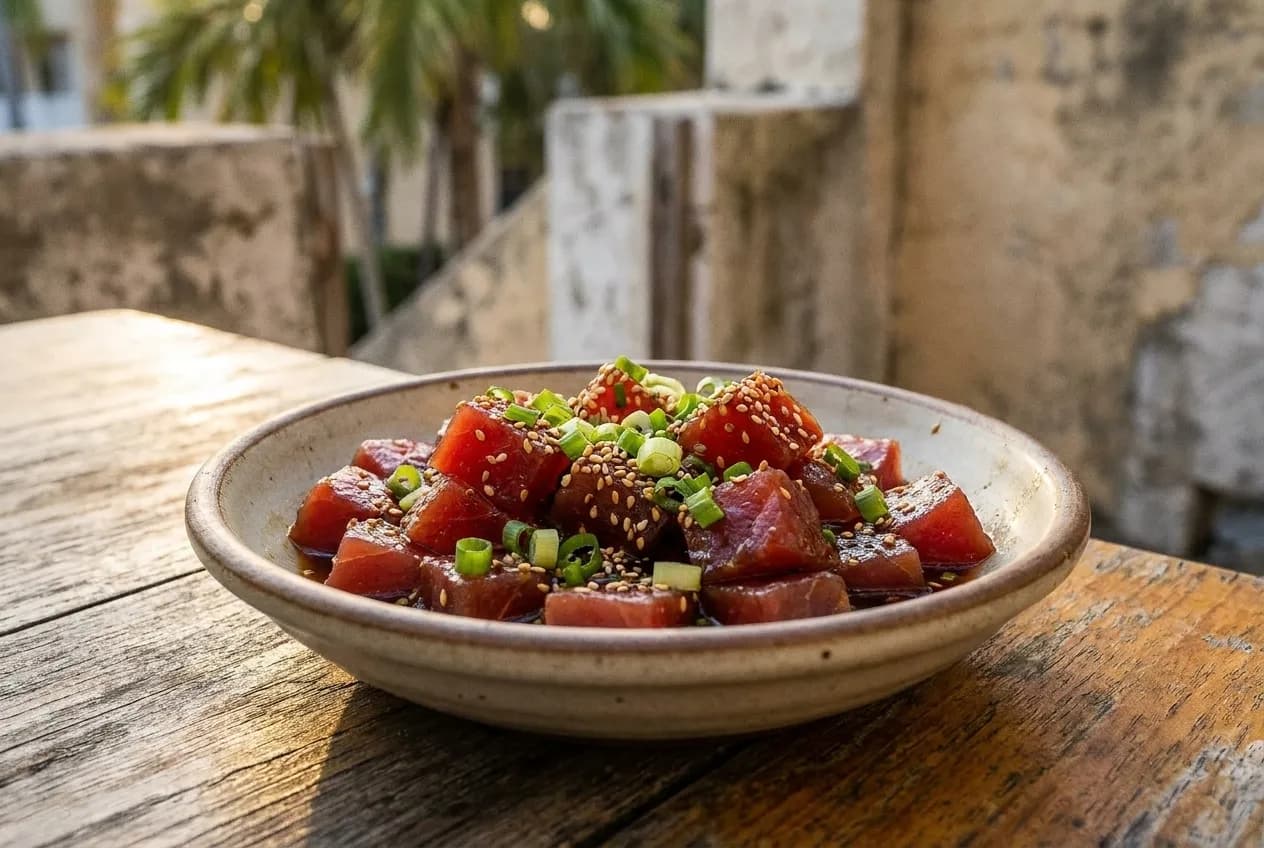
Poke, in Hawaii, is a preparation rather than a format. It means cut or sliced, and it refers to fish cut into cubes and dressed - traditionally with sea salt, seaweed and roasted kukui nut, later with shoyu, sesame oil and onion - then left to sit so the marinade works. It is sold from a case at a fish counter or a supermarket, by weight, already made. What spread across the American mainland in the 2010s is something else: an assembly line where you pick a base, a protein, six toppings and a sauce, and it is built in front of you. Both exist in Miami. They are not the same food.
The counters doing this properly keep short hours and several are lunch-only. Tell Karpo where you are and when you want to eat.
The difference, mechanically
In the traditional version the fish is cut and dressed in advance and allowed to marinate - anywhere from twenty minutes to a few hours. The shoyu and sesame penetrate, the onion softens slightly, the surface of the fish firms and takes on colour. It is a cured preparation, in the way a ceviche is, and the flavour is integrated rather than layered.
In the assembly-line version, plain raw fish is scooped from a tray onto rice and then sauced on top. Nothing has marinated. The sauce sits on the surface and, because the bowl is built in a paper container with rice underneath, most of it ends up pooled at the bottom. That is why these bowls so often taste of a lot of things separately rather than of one thing. It is a perfectly good lunch. It is a rice bowl with raw fish on it.
Telling them apart before you order
Look at the case. A traditional counter has bowls or trays of already-dressed fish - spicy tuna, shoyu ahi, salmon with onion - visibly marinated, often in two or three fixed versions. You point at one and they weigh it out or scoop it. An assembly-line shop has trays of undressed protein next to trays of edamame, corn, seaweed salad and crab mix, and a rack of squeeze bottles at the end.
The second tell is choice. A real poke counter offers three or four preparations. A bowl shop offers a hundred permutations. Abundance of choice is the signature of the format, not of the food. And the third tell is where it is sold: the most traditional versions in Miami are often inside fish markets and Asian supermarkets rather than in standalone shops with a queue system, which is exactly where the good version hides.
How to judge the fish
This matters more than any other variable, because poke is raw fish with seasoning on it and there is nowhere to hide. Good ahi is deep red to pink-red, translucent rather than opaque, and glossy without being wet. Dull, brownish or grey edges mean it has been cut too long ago. A uniform, almost fluorescent red across every cube can indicate treatment with carbon monoxide to fix the colour, which is legal in some markets and is a sign that appearance is being managed.
Texture is the other check. The cubes should hold their shape and have some resistance; mushy fish has been frozen and thawed badly. And smell, if you can - fresh fish smells of almost nothing. Any real fishiness is the first sign of age. A counter that cuts to order or cuts twice a day will be visibly better than one working from a single morning prep by four in the afternoon.
What to order
At a traditional counter, take the shoyu ahi first - soy, sesame oil, sweet onion, sometimes chilli - because it is the baseline against which everything else is measured. Spicy tuna, which in the American context usually means mayonnaise and sriracha, is the most popular and the least informative about the fish underneath, so order it second if at all.
At an assembly-line shop, the way to improve the bowl substantially is to strip it back. Two proteins at most, no more than three toppings, one sauce, and ask for the sauce mixed with the fish rather than drizzled over the top - most places will do this and it is the single change that gets closest to what poke is supposed to taste like. Skip the crab mix, which is mayonnaise and surimi and drowns everything.
Where it is in Miami
The assembly-line shops are everywhere - Brickell, Wynwood, the beach, Coral Gables, and every food hall - and they are aimed at the weekday lunch trade. That means they are busiest between eleven and two and several close early in the evening, and it means the fish is freshest at the start of service rather than at the end.
The more traditional versions are harder to find and are worth the effort: fish markets with a prepared counter, Japanese and Hawaiian-leaning restaurants that treat poke as a starter rather than a format, and Asian supermarkets in the south and west of the county. Miami's advantage over most American cities here is genuine - it is a coastal city with real fish supply - and the good counters use it.
Practical notes
Prices: fourteen to twenty dollars for a built bowl, often less by weight at a fish counter. Timing: go at the start of lunch service rather than the end, and be sceptical of anything sitting in a case at four in the afternoon. Judge on colour, gloss and texture rather than on the topping list. Ask for the sauce mixed through rather than drizzled. Two proteins, three toppings, one sauce. Poke does not travel - the rice firms and the seaweed weeps into the fish within about forty minutes - so eat it within a few blocks of where it was made. And if a place offers a hundred combinations, it is a bowl shop, which is fine as long as you order it like one.
Tags: #BestPokeNearMe #Miami #PokeBowl #Ahi #ShoyuPoke #Brickell #Wynwood #MiamiEats #RawFish #FishMarket #CoralGables #PokeCounter #HawaiianFood #MiamiLunch
All trademarks are the property of their respective owners.
Ask Karpo first
The difference between a marinated counter and an assembly line is not something a listing will tell you. Ask Karpo which places near you dress the fish in advance, which are freshest at the hour you are eating, and whether there is a fish market counter nearby doing it properly by weight.