The baseline has moved. A latte in Los Angeles in 2026 sits somewhere between five and seven dollars in most of the city, and at that price the question changes from where to find cheap coffee to what you are actually willing to give up. The good news is that the answer is usually not quality. It is almost always format, location or milk — and if you are flexible on those three, the best coffee in Los Angeles under five dollars is a real category rather than a consolation prize.
Prices and hours on this stuff move constantly. Ask Karpo what is near you and what it actually costs today, rather than driving to a place that repriced in March.
Give up the milk, not the roaster
The single biggest lever is the drink rather than the venue. At most serious LA roasters, a batch-brew filter coffee lands somewhere around three to four dollars while the latte from the same beans is closer to six or seven. You are not buying worse coffee — in a well-run room you are frequently buying better coffee, because batch brew is where a roaster shows off the origin. What you are giving up is the milk, the steaming and the two minutes of labour. If your objection to filter is that it arrives lukewarm, ask for it fresh off the next brew cycle; most bars will happily tell you when that is.
The market counters
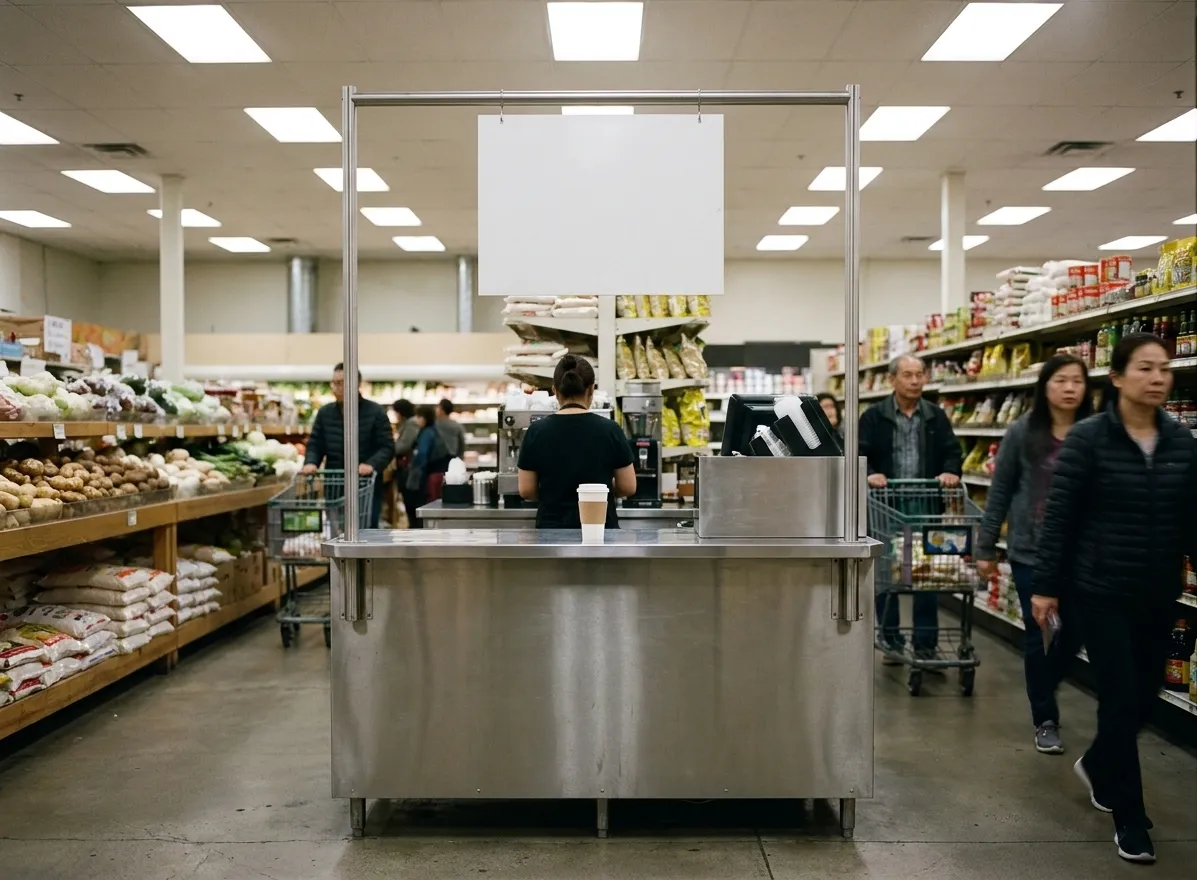
The best value in this city is consistently found in counters embedded inside something else. Concerto Coffee, tucked inside Zion Market in Koreatown, is the reference case: it pours Kona and a range of teas at prices that look like a mistake next to a standalone cafe two blocks away, because the rent maths is completely different. This pattern repeats across the city — grocery halls, bakeries, hardware-adjacent corners in the Valley. The coffee is not a loss leader exactly, but it is not carrying a lease on its own either.

The trade is atmosphere. There is nowhere to sit, the lighting is fluorescent, and nobody will ask how your day is going. For a cup you are carrying to a car anyway, none of that costs you anything. It is also worth knowing that these counters tend to keep the hours of the host building rather than cafe hours, which cuts both ways — a market counter will often still be pouring at seven in the evening when every specialty room in the neighbourhood shut three hours ago.
Refills, which almost nobody uses
A meaningful number of neighbourhood cafes in Los Angeles still run a refill policy on drip — often a dollar or so, sometimes free if you stay. Burbank in particular has several rooms where the basic coffee options sit under five dollars and refills bring the effective price of a two-hour sit down under three. This is almost never advertised anywhere except a card by the till, which is why it survives; it is worth asking outright because the answer is yes more often than you would expect.
The times of day that cost less
Late-afternoon discounting is not common in LA the way it is in some cities, but end-of-day pastry markdowns are near-universal, and a filter coffee plus a half-price pastry at four in the afternoon is a genuinely good deal that nobody markets. The other timing point is the opposite end: several roasters run a cheaper, simpler menu before about eight in the morning, when the queue is commuters rather than sitters.
Bakeries are the reliable version of this. A bakery that brews decent drip is almost always cheaper than a cafe that sells pastry, because the coffee is the accompaniment rather than the product, and the margin is already in the laminated dough. In neighbourhoods where the specialty rooms have priced a plain filter at five dollars, the panadería two doors down is frequently doing a better cup for half of it.
Why the price went up, and what that means for you
It helps to know that this is not simply LA cafes being greedy. Green coffee costs rose sharply across the market, and a cafe's other two big inputs — rent and wages — have gone the same direction in this city specifically. A five-dollar latte in 2019 and a seven-dollar latte in 2026 are, in real terms, roughly the same transaction. What has changed is that the gap between the cheapest acceptable cup and the standard cup has widened, which is precisely the gap this article lives in.
The practical consequence is that the savings are now in the fixed costs rather than the coffee. A room with no seating, no table service and no lease of its own can sell you the same beans for two dollars less, and that is the whole trick. Once you see it that way, finding cheap coffee in Los Angeles stops being about hunting for bargains and becomes about noticing which parts of the experience you were not using anyway.
What is not worth it
Two categories consistently disappoint at this price point. The first is the cheap iced drink at a room that roasts light — you are paying for dilution and losing everything delicate about the coffee. The second is the discounted large size. A twenty-ounce milk drink at a modest price is usually a small amount of espresso stretched a very long way, and it is the one order where the price genuinely is telling you something about the quality. Order the smallest milk drink on the menu at a good roaster instead. It will cost roughly the same as the large one at a bad one and it will taste like coffee.
Tags: #LosAngeles #LACoffee #BestCoffeeLA #CheapEatsLA #CoffeeUnder5 #Koreatown #Burbank #BudgetLA #SpecialtyCoffee #DripCoffee #LAEats #CoffeeGuide #LAOnABudget #ValueLA #LAGuide
All trademarks are the property of their respective owners.
Ask Karpo first
Ask Karpo where the genuinely good cheap coffee is near you in Los Angeles right now, what the drip actually costs at each one, and which nearby rooms still do refills.