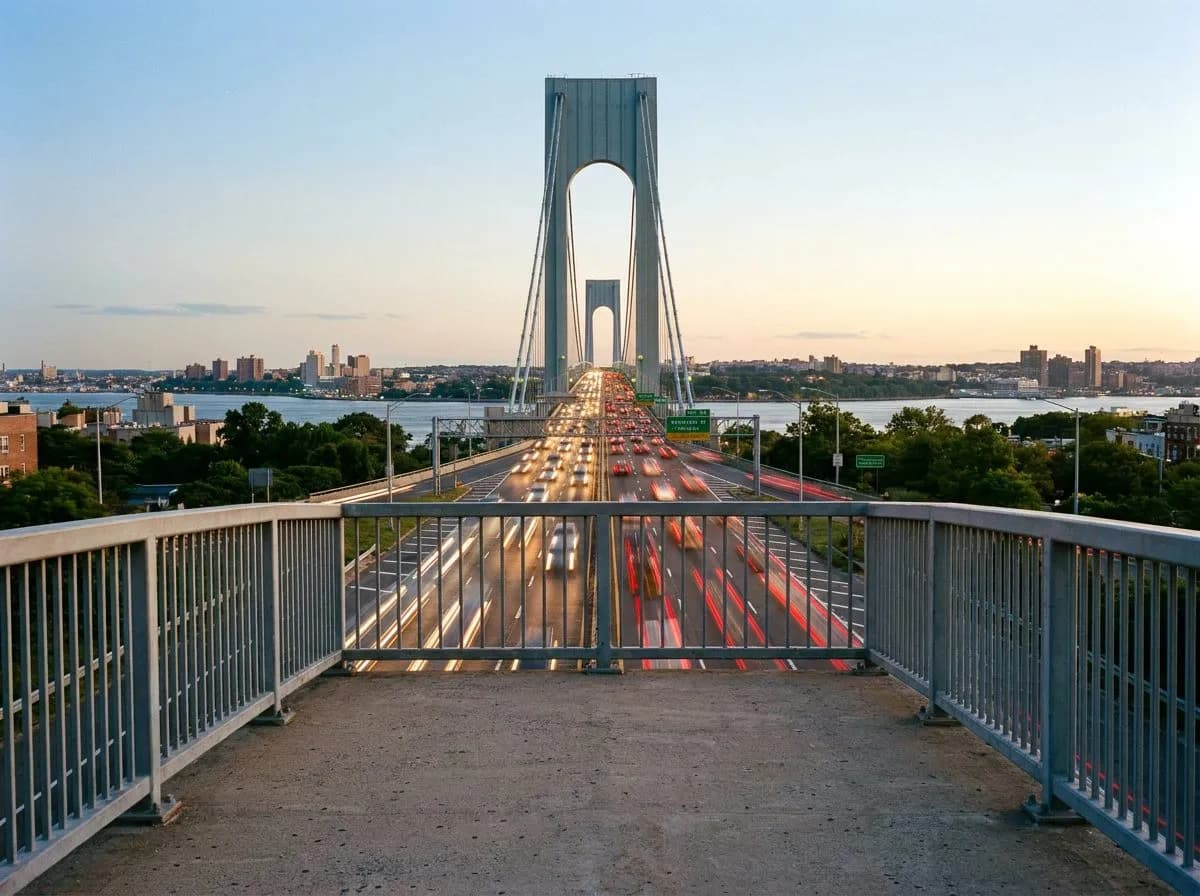
Most pedestrian overpasses exist to solve a problem: how to move bodies across rivers of asphalt without carnage. The Shore Parkway overpass in Dyker Heights does exactly that, spanning six lanes of Belt Parkway traffic with the elegance of pure function. Concrete, railings, a gentle arch. Nothing designed to make you stop. And yet people do. Not many, and never for long, but enough that you notice the phenomenon if you visit more than once. They pause mid-crossing, lean against the western rail, and watch. The Verrazano Bridge rises in the distance like a patient argument for suspension engineering. Below, the Belt hums its endless commute. This is infrastructure as accidental theater.
The geometry of the view
The western railing offers the clearest Verrazano view, but only from the center span; too far east and the frame is blocked by the overpass's own support beam. It's a narrow window, maybe fifteen feet of optimal vantage, where the cables and towers align without obstruction. Late-afternoon light does the best work here, catching the suspension cables and turning them into bright filaments against the gray-blue harbor. Early morning offers a softer palette, the bridge a silhouette against the pale sky. By winter 2026, the view hasn't changed in any meaningful way—the Verrazano doesn't reinvent itself—but the seasonal light shifts the mood considerably.
The overpass itself is unremarkable. Poured concrete, utilitarian railings, no plaques or interpretive signage. It connects the residential blocks south of the Belt to the commercial strip and school zones to the north, a pedestrian artery that exists because highways sever neighborhoods. The design assumes transit, not contemplation. But stand still long enough and the structure's simplicity becomes an asset. There's nothing to distract from the primary elements: bridge, traffic, sky.
Rush hour as white noise
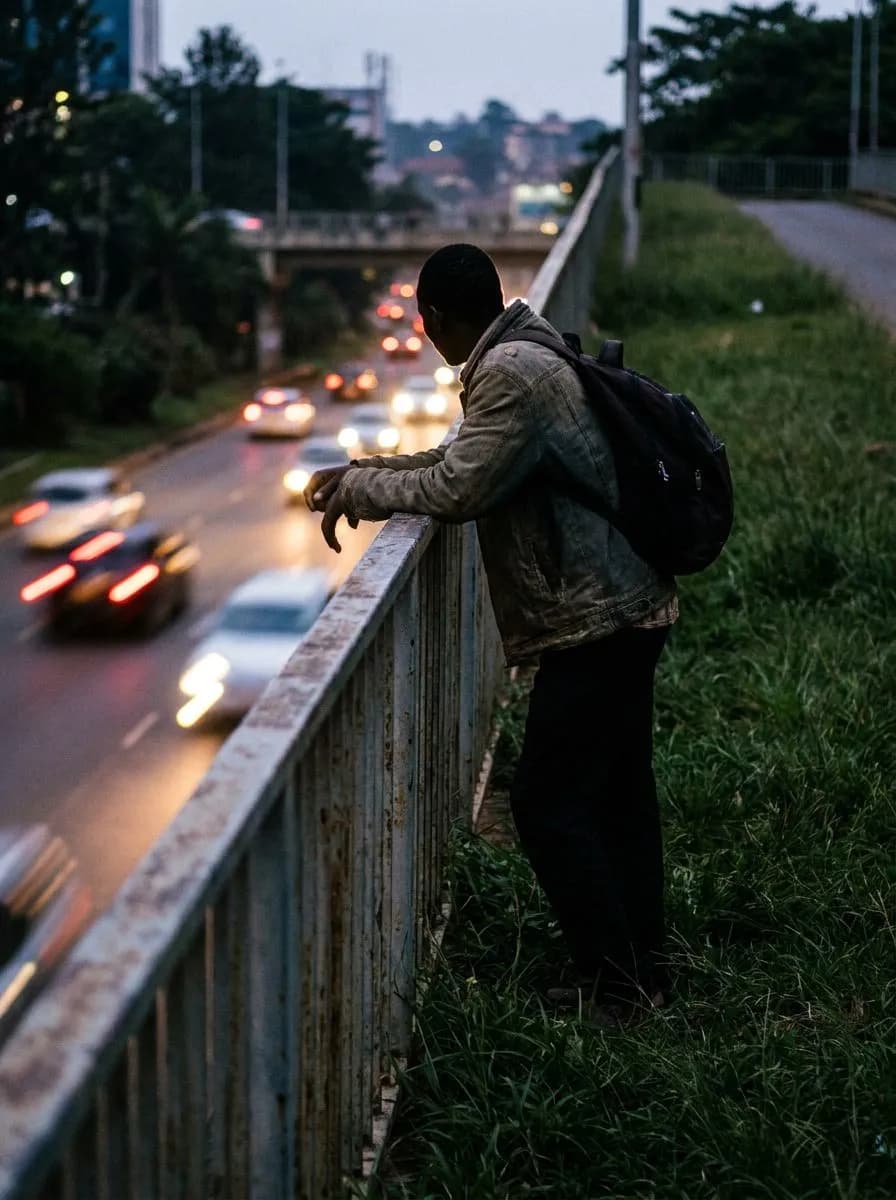
Traffic sound peaks during the 7-9am and 4-6pm windows, creating a white-noise effect that locals describe as 'the Belt lullaby.' It's not pleasant in the conventional sense—no one mistakes six lanes of parkway traffic for a babbling brook—but it has a rhythm. The whoosh and hum blend into a steady wash of sound, punctuated by the occasional truck or motorcycle asserting its individuality. Some people find it meditative. Others find it numbing. Either way, it provides a sonic buffer, a layer between you and the quieter anxieties of the day.
The sound drops off considerably outside those windows. Midday traffic is lighter, more sporadic, each vehicle audible as an individual event rather than part of a collective roar. Late evening, after ten, the Belt becomes almost conversational—you can hear engines shift gears, tires hiss over pavement. The overpass takes on a different quality then, less observation deck and more lonely outpost. Most visitors prefer the daylight hours, when the view and the soundtrack work in tandem.
School dismissal and the 5:15 surge
The overpass may be busier around school dismissal time and parents walk children across to the residential blocks south of the parkway. For about twenty minutes, the bridge becomes a parade of small backpacks and hand-holding, parents chatting in clusters while kids test the echo acoustics of the underpass. It's the only time the structure feels truly communal, less a piece of infrastructure and more a neighborhood threshold. By 5:40, the crowd thins, leaving behind the occasional straggler and the regulars who come for the view.
If you're hoping to experience the overpass as a solitary observation point, avoid the post-school window. Come mid-morning, or later in the evening, or on a weekend when the rhythm shifts entirely. Weekend plans that include a quiet walk through Dyker Heights can easily fold in a five-minute stop here, a brief intermission between errands or brunch. The lack of amenities—no benches, no shelter, no vendor selling hot pretzels—keeps the tourist traffic to near zero.
What you're watching
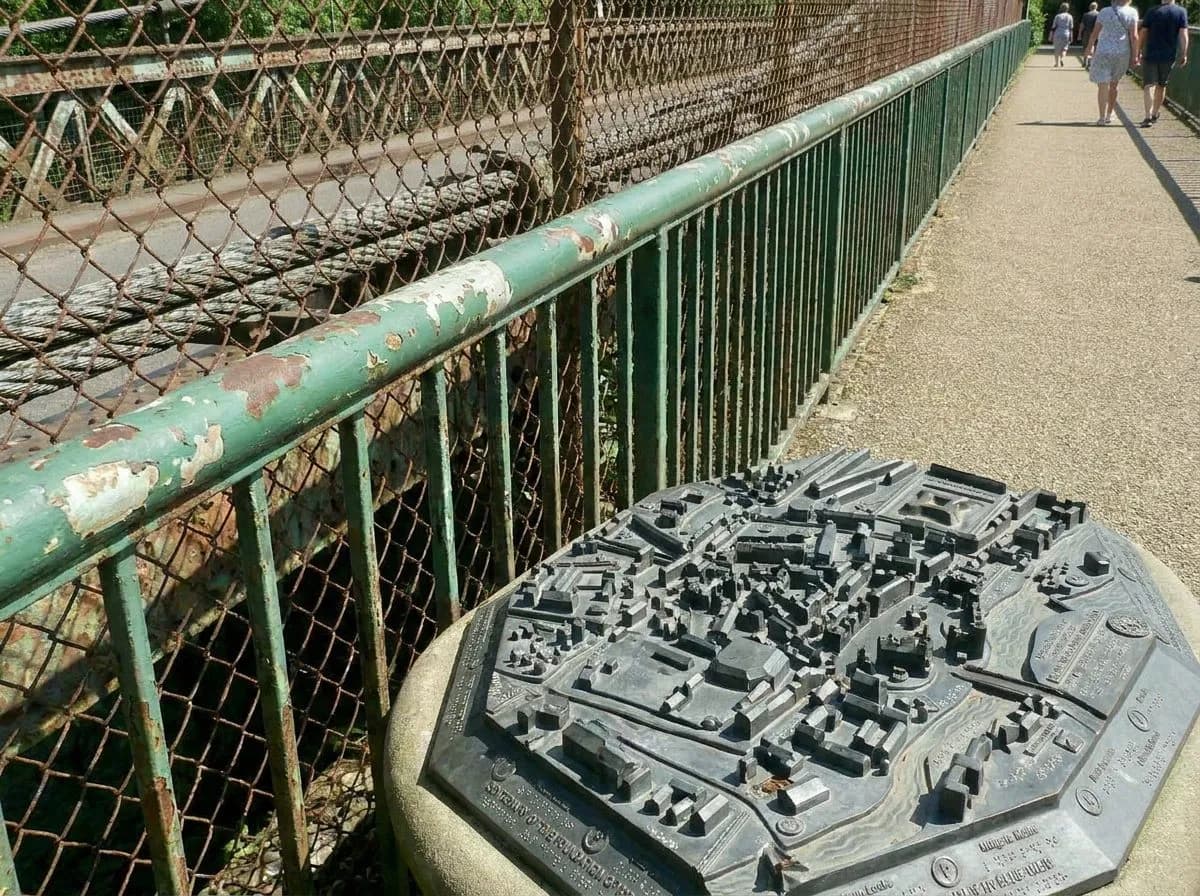
From the center of the overpass, the Verrazano dominates the western frame, but the secondary show is the traffic itself. The Belt moves in waves, responsive to some invisible choreography of lights and merges and human impatience. During rush hour, it's a slow crawl, brake lights pulsing in sequence. Midday, it flows more freely, cars spacing themselves out, finding their lanes. There's something hypnotic about it, the way individual decisions—lane changes, speed adjustments—create a collective pattern.
You start to notice vehicle types. Sedans and SUVs predominate, but there are delivery trucks, service vans, the occasional motorcycle weaving through gaps. In late 2026, the mix hasn't shifted dramatically—electric vehicles are more common, quieter, but the overall composition remains familiar. The overpass offers a vantage that makes every car legible, a rolling census of the city's working movement.
Why linger
No one comes to Dyker Heights for this overpass. It's not on maps, not listed in guides, not tagged in Instagram geolocation clusters. It exists in the category of infrastructure that serves a purpose and then fades into the background. But that's part of its appeal. To stop here is to claim a moment that isn't curated, that doesn't ask for your engagement or your wallet. You can stand for two minutes or twenty. No one checks. No one cares.
The act of watching traffic is, admittedly, a niche pleasure. It requires a tolerance for repetition and a willingness to find meaning in motion that isn't directed at you. But for a certain kind of urban observer, it's exactly right. The overpass offers a static point in a city that rarely sits still. The Verrazano reminds you that some structures endure. The traffic below reminds you that the city is always, always moving. And you, for a few minutes, get to be the one standing still.
Practical notes
The Shore Parkway pedestrian overpass crosses the Belt Parkway in Dyker Heights, Brooklyn. Nearest subway access varies; verify current walking routes and station access before visiting. Street parking is generally available on surrounding residential blocks. The overpass is open 24/7, accessible year-round, though winter wind can be sharp and persistent. No facilities, no seating. Bring layers if you plan to linger. The bridge is wheelchair accessible via ramped approaches on both sides. Verify local construction schedules before visiting, as the Belt occasionally sees lane closures that may affect noise levels.
Tags: #BeltParkway #ShoreParkway #VerrazanoBridge #DykerHeights #Brooklyn #TheLongWayHome #NYCInfrastructure #UrbanObservation #HiddenNYC #WinterWalks #CityRhythms #PedestrianPerspective #NYCBridges #QuietMoments #Winter2026
Sources consulted: Belt Parkway - Wikipedia · Verrazzano-Narrows Bridge - Wikipedia · Dyker Heights - Wikipedia · Shore Road Park - NYC Parks · NYSDOT Region 11 - NYC
All trademarks are the property of their respective owners.