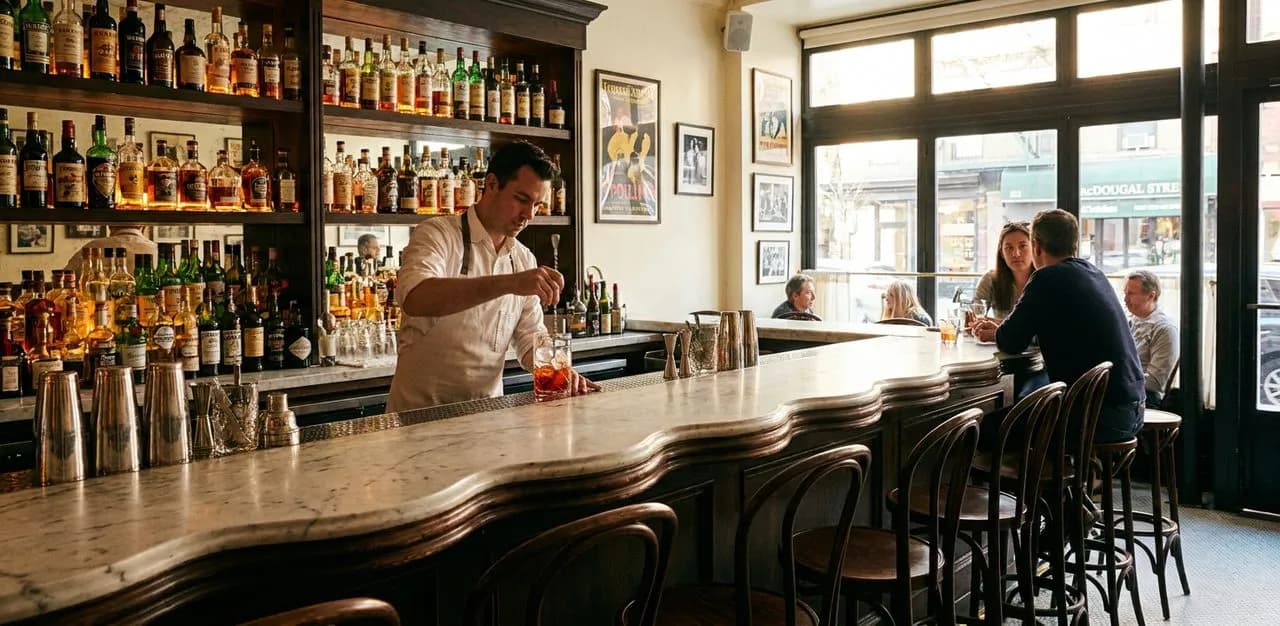
The marble bar runs cool under your forearms even on warm spring evenings, a geological counterpoint to the amber glow of backlit amari bottles. Dante occupies its MacDougal Street corner with the kind of casual permanence that comes from 111 years of uninterrupted tenancy—first as an Italian café serving espresso to neighborhood regulars, now as an aperitivo bar where the Negroni is elevated to liturgy. The bar stools face a wall of Italian spirits arranged like a periodic table of bitterness, and the bartenders move with the quiet confidence of people who've built the same drink a thousand times and still treat each one as though reputation depends on it.
The corner stool and its sightlines
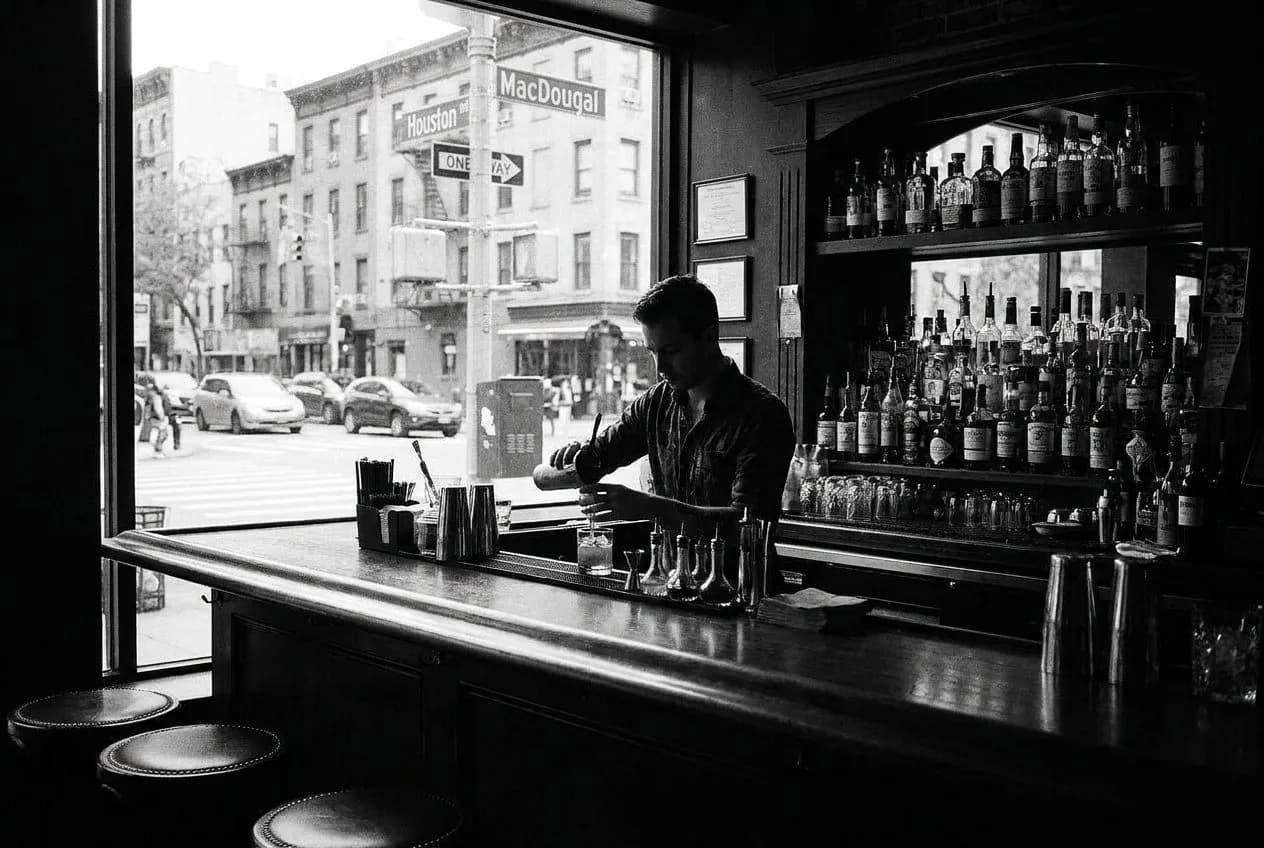
Geography matters here. The corner bar stool at the MacDougal Street end offers sightlines of both the bartender's workspace and the Houston Street intersection, a dual-aspect perch preferred for people-watching during the 5pm to 7pm aperitivo hour when the light slants gold through the windows and the post-work crowd begins to gather. From this vantage you can track the bartender's choreography—the reach for a bottle of Campari, the measured pour, the hypnotic stir—while simultaneously catching the sidewalk parade of dog-walkers, NYU students, and tourists angling for Washington Square.
It's theater on two stages. Inside, the ritual of drink-making unfolds with balletic precision. Outside, the West Village performs its eternal show of studied casualness and accidental beauty. The corner stool splits the difference, offering both intimacy with the craft and distance enough to observe the neighborhood's evening transformation. You're participant and spectator at once, which is precisely the aperitivo ideal: present, alert, but not hurried.
Twelve variations on a theme
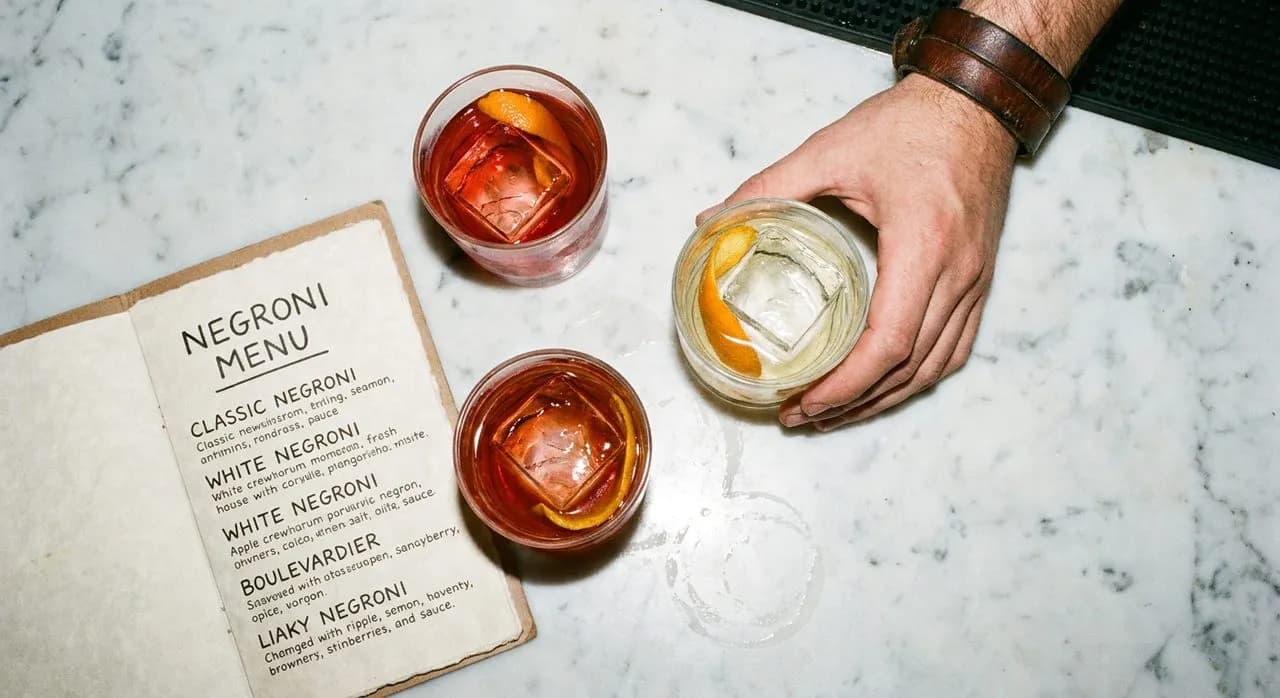
The Negroni menu lists twelve variations including the house Dante Negroni with Cocchi Americano, each a meditation on the holy trinity of gin, vermouth, and Campari. Bartenders build each with a specific stirring count and large-format ice cube, a technique standardized across all staff so that your drink tastes the same whether you visit on a Tuesday afternoon or a Saturday midnight. The standardization is not corporate rigidity but craft discipline—the kind that allows for consistency without sacrificing soul.
The variations range from the orthodox to the playful. Some swap mezcal for gin, others introduce sherry or aged spirits into the equation. The menu reads like a taxonomy of bitterness, each entry a small thesis on balance and proportion. You can taste your way through the roster over multiple visits, charting your own course from familiar to experimental, or you can become a devotee of a single expression.
Bartender as priest
Watch a Dante bartender build a Negroni and you witness ritual made flesh. The bottle is lifted, the pour measured by eye and long practice, the mixing glass filled with ice that cracks and settles. Then comes the stir: not a casual swirl but a deliberate, rhythmic motion, the bar spoon tracing ellipses while condensation beads on the glass exterior. The standardized stirring count ensures dilution is calibrated, temperature is precise, and the drink achieves that perfect viscosity between water and syrup.
The large-format ice cube is sacramental object, a single clear block that chills without over-diluting, melting slowly enough that your drink stays cold and balanced through the final sip. The bartender's hands move with economy—no flourish, no wasted gesture. This is not flair bartending. This is the quiet confidence of someone who knows that technique, applied consistently, produces transcendence.
Café history and aperitivo rebirth
Dante opened as a café in 1915 and was later revived as a cocktail bar in the 2010s; the marble bar top is original to the 1915 build, a physical through-line connecting the caffè culture of a century ago to the cocktail culture of today. The space retains echoes of its first life—tin ceilings, narrow proportions, the sense of a neighborhood gathering place that never sought to be more than essential.
Where once the bar served morning espresso to Italian immigrants and Village bohemians, it now pours aperitivo to a new generation of regulars who've adopted the Italian ritual of the pre-dinner drink. The shift from caffeine to Campari is less radical than it seems; both are bitter, both are social, both mark transitions in the day. The café was always a threshold space, and it remains one, just calibrated to a different hour and a different thirst.
The century-old marble has absorbed a lot of elbows, a lot of stories. It's cool and smooth and faintly veined, a material that improves with age. Sitting at it now, sipping a Negroni in the late-afternoon light, you're connected to everyone who ever leaned here—the espresso drinkers, the poets, the exiles, the neighborhood fixtures. Continuity is rare in New York; Dante offers it in solid stone.
The aperitivo hour as discipline
Aperitivo is not just a drink but a philosophy, a daily practice of slowing down before speeding up again. The hour between work and dinner, the space between obligation and appetite, becomes an opportunity for recalibration. At Dante the aperitivo hour is observed with Italian seriousness: the drinks are strong enough to matter but not so strong as to derail the evening, the snacks are present but not filling, the lighting shifts from bright to amber as the sun drops behind the buildings. You arrive keyed-up from the day; you leave ready for whatever comes next.
Spring in the West Village amplifies the effect. The weather cooperates, the sidewalks bloom with foot traffic, the sense of possibility hangs in the warming air. Sitting at the bar with a Negroni and a view of the corner, you're both anchored and adrift, committed to this moment but aware of the city humming beyond the glass. It's a pleasurable limbo, the kind of suspension that reminds you why you live here, why you tolerate the rent and the crowds and the relentless pace. For one drink, maybe two, the city becomes manageable, even beautiful.
Practical notes
Dante is located on MacDougal Street in the West Village; verify the exact street number before publication. Nearest subway: 1 train to Houston Street, or B/D/F/M to Broadway-Lafayette. Street parking is scarce; public transit is strongly recommended. Hours vary seasonally; verify directly before visiting. The bar is small and popular, especially during aperitivo hours; arrive early for the best seat selection. Reservations are available for table service. Accessible entrance at street level; restrooms downstairs. Bring curiosity and a willingness to embrace bitter flavors. Dress is casual but considered; this is the Village, after all.
Remove #Spring2026 unless the article is explicitly tied to a verified event or dated feature.
Please drink responsibly. Must be of legal drinking age.
Sources consulted: Negroni cocktail · Aperitivo tradition · West Village NYC · New York bars
All trademarks are the property of their respective owners.