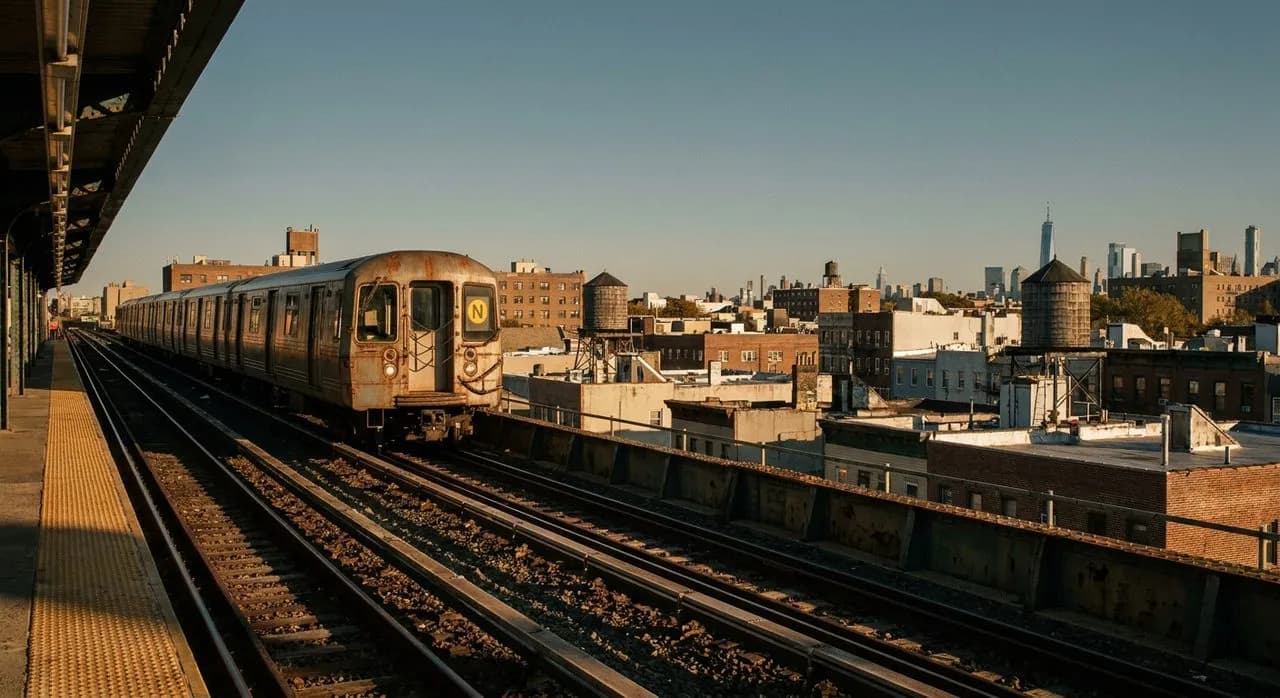
The train pulls into Ditmars Boulevard and empties. Passengers disperse down the stairs, the doors close on vacant cars, and the conductor walks the length of the platform to switch ends. For a brief interval—about a minute or so—the train sits idlethe train sits idle. The hum of the third rail fills the pause. Traffic noise drifts up from 31st Street below. This is the end of the line, and the turnaround itself is the moment worth noticing.
The geometry of a terminus
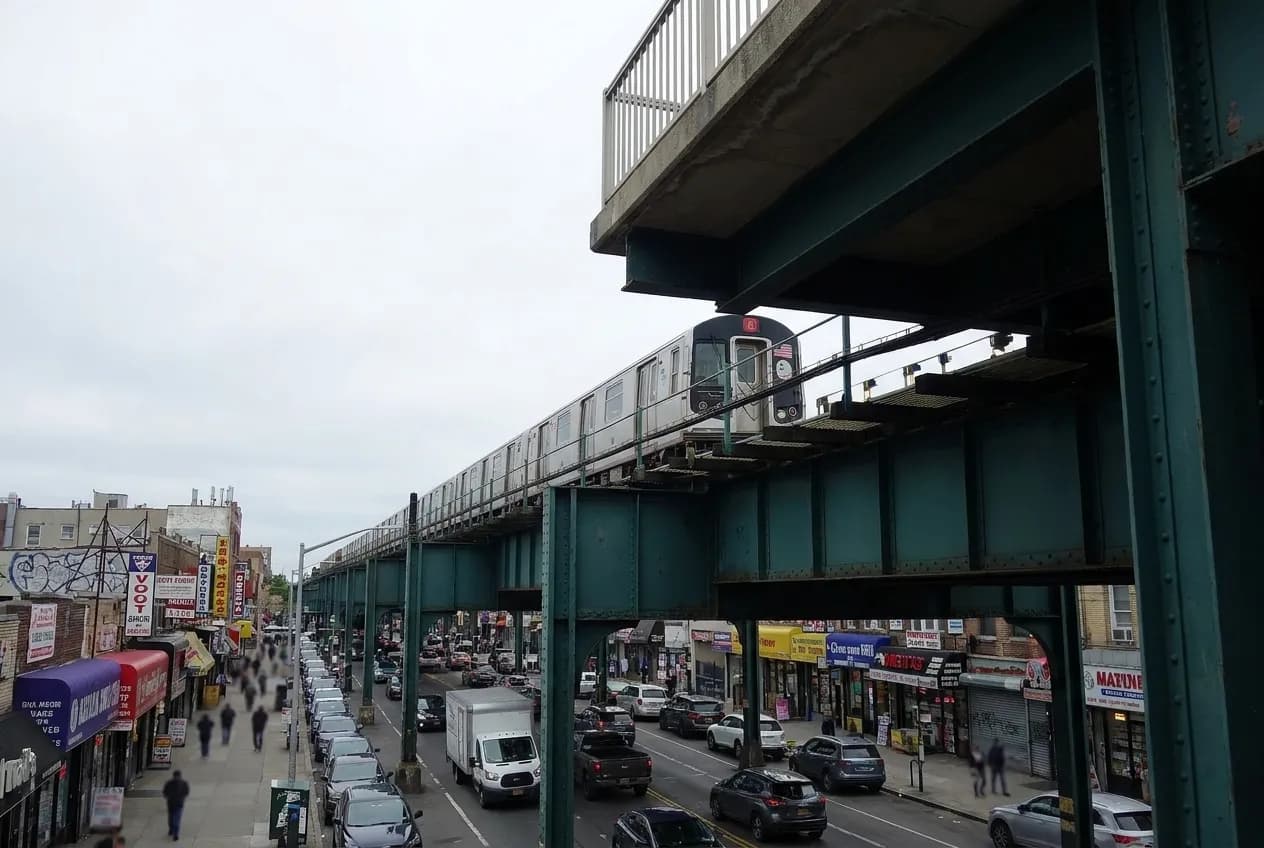
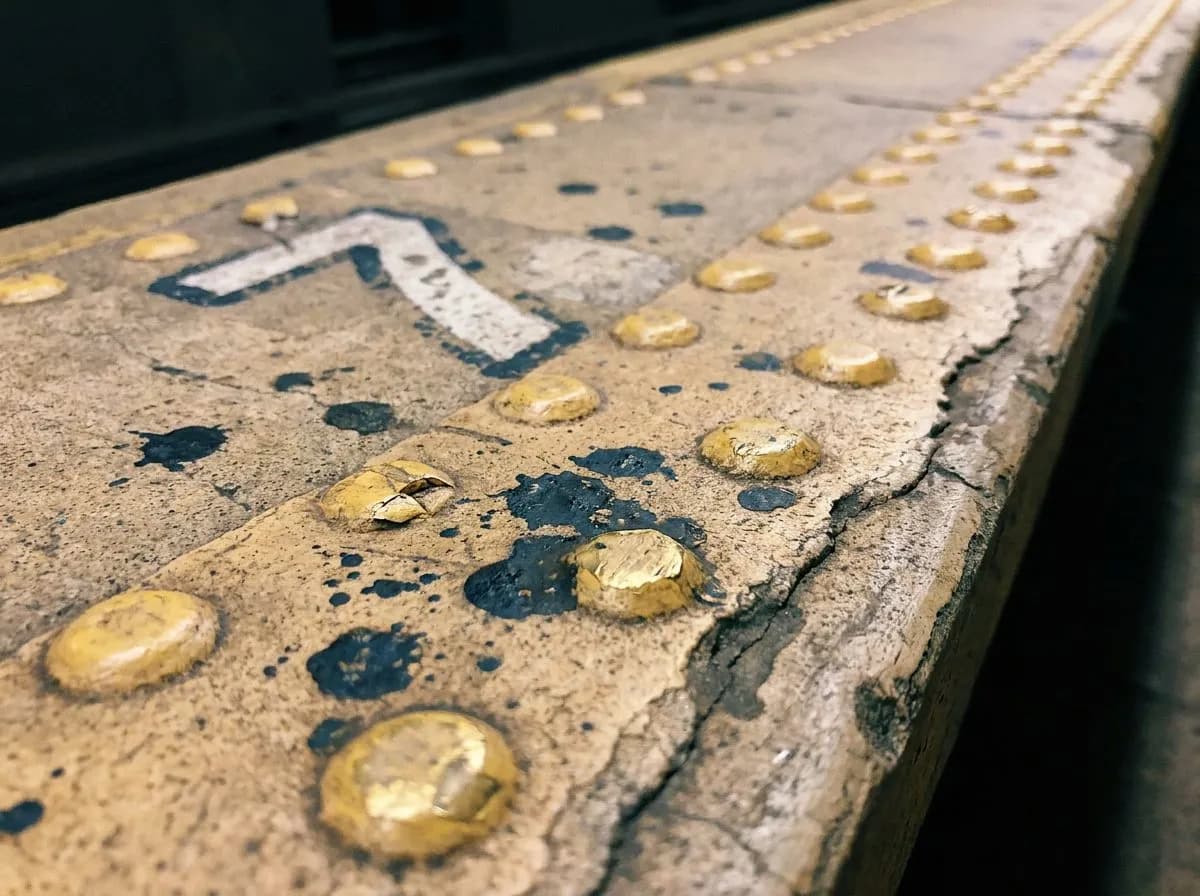
Ditmars Boulevard is not a through-station. It's a loop, a pivot point, a place where momentum becomes stillness before reversing direction. The elevated structure curves gently as it approaches, slowing the train into its final berth. Steel girders frame the platform, painted in that particular MTA green-gray that has survived decades of salt air and winter freeze. The canopy overhead offers partial shelter but leaves the far ends open to weather and light. The architecture here is purely functional—no grand arches or decorative tilework—yet the honest simplicity of its industrial design carries its own stark beauty.
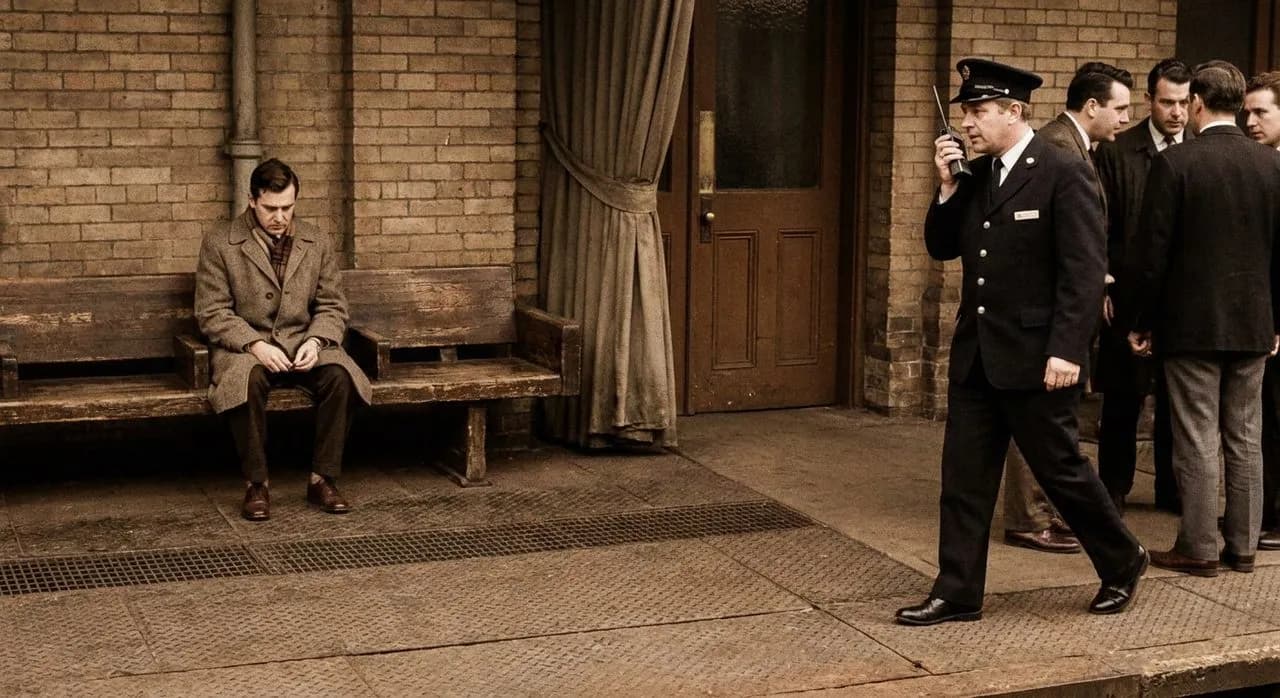
Stand here long enough and the rhythm becomes legible. Trains arrive, discharge, idle, then fill again with passengers who've been waiting on the benches. The loop is both operational necessity and accidental theater—a mechanical ballet performed dozens of times each day, barely noticed by anyone except those who choose to linger. Watch closely and you'll see the same crew members cycle through, the same conductors who've perfected the timing of their platform walk, their movements economical and practiced.
The afternoon window
Timing matters if you want the platform to yourself. A northbound N or W train departing Manhattan to Ditmars Boulevard may be less crowded; the terminal itself is the northern end of the line, arriving at the terminus nearly empty due to school schedule gaps. The morning rush has long dissipated, the post-lunch commuters have already passed through, and the evening surge hasn't yet begun. Board that train and you're likely to find an entire car to yourself, the kind of solitude that feels almost anachronistic on a New York subway.
This timing quirk—this brief lull in the day's cadence—transforms the station. Without the press of bodies and the urgency of transfers, the structure reveals itself. You notice the rivets in the beams, the way light slants through the canopy gaps, the surprising quiet that settles over an elevated platform in the middle of a dense neighborhood. The wind moves differently through empty space, carrying scents from the street-level bakeries and the distant salt tang of the East River.
Rooftop-level sightlines
The elevation here offers something rare in a city guide to ground-level curiosities: a middle-altitude view. You're not in a skyscraper looking down at abstract geometry, nor are you at street level hemmed in by brick and glass. Instead, you're suspended at the height of Astoria's rooftops, eye-level with chimneys and television antennas and the small gardens some residents have coaxed onto tar-paper surfaces. Backyard trellises, laundry lines, the odd folding chair left out after summer—the intimate architecture of rowhouse living spreads below.
To the north and west, the density thins slightly and the East River emerges, a gray-blue band depending on the season and the quality of late 2026 light. The platform offers limited elevated views toward the East River and nearby waterfront areas, visible only when standing past the stairwell exit. It's a sobering landmark, the bridge and facility unmistakable even at this distance, a reminder of the city's layered geographies—leisure and incarceration, transit and stasis, all within the same sightline.
The pause as destination
Most transit endpoints are forgettable—utilitarian spaces designed for efficient passenger exchange, nothing more. Ditmars defies that plainness not through ornament or architecture but through the quality of its pause. The turnaround creates a pocket of suspended time, a brief interval when the machinery of movement stops and you're left standing in a structure that exists solely to facilitate departure.
There's something quietly affecting about watching a conductor complete the walk from one end of the train to the other, key in hand, preparing to reverse direction. It's a human gesture embedded in an automated system, a reminder that even the most routine operations depend on individual attention. The train will leave again in moments, but for now it simply waits.
The sensory texture of terminus air
What distinguishes Ditmars from interior subway stations is how exposed it remains to the atmosphere of Astoria itself. The elevated platform breathes with the neighborhood. In morning hours, the smell of coffee and fresh bread drifts up from the bakeries lining 31st Street—particularly strong when wind comes from the south. By afternoon, the scent shifts: grilled meat from the kebab shops, oregano and garlic from the Greek tavernas, occasionally the sweet char of roasting nuts from a street cart positioned near the base of the stairs.
Sound here is equally unfiltered. The screech of brakes echoes differently in open air than in tunnels—sharper, less compressed, followed by actual silence rather than the constant rumble of underground acoustics. Birds nest in the steel framework and their calls punctuate the intervals between trains. Pigeons, mostly, but also house sparrows and the occasional gull blown in from the river. In early evening during warmer months, you can hear music from backyard gatherings below, fragments of conversation in half a dozen languages, the particular pitch of children playing in small urban spaces.
The light changes throughout the day in ways that underground commuters never experience. Morning sun comes low and golden from the east, casting long shadows of the steel beams across the platform in geometric patterns. Afternoon light is harsher, more vertical, reducing shadows to small dark pools directly beneath objects. Late afternoon in autumn—September through November—offers the most dramatic show: the sun descends toward New Jersey across the river, backlighting the Manhattan skyline visible to the south and painting the platform in amber and rose tones that make even the industrial gray girders glow briefly before dusk erases color into silhouette.
What to do with the extra minutes
If you've ridden to the end deliberately, give yourself permission to stay through a full cycle. Watch one train depart and wait for the next to arrive. The intervals are manageable, especially off-peak, and the act of waiting without urgency is itself a small act of resistance against the city's usual tempo. Bring a notebook, a camera, or nothing at all. Some visitors find that simply standing still and observing the mechanical routine creates a meditative quality, a structured emptiness that clears the mind in unexpected ways.
The neighborhood below is worth exploring if you have more time—31st Street runs south toward a mix of cafés, bakeries, and family-run shops that have anchored this corner of Astoria for generations. But the platform itself rewards a slower engagement, a willingness to notice the mechanics and the margins, the places where infrastructure and atmosphere overlap.
Practical notes
Ditmars Boulevard is the northern terminus of the N and W trains, located at 31st Street and Ditmars Boulevard in Astoria, Queens. The elevated platform is accessible via stairways; verify current accessibility options directly with the MTA before visiting if elevator access is required. The station is open 24 hours. Nearest parking is metered street parking along adjacent blocks. Bring layers—the platform is exposed to wind and weather. The northwest corner past the stairwell offers the best sightlines toward the river.
Tags: #DitmarsBlvd #AstoriaQueens #NYCSubway #TheLongWayHome #NTrain #WTrain #ElevatedPlatform #QueensNYC #TransitCulture #SubwayTerminus #AstoriaViews #HiddenNYC #Fall2026 #CityRhythms #EndOfTheLine
Sources consulted: Ditmars Boulevard Station (Wikipedia) · MTA Station Info · Astoria, Queens (Wikipedia) · NYC Planning - Queens · New York Times - New York
All trademarks are the property of their respective owners.