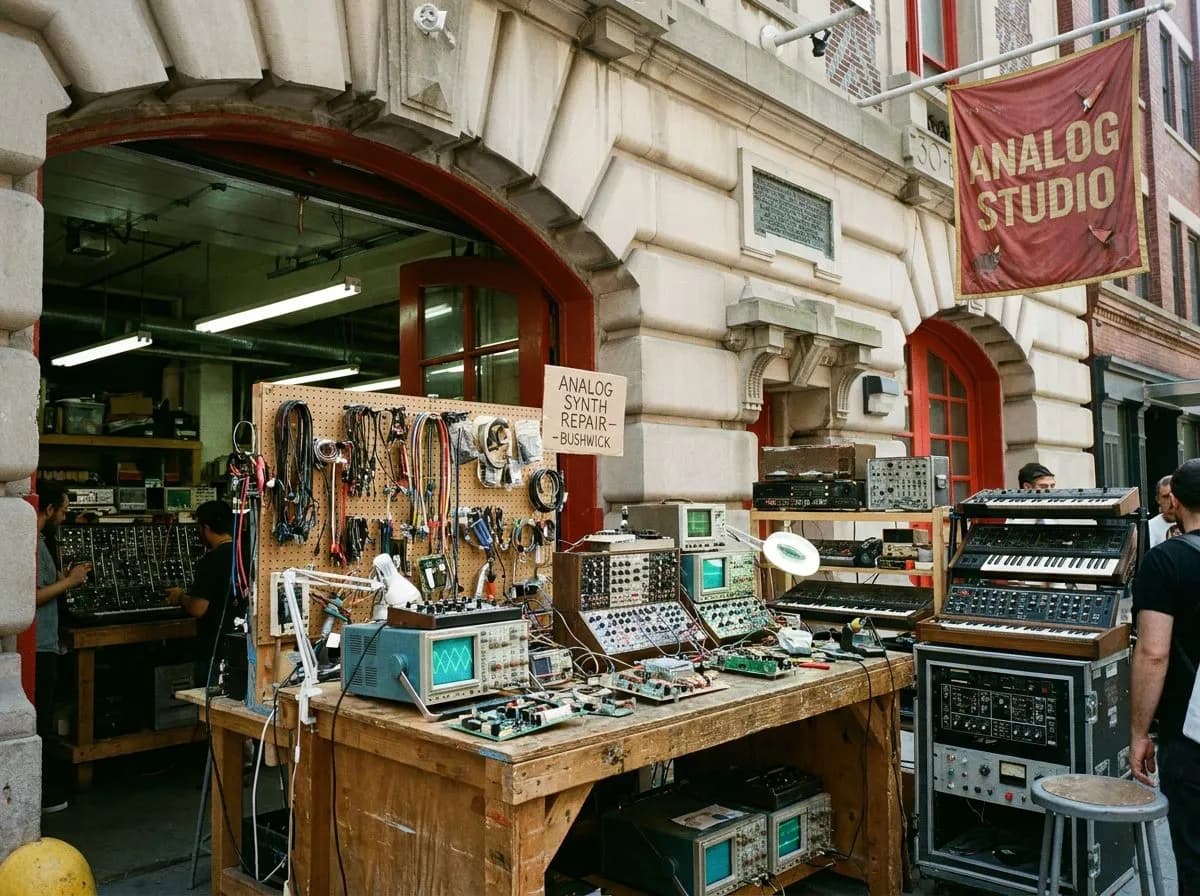
The smell hits you first: rosin flux and warm solder, the sweet metallic signature of electronics repair. Inside a ground-floor studio on Morgan Avenue, analog synthesizers lie open on anti-static mats like patients mid-surgery, their circuit boards exposed, their oscillators silent. An oscilloscope traces gentle sine waves in green phosphor. Soldering irons rest in brass coil holders, tips gleaming. This is not a museum of vintage gear—it's a working repair shop where Moog modules from the 1970s get new life, where Casio SK-1 keyboards are coaxed into glitchy noise generators, and where custom Eurorack oscillators take shape one resistor at a time.
The workshop floor
The studio occupies a narrow storefront space, fluorescent work lamps clamping to the edges of two long benches. Multimeters, wire strippers, and desoldering pumps occupy every square inch not claimed by synth chassis. A pegboard wall displays rows of custom Eurorack modules—handbuilt oscillators, filters, LFOs—each faceplate laser-etched and powder-coated in matte black or electric blue. It's the kind of organized chaos that speaks to thousands of hours at the bench, muscle memory guiding tweezers to SMD components the size of grains of rice. Beneath one bench, plastic drawers sorted by component type hold resistors, capacitors, and integrated circuits in carefully labeled rows, a taxonomic system that makes sense only to someone who's spent years building and rebuilding these machines.
Near the window sits an ARP Odyssey, its orange-and-black faceplate catching late-afternoon light. It's the technician's personal unit, kept on hand for testing replacement parts and demonstrating filter sweep behavior to clients who need to hear what a properly calibrated resonance control should sound like. The synth doubles as both reference standard and teaching tool, its sliders worn smooth by years of use.
What gets fixed here
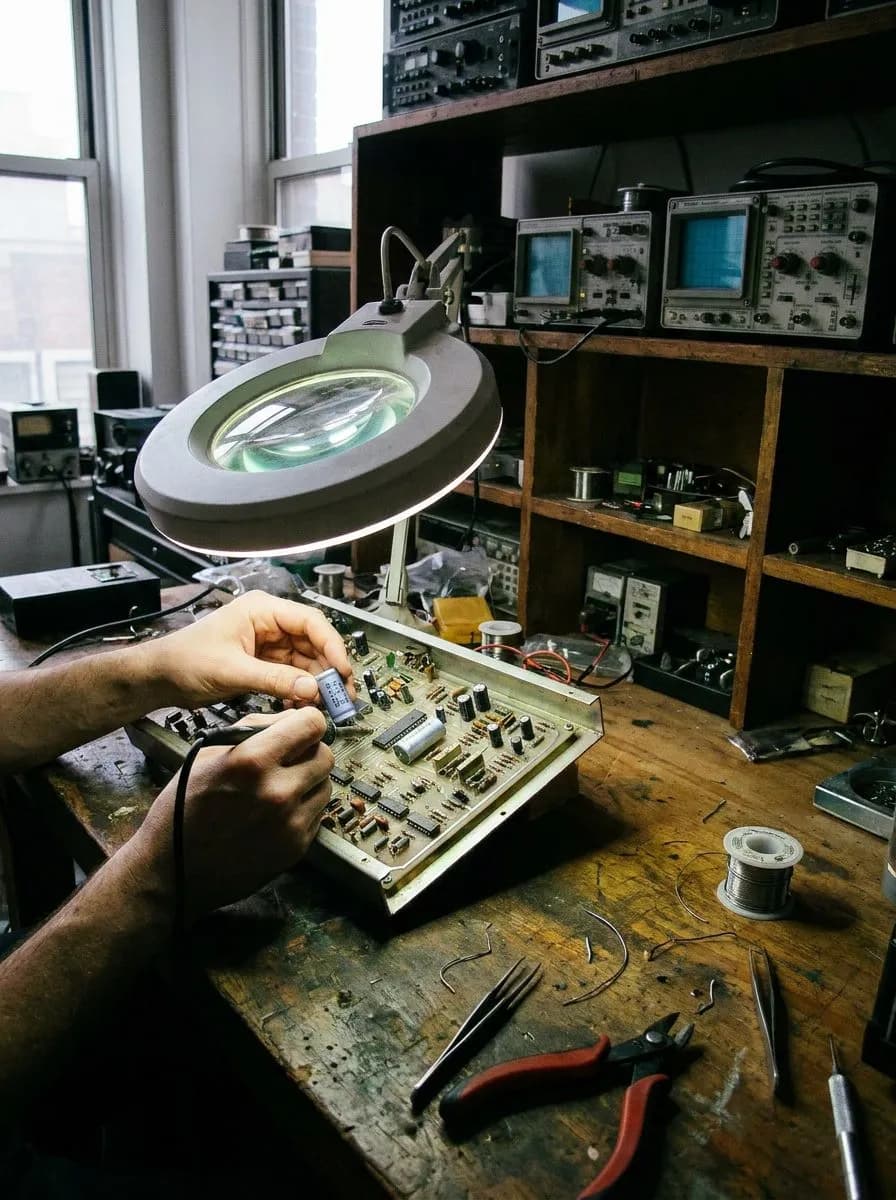
Vintage gear arrives with predictable ailments. Electrolytic capacitors dry out after decades, causing hum and drift. VCO circuits fall out of tune, their temperature compensation drifting as transistors age. Membrane switches on 1980s polysynths crack and fail. The technician tackles them all: Moog Prodigy modules, Roland SH-series mono synths, Korg MS-20s with scratchy patch-bay jacks. A basic Moog capacitor replacement runs eighty to one hundred twenty dollars depending on module count; full calibration adds sixty and requires a forty-eight-hour turnaround to allow the circuits to stabilize after component swaps.
Beyond restoration work, the studio offers circuit-bending services—deliberately short-circuiting toy keyboards and samplers to coax out glitches, stutters, and unpredictable timbres. A shelf near the door holds a menagerie of modded Speak & Spells and Casio VL-Tones, their cases festooned with body-contact points and photoresistor patches. It's sound design through controlled chaos, and the results range from lo-fi charm to outright noise art. Some instruments receive nothing more than a few strategically placed switches and wire leads; others undergo total transformations, their original circuits bent into unrecognizable sonic territories.
The technician's rhythm
Walk-ins are welcome, but timing matters. Hours vary; confirm directly with the studio; the technician finishes day jobs and returns to the studio for repairs and custom builds. Ring the buzzer three times—once to announce yourself, twice more to confirm you're not a delivery mis-routed to the wrong address. The door unlocks with a metallic click, and you climb two steps into the workshop proper.
If you're planning weekend plans that lean more toward hands-on curiosity than passive consumption, this is the kind of stop that rewards a detour. Bring a synth that needs work, or simply ask questions about voltage-controlled filters and waveform shaping. The technician is generous with explanations, tracing signal paths on schematic printouts taped to the wall and demonstrating the audible difference a single capacitor swap can make.
Custom Eurorack builds
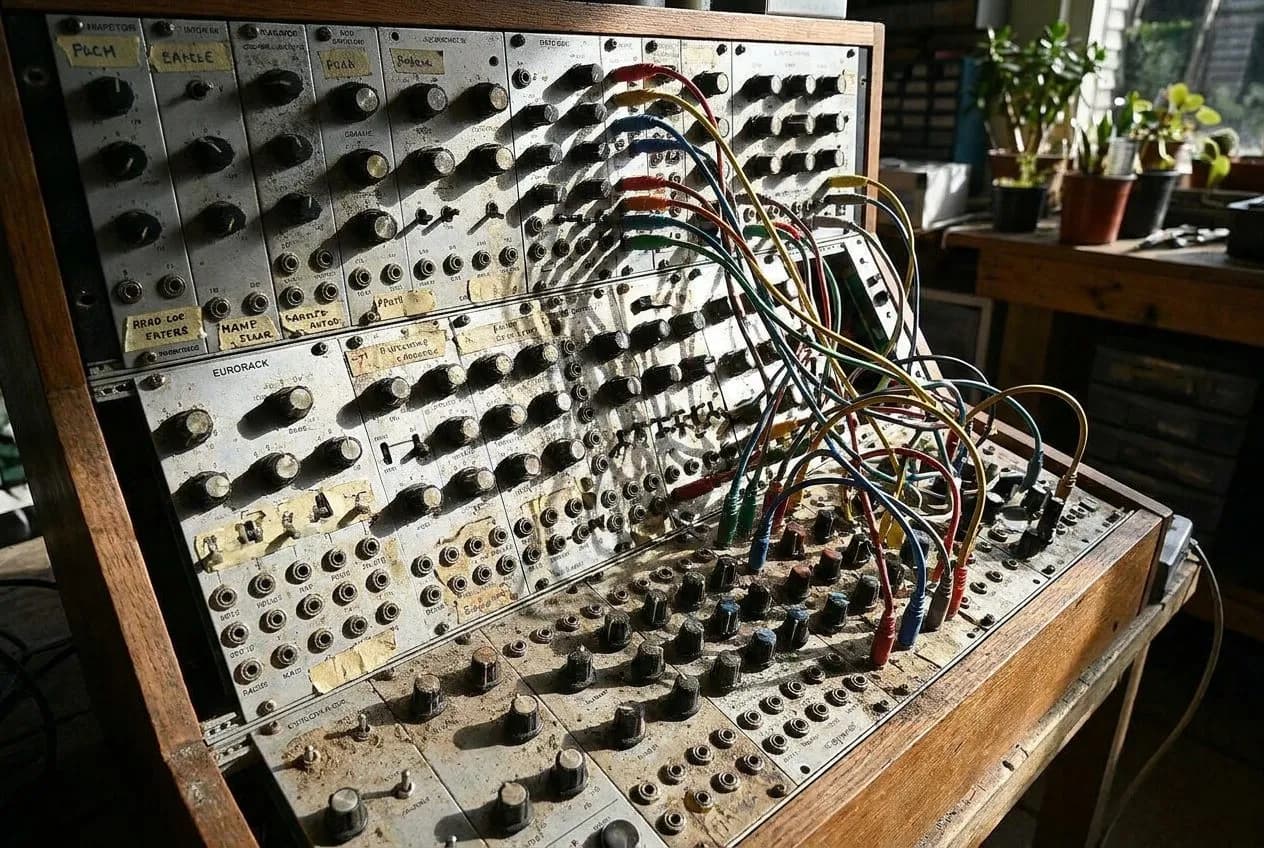
The pegboard modules aren't just for show. The studio accepts commissions for custom Eurorack builds—clones of classic circuits, original designs, or hybrids that blend analog oscillators with Arduino-driven sequencers. Lead times stretch into weeks during busy stretches of late 2026, but the work is meticulous: hand-soldered connections, matched transistor pairs for VCO stability, panel graphics that balance readability with visual restraint.
Prices vary wildly depending on complexity, but a straightforward VCO module starts around two hundred fifty dollars for parts and labor. More elaborate builds—wavetable oscillators, polyphonic envelope generators—can climb past six hundred. The technician sources components from European suppliers when necessary, chasing down obsolete ICs and NOS op-amps that keep vintage circuits singing.
The sensory fingerprint
Sound leaks from the space in odd bursts: a sawtooth wave ramping up and down, a filter swept from muddy bass to whistling treble, the crackle of a contact mic taped to a circuit board. The lighting is utilitarian—bright task lamps that cast hard shadows—but the clutter has its own aesthetic. Spools of wire in primary colors, drawers labeled with faded Dymo tape, a coffee mug holding Allen wrenches and precision screwdrivers.
It's a space built for function, not Instagram, and that's precisely the appeal. No exposed brick or Edison bulbs here, just the honest materiality of electronics work: copper traces, solder joints, the faint ozone smell of a hot soldering iron biting into flux-cored wire.
The block and its neighbors
Morgan Avenue between Ingraham Street and Grattan Street holds a particular mixture of industrial holdovers and creative conversions. Two doors down from the synth studio, a letterpress shop runs weekend printing workshops, the rhythmic thump of cast-iron presses audible through shared walls. Across the street, a woodworking collective occupies a former metalwork facility, sawdust drifting onto the sidewalk when the overhead door rolls open on warm evenings. The block retains the feel of working trades rather than polished retail—loading docks still function, roll gates still rattle down at closing time.
This concentration of hands-on makers isn't accidental. Rents on this stretch remain just low enough to support small-scale fabrication, and the building codes haven't yet chased out tenants who need ventilation for soldering fumes or tolerance for irregular hours. Walk the block on a weeknight and you'll see lights burning in half a dozen studios, each one devoted to some form of analog craft that demands physical space and patient labor. It's a neighborhood context that makes the synth repair shop feel less like an anomaly and more like one node in a network of people still committed to making things by hand.
Who shows up
Clients range from bedroom producers hauling in thrift-store Casio finds to studio engineers with road-worn Minimoogs that need full overhauls. A few regulars stop by just to talk shop, swapping stories about rare modules and DIY builds gone wrong. The vibe is collegial, not competitive—everyone here understands that analog synthesis is equal parts art and troubleshooting.
Occasionally a musician will commission a circuit-bent instrument for a specific project, describing the sonic palette they're chasing—glitchy, unpredictable, lo-fi—and leaving the technical execution to the technician. Those collaborations yield some of the studio's most distinctive work: one-of-a-kind noise boxes that blur the line between instrument and sound sculpture.
Practical notes
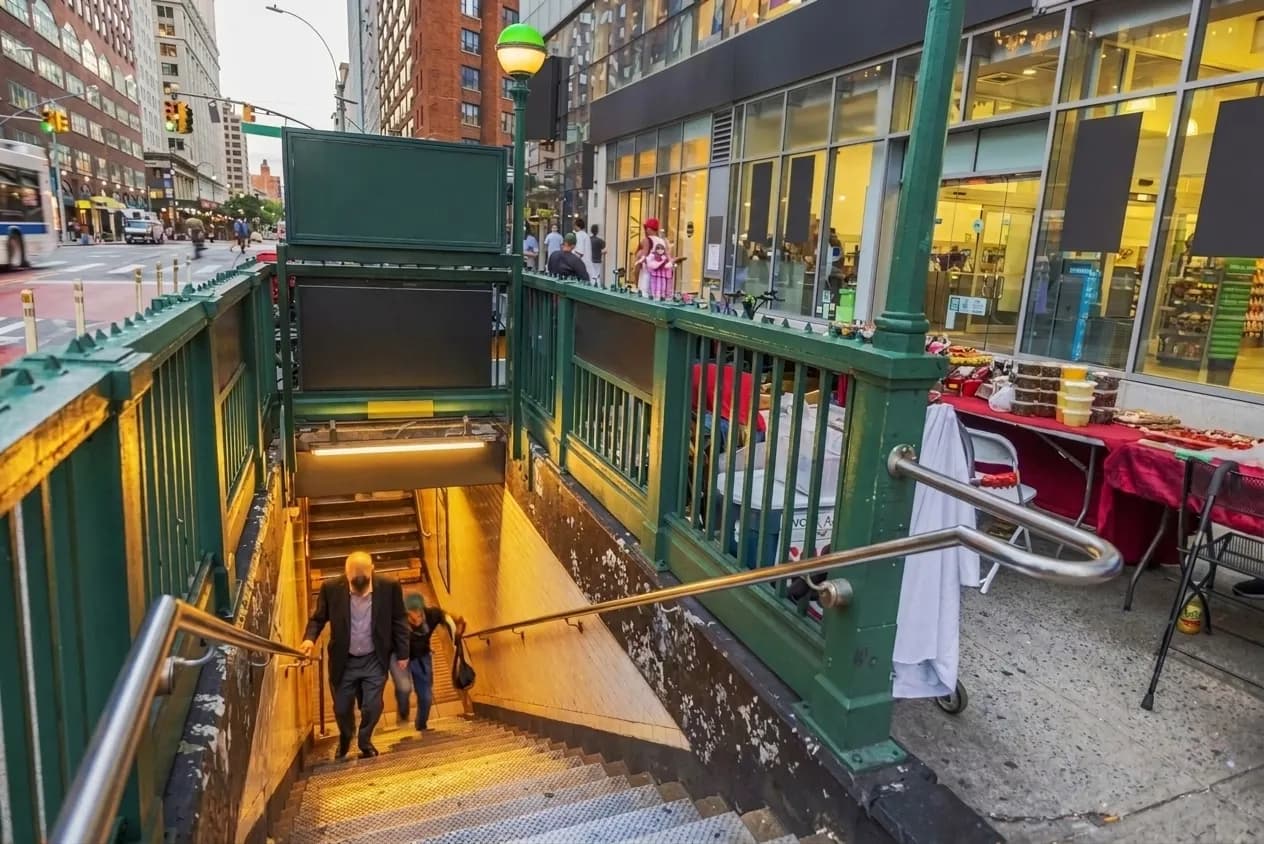
The studio is located on Morgan Avenue in Bushwick, near the Morgan Avenue L train station. Street parking may be available on nearby side streets Hours lean toward weekday evenings, generally six to eight, but it's wise to confirm availability before hauling gear across the borough—ring the buzzer three times. The space is ground-floor accessible. Bring your synth, a description of the problem, and patience; good repair work doesn't rush. Cash and Venmo accepted.
Tags: #TheOddEdit #BushwickNYC #AnalogSynth #SynthRepair #CircuitBending #EurorackModular #VintageGear #MoogRepair #ARPSynth #ElectronicsWorkshop #NYCMusic #SynthCommunity #HandsOnAudio #MorganAvenue #BushwickStudios
Sources consulted: Analog Synthesizer · Circuit Bending · Moog Music Official · Bushwick NYC · Time Out New York Music
All trademarks are the property of their respective owners.