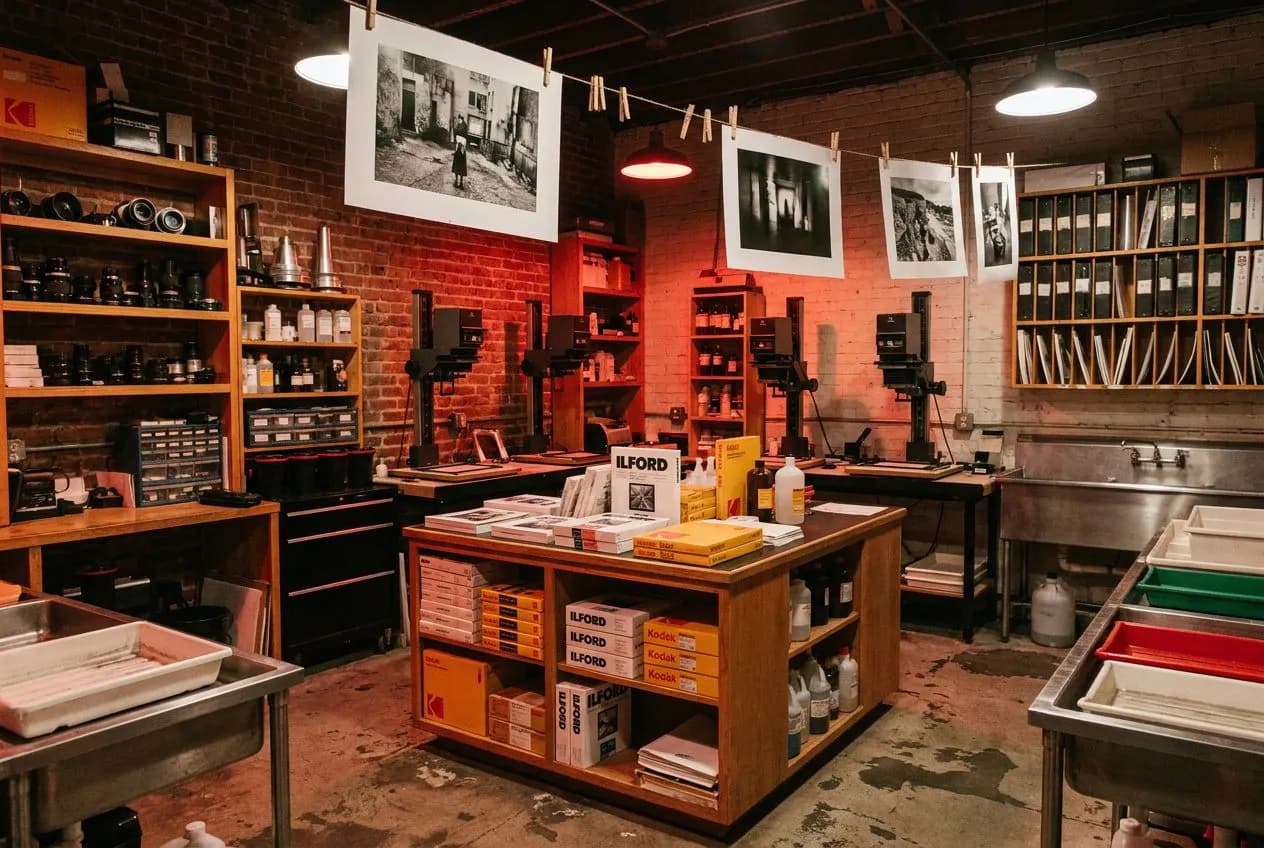
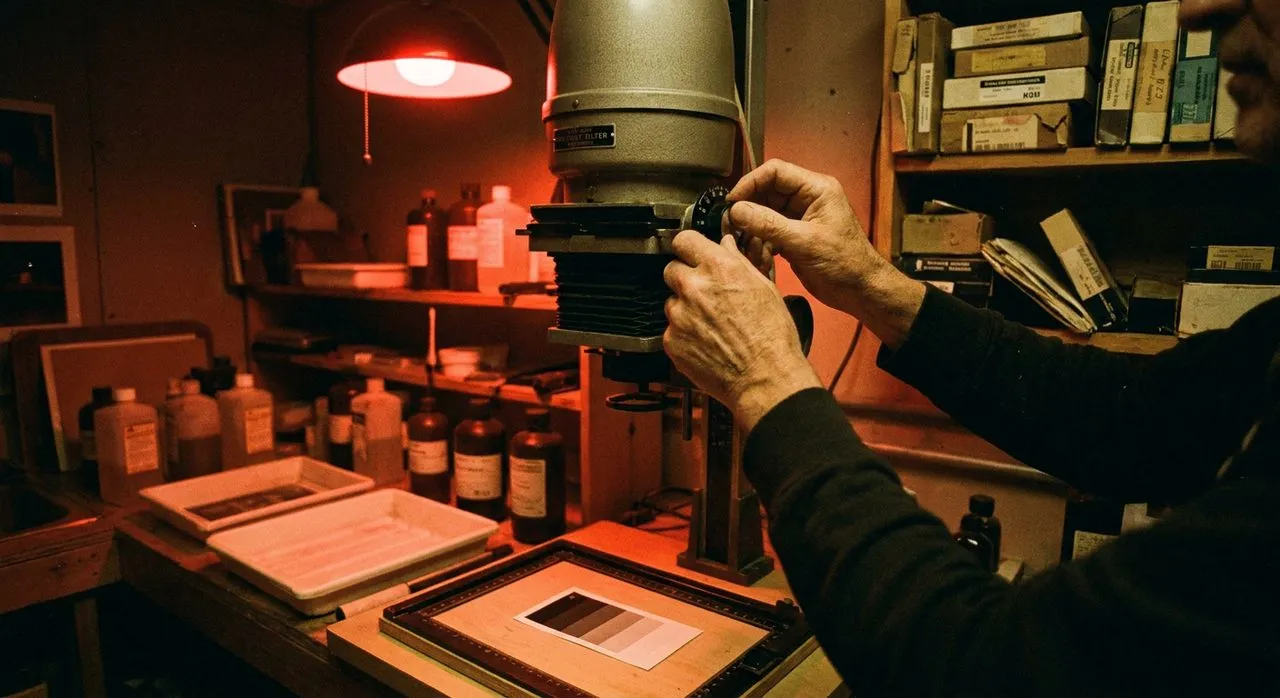
The door closes behind you, and the world snaps into monochrome. Under the glow of red safelights, a dozen Omega enlargers stand like sentries along workbenches, their negative carriers waiting to project memory onto paper. The air is sharp with acetic acid—the smell of stop bath, of patient chemistry, of images surfacing from nowhere. This is a shared darkroom in a Gowanus loft, and it exists for the kind of photographer who still believes that film holds something digital can't quite replicate. It's a place where negatives become prints through dodging tools fashioned from cardboard, where glossy paper clips to wire drying racks, and where weekend plans might mean three hours in the dark.
The Space and the Light That Isn't
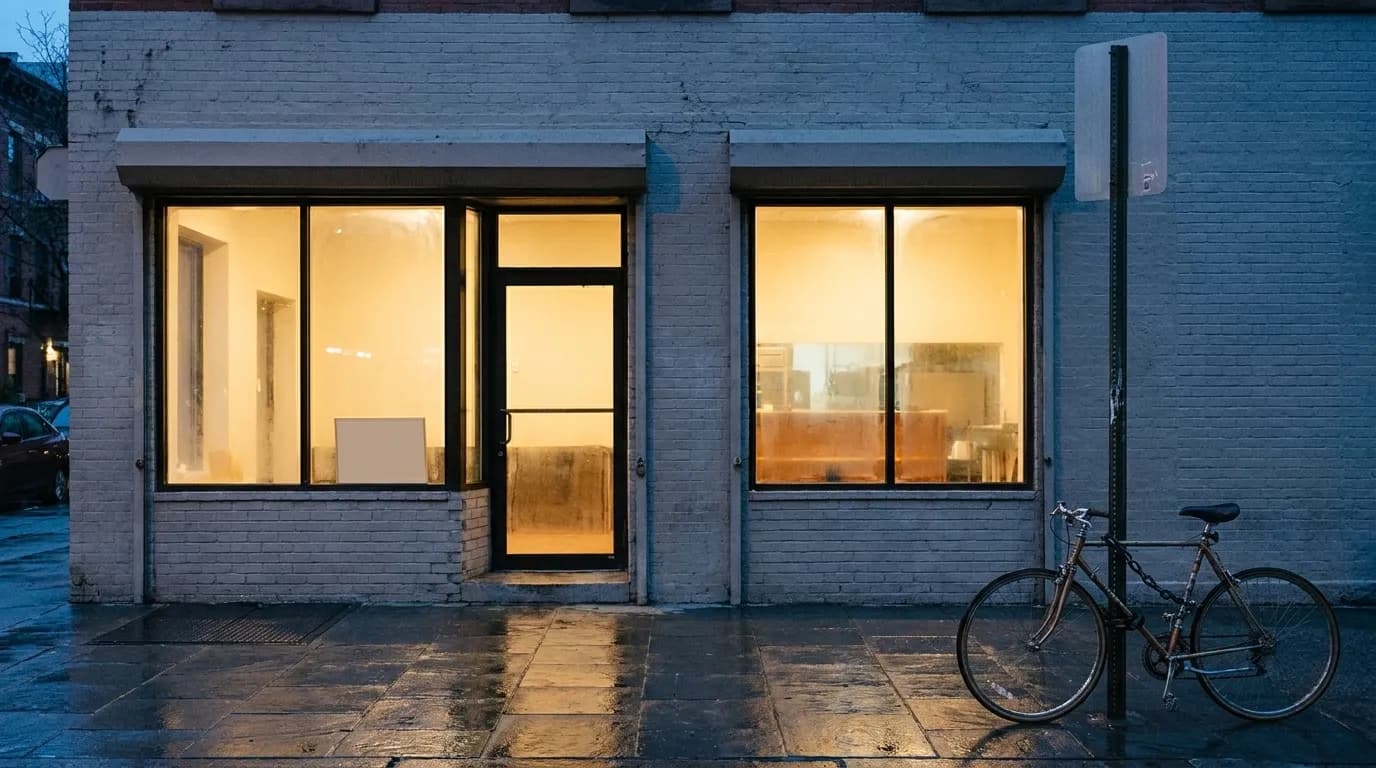
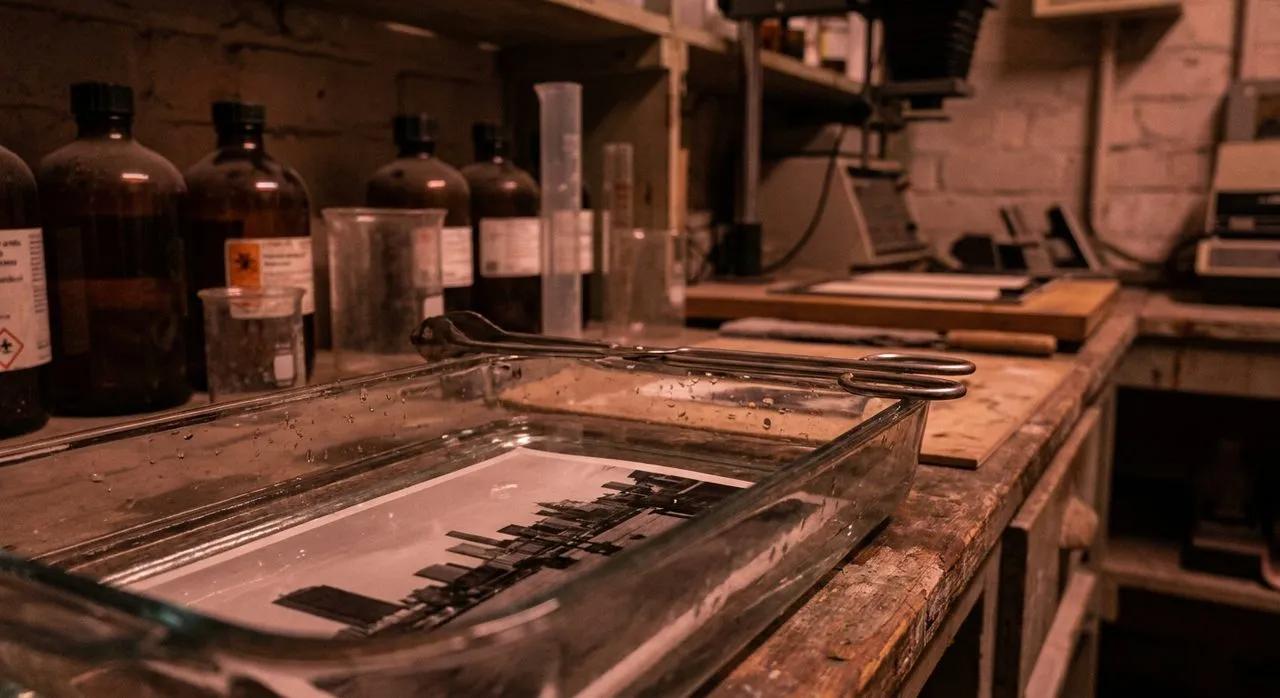
The loft occupies an industrial floor in a building that spent decades housing other things before photographers claimed it. Blackout curtains seal every window; the only illumination comes from safelights mounted above each station. The effect is disorienting at first—your pupils dilate, your sense of time loosens, and you begin to move by touch as much as sight. Stainless-steel trays line the wet benches in orderly rows: developer, stop bath, fixer, wash. The chemistry is fresh, rotated weekly, and included in every session.
The studio splits into zones. Dry tables hold enlargers and timers. Wet benches accommodate developing trays deep enough for prints up to 16x20 inches. A drying rack spans one wall, clips dangling like a installation of recent memory. The floor is sealed concrete, easy to mop when fixer spills. There's a utility sink for washing prints and rinsing hands, a shelf stocked with tongs and thermometers, and a bulletin board pinned with exposure charts and pH reminders.
How Booking Works
Three-hour darkroom slots have member and non-member rates. Chemistry is included in that rate, but paper must be purchased on-site or brought from home. The studio stocks a selection of silver gelatin papers—Ilford, Foma, Adox—in various grades and surfaces, sold at near-wholesale prices. If you've got a stash of expired Agfa in your freezer, you're welcome to bring it. Booking happens via a shared online calendar that fills quickly in late 2026, especially evenings and weekends. Members enjoy priority access and discounted rates after their first three months.
The Enlarger in the Corner
Most stations accommodate prints up to 11x14 inches, the sweet spot for silver gelatin work. But the enlarger in the far corner is reserved for large-format printing up to 16x20 inches and requires advance booking. It's the only one equipped with a cold-light head, which produces softer, more even illumination than condenser enlargers—ideal for negatives with dense highlights or delicate tonal transitions. Large-format photographers printing 4x5 or 8x10 negatives gravitate to this station, where the extra headroom and precision alignment make all the difference.
Using the large-format enlarger costs an additional fifteen dollars per session, and it's worth every cent if you're working at scale. The cold-light head reduces grain and contrast compared to a condenser setup, lending prints a luminous, almost three-dimensional quality. It's also finicky—temperature shifts affect the light output, so the studio keeps the loft climate-controlled year-round. Book this station a week ahead if you're planning a serious printing session; it's often claimed by regulars working on portfolios or gallery editions.
Saturday Orientation
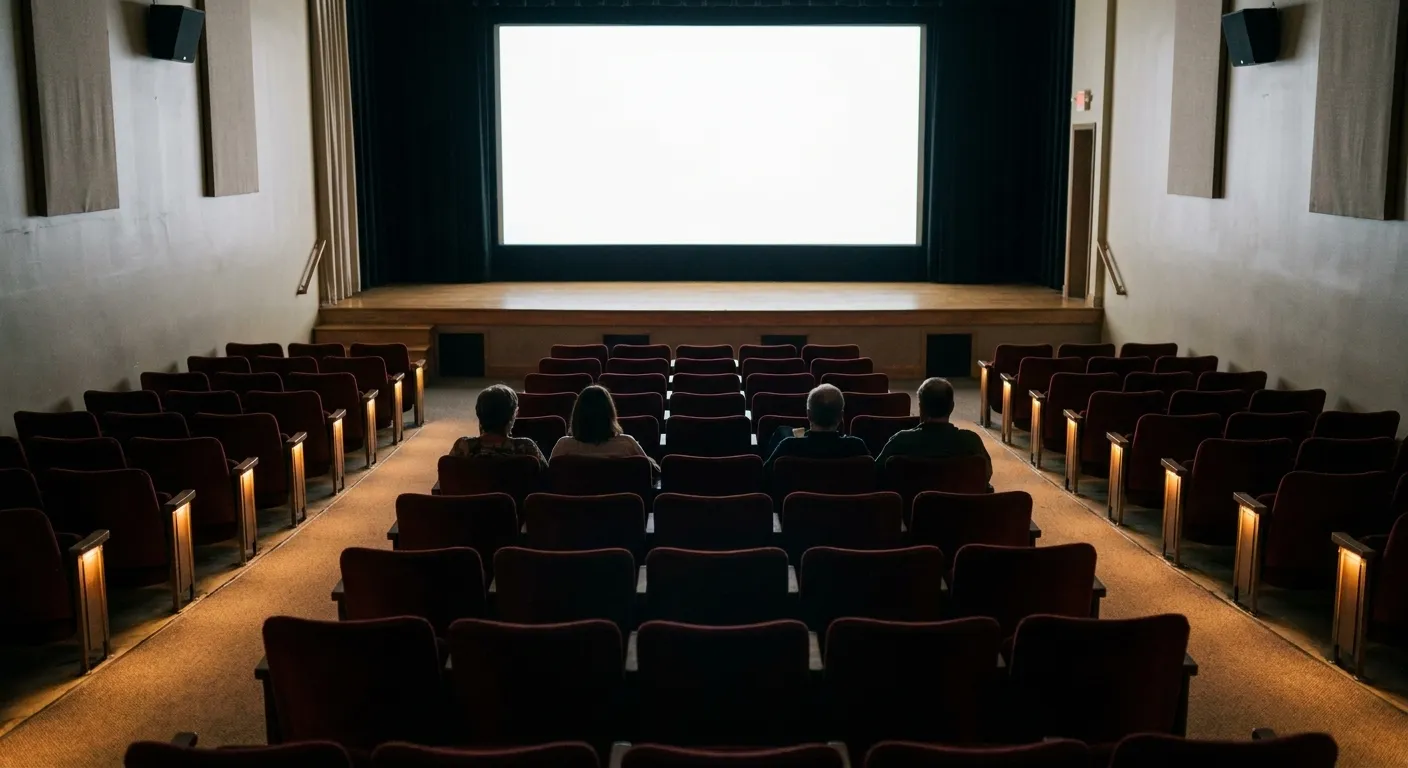
First-time users can't simply walk in and start printing. Saturday orientation sessions run at eleven a.m. and cover safe darkroom practices, chemistry handling, and equipment use. Attendance is required before booking a solo session. The orientation lasts about ninety minutes and walks you through the entire workflow: loading a negative carrier, setting up an easel, dialing in exposure and contrast, and moving a print through the chemistry sequence without contaminating the baths. You'll leave with a test strip and at least one finished print.
The orientation fee is twenty dollars, waived if you purchase a membership the same day. It's taught by a rotating cast of experienced printers who've been using the space for some time. They're patient with beginners and generous with troubleshooting advice—why your highlights are blowing out, why your blacks look muddy, why your print is curling as it dries.
What a Session Feels Like
Three hours sounds generous until you're halfway through your second roll of negatives and realize you've barely scratched the surface. Printing is slower than you expect. Each image demands test strips to nail exposure, then a full print to check composition, then adjustments—burning in a sky, dodging a face, swapping contrast filters to tame harsh lighting. You learn to move deliberately. Negatives slip into carriers emulsion-side down. Easels click into place. The enlarger hums as you focus the projected image on the baseboard, grain sharpening under the red glow.
Then comes the alchemy. Paper slides into developer, and for the first twenty seconds nothing happens. Then the image begins to emerge—faint at first, then darker, contours resolving, shadows deepening. You lift the print with tongs, let it drip, and transfer it to the stop bath, which halts development with a faint hiss. Thirty seconds there, then into the fixer, where the paper turns from fragile to archival. The final wash takes longest—ten minutes under running water to clear residual chemistry. By the time you clip your prints to the drying rack, your hands smell of fixer and your back aches from leaning over trays, but the prints are real in a way that files on a screen will never be.
Practical Notes
The darkroom is located in a Gowanus loft accessible by nearby subway lines; verify current transit and parking details. The studio operates seven days a week with sessions starting as early as nine a.m. and running until eleven p.m.; verify current hours and book via the online calendar. The loft is a walk-up with no elevator; accessibility is limited. Bring your negatives, a notebook for exposure notes, and patience. Paper, chemistry, and all darkroom tools are provided. Expect to smell like fixer for hours afterward—it's part of the deal.
Tags: #AnalogPhotography #DarkroomRental #SilverGelatinPrinting #GowanusNYC #FilmPhotography #BlackAndWhitePrints #TheOddEdit #NYCCreativeSpaces #WeekendPlans #HandmadePrints #FilmLab #PhotographyStudio #AnalogCommunity #NYCArts #TraditionalPrinting
Sources consulted: Darkroom · Gelatin Silver Print · Gowanus, Brooklyn · Time Out New York Arts · MTA Info
All trademarks are the property of their respective owners.