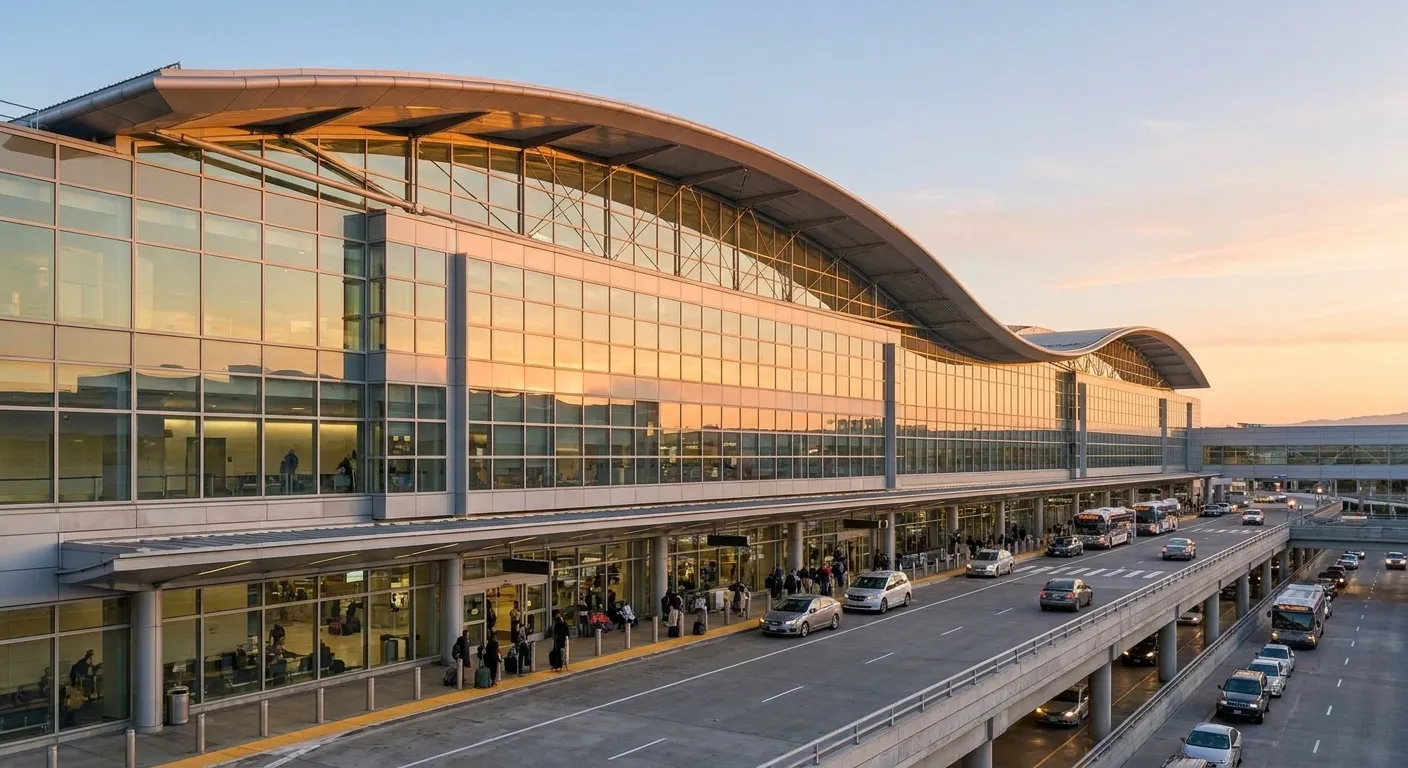
The connector between Harvey Milk Terminal 1 and San Francisco International's sprawling International Terminal sees thousands of passengers daily, many of them racing between American Airlines domestic arrivals and international departures or navigating the reverse route after landing from overseas. The terminal layout and AirTrain system work efficiently when you know which line to take and when to skip the train entirely, but the wrong choice can turn a comfortable forty-minute connection into a sprint through security checkpoints and past boarding areas. Understanding the physical paths, security timing, and late-night maintenance windows makes the difference between a smooth transfer and a missed flight.
Karpo tracks live security wait times at every SFO checkpoint and shows you which AirTrain line gets you to your connection fastest, updated every four minutes.
Understanding the terminal layout
San Francisco International Airport arranges its four terminals in a horseshoe, with Harvey Milk Terminal 1 anchoring the northern end and the International Terminal stretching along the south side. American Airlines operates primarily from Terminal 1's B gates—B1 through B27—where most domestic departures to cities like Dallas originate. The International Terminal splits into two boarding areas: A Gates on the west side and G Gates on the east, connected by the main hall on the arrivals level.
Once you pass through any security checkpoint, you can walk to every gate in the airport without rescreening. This airside connection system means a traveler arriving at Terminal 1 Gate B15 from Dallas can walk directly to International Terminal Gate A7 for a connecting flight to Tokyo, provided they stay within the secure zone. The key is knowing which connectors exist and when walking beats riding AirTrain, especially during the late-night maintenance window when the automated system slows down.
Terminal 2 sits between Terminal 1 and Terminal 3 in the horseshoe, handling gates C1 through C11 and D1 through D18. Terminal 3 serves United Airlines at gates E2 through E13 and F5 through F22. The current Terminal 3 AirTrain station remains closed until 2027, which means travelers using Terminal 3 must walk to the combined Terminals 2 & 3 station or use the post-security connectors to reach other boarding areas. This construction quirk actually creates a faster walking route for passengers transferring between Terminal 3 and International G Gates through the connector near Gate F1.
AirTrain routes and timing
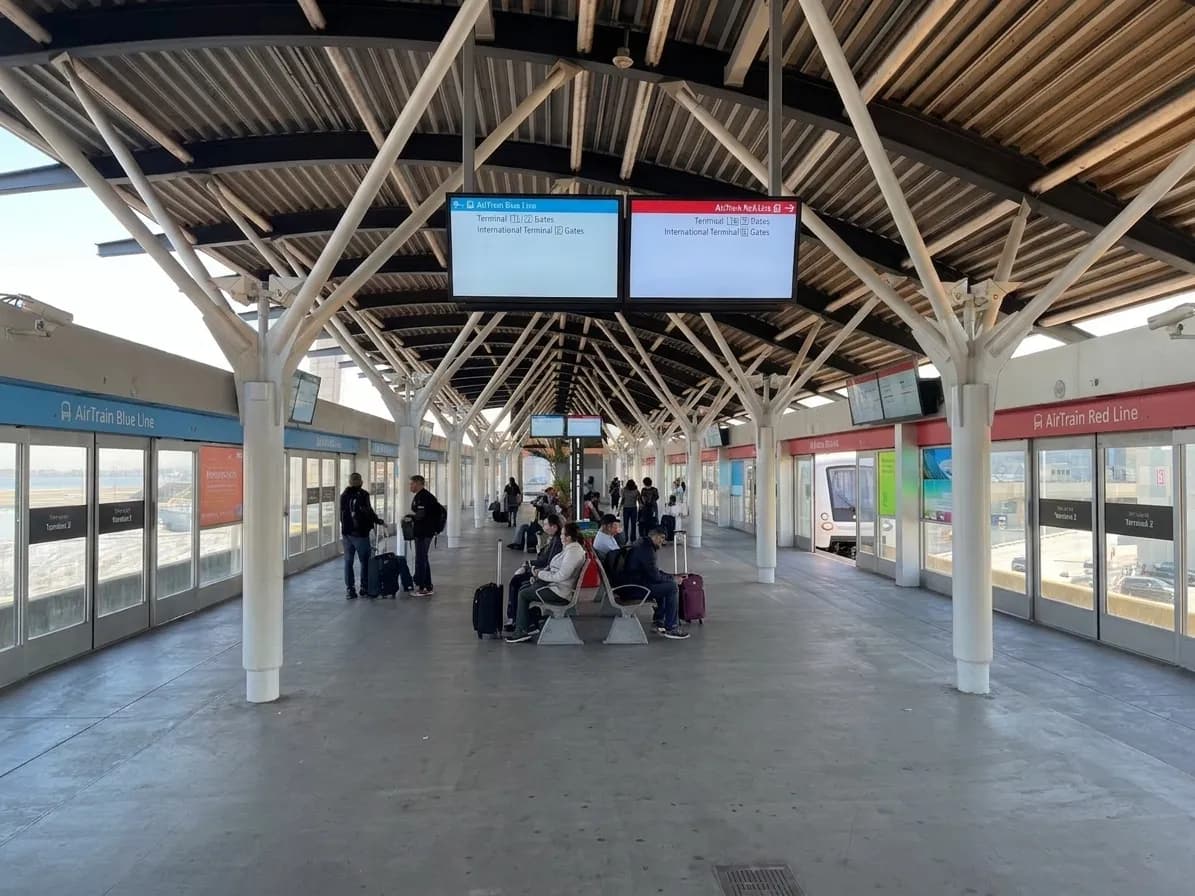
AirTrain operates two color-coded loops around the clock. The Red Line travels clockwise and connects all terminals, terminal garages, the BART station, and the Grand Hyatt in roughly nine minutes for a complete circuit. If you land at Harvey Milk Terminal 1 and need to reach International Terminal A Gates, the Red Line stops first at Terminal 2, then International Terminal A, making it a quick two-stop ride. Departures run as frequently as every four minutes during peak hours.
The Blue Line runs counterclockwise and adds stops at Long-Term Parking and the Rental Car Center, extending the full loop to about twenty-five minutes. This line serves travelers who need to pick up rental cars or retrieve vehicles from long-term lots, but it takes significantly longer to reach the same terminal stations the Red Line covers. A passenger arriving at International Terminal G and heading to Harvey Milk Terminal 1 should always choose the Red Line unless they specifically need the rental car center stop.
Between 11pm and 5am each night, routine maintenance extends travel times and may alter the usual service pattern. During this window, walking often proves faster than waiting for an AirTrain that might take twelve or fifteen minutes to arrive. The walk from Harvey Milk Terminal 1 to International Terminal A Gates via the post-security connector takes about eight minutes at a normal pace, while the same trip on AirTrain during maintenance can stretch to twenty minutes including wait time and the extended loop.
Security checkpoint strategy
Seven security checkpoints serve SFO's terminals, each with different operating hours and crowd patterns. Checkpoint A in the International Terminal opens at 4:15am and stays open until 2am, making it one of the longest-operating screening points. Checkpoint B in Harvey Milk Terminal 1 opens at 3:15am for the main level and 4am for the Mezzanine Level, with the Mezzanine location consistently showing shorter lines until the morning rush peaks around 6:30am. Travelers with early American Airlines departures from Terminal 1 B Gates often save fifteen to twenty minutes by using Checkpoint B Mezzanine instead of the main checkpoint.
All checkpoints offer TSA PreCheck, Priority Line, and CLEAR lanes, but the distribution of these services varies by checkpoint size and terminal traffic. Checkpoint D in Terminal 2 and Checkpoint F1 in Terminal 3 both open at 3:15am and close at 12:30am, handling moderate volumes compared to the busier International Terminal checkpoints. If you arrive at Terminal 2 or 3 with extra time and notice long lines, you can walk to another terminal's checkpoint, pass through security there, and then walk airside to your actual gate.
The TSA recommends arriving two hours before domestic flights and three hours before international departures, but these windows tighten during Monday morning peaks and Thursday and Friday evening rushes when business travelers and weekend fliers converge. Checkpoint wait time data displays on monitors throughout the terminals, though the system occasionally goes offline. Real-time apps and services that track security line lengths become essential during high-traffic periods, particularly for passengers connecting through Harvey Milk Terminal 1 to international flights in the A or G boarding areas.
Walking the terminal connectors
Harvey Milk Terminal 1 connects directly to International Terminal A Gates through a post-security walkway, making it the fastest route for passengers transferring between these two boarding areas. After arriving at any Terminal 1 B Gate, follow signs toward International Terminal A Gates and cross through the connector, which takes about five minutes. This walkway bypasses AirTrain entirely and keeps you within the secure zone, eliminating any risk of missing a tight connection while waiting for the next train.
Passengers in Terminal 1 who need to reach International Terminal G Gates face a different situation. The direct airside connector does not extend to G Gates, so travelers must either exit Terminal 1, proceed to the G Gates security checkpoint on the arrivals level, and rescreen, or take AirTrain to International Terminal G Station. The exit-and-rescreen option works best when you have checked luggage to collect anyway, while AirTrain makes sense for carry-on-only travelers with time to spare.
Terminal 2 and Terminal 3 link to International Terminal G Gates through a post-security connector near Terminal 3 Gate F1. This walkway entrance sits near the United gates in Terminal 3 and exits near International Terminal Gate G1, creating a seamless airside path. If you land at Harvey Milk Terminal 1 and need International G Gates, walking to the Terminal 2 & 3 AirTrain station, riding one stop to Terminal 3, and using the F1 connector often proves faster than riding AirTrain all the way around to International G Station, especially during late-night maintenance hours.
American Airlines operations at Terminal 1
American Airlines operates check-in counters and baggage drop on the departures level of Harvey Milk Terminal 1, with gates concentrated in the B boarding area. Flights to Dallas Fort Worth typically depart from gates in the B1 through B15 range, though gate assignments change daily based on aircraft type and schedule. The Terminal 1 modernization project has created a bright, wide concourse with local food outlets and art installations, replacing the older infrastructure that served the airport for decades.
Baggage claim for arriving American Airlines flights sits on the lower arrivals level. After exiting the jet bridge, follow signs for Baggage Claim, descend to the baggage hall, and check the monitor screens for your carousel number. From baggage claim, ground transportation options line up at the curb outside, including ride-share pickup zones, taxis, and hotel shuttles. If you need to reach another terminal, parking garage, or the BART station, follow signs to AirTrain, which stops at Harvey Milk Terminal 1 Station on Level 3, accessible by elevator or escalator from baggage claim.
Southwest Airlines also operates heavily from Terminal 1, particularly to cities like San Diego, Las Vegas, and Phoenix, which creates peak congestion during typical business travel windows. Monday mornings and Thursday and Friday evenings see the heaviest traffic at Terminal 1 checkpoints, with lines sometimes extending back toward the check-in counters. Travelers flying American Airlines to Dallas during these windows should add an extra fifteen to twenty minutes to their arrival time, or use the Checkpoint B Mezzanine entrance to avoid the main checkpoint crush.
Practical notes
Harvey Milk Terminal 1 sits at 780 McDonnell Road, San Francisco, CA 94128, with the International Terminal at 575 North McDonnell Road. All terminals operate 24 hours, though individual security checkpoints open and close on staggered schedules—Checkpoint B Mezzanine runs 4am to 11pm, while Checkpoint A stays open 4:15am to 2am. AirTrain provides free year-round service every four to ten minutes depending on time of day, with extended travel times during nightly maintenance from 11pm to 5am. BART trains connect to SFO via the Garage G AirTrain/BART station, with the last train leaving around midnight on weekdays and 1am on weekends. Parking rates vary by garage: domestic terminal garages charge hourly and daily rates, while long-term parking offers lower daily maximums. Always verify your airline's terminal assignment and gate location before arriving, as construction and operational changes continue through 2027.
Tags: #SFOAirport #HarveyMilkTerminal #AmericanAirlines #AirportNavigation #SFOAirTrain #TerminalTransfer #TSAPreCheck #SanFranciscoTravel #AirportHacks #TravelTips #SFOInternational #AirportSecurity #BayAreaTravel #FlySFO #TerminalGuide
All trademarks are the property of their respective owners.
Ask Karpo first
Need to know which security checkpoint is moving fastest right now, or whether the AirTrain Red Line will get you to your gate faster than walking? Ask Karpo in iMessage—I'll check live wait times, track your connection window, and route you through the fastest path between Harvey Milk Terminal 1 and the International Terminal, whether you're catching an American Airlines flight to Dallas or connecting from overseas.