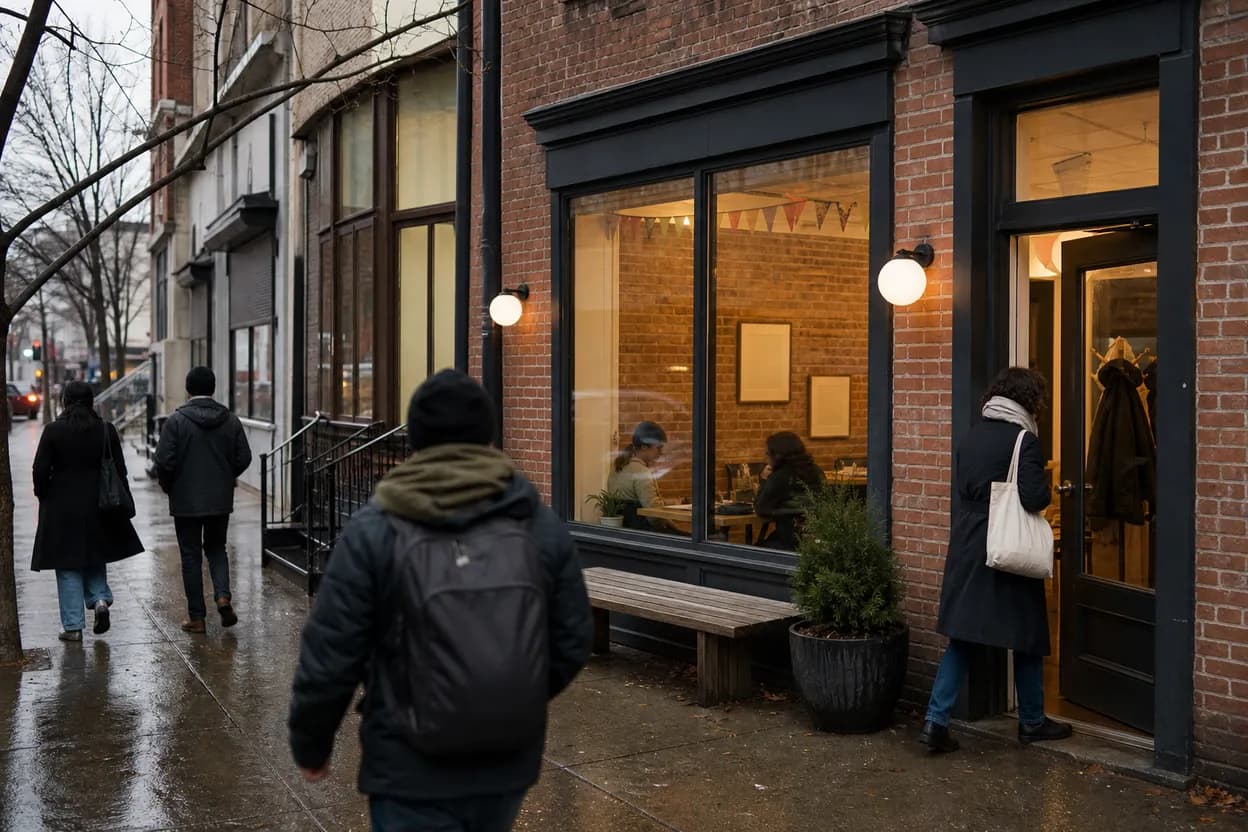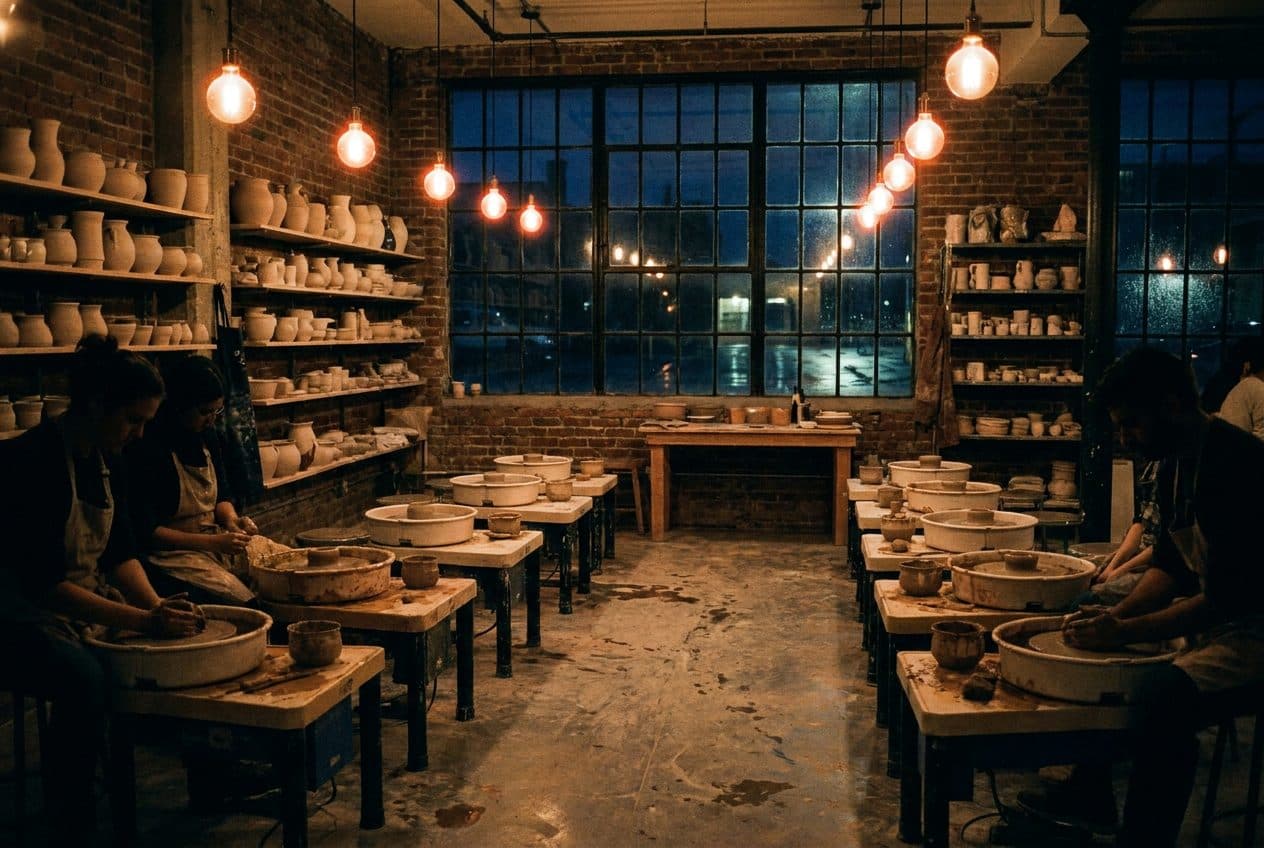
You walk into a Gowanus studio on a Wednesday night and the air smells like wet earth and something faintly metallic. Ten pottery wheels are arranged in a loose semicircle under Edison bulbs that cast everything in warm amber. You're here for two hours of drop-in wheel time, and nobody asks if you've done this before.
The Room Has Its Own Temperature
The studio sits in a converted industrial space off Third Avenue, the kind of building that still has loading dock grooves in the concrete floor. Inside, it's warmer than the street by at least ten degrees—kilns run hot even when they're not firing, and the humidity from all that wet clay hangs in the air like a greenhouse. You hang your coat on a wall hook that's crusted with dried slip, the chalky clay residue that gets everywhere. The instructor, a woman with clay permanently embedded under her short nails, gestures to an open wheel. You sit on a wooden stool that's worn smooth in the center from years of people shifting their weight as they lean into their work.
Your Hands Learn a Language Your Brain Doesn't Speak
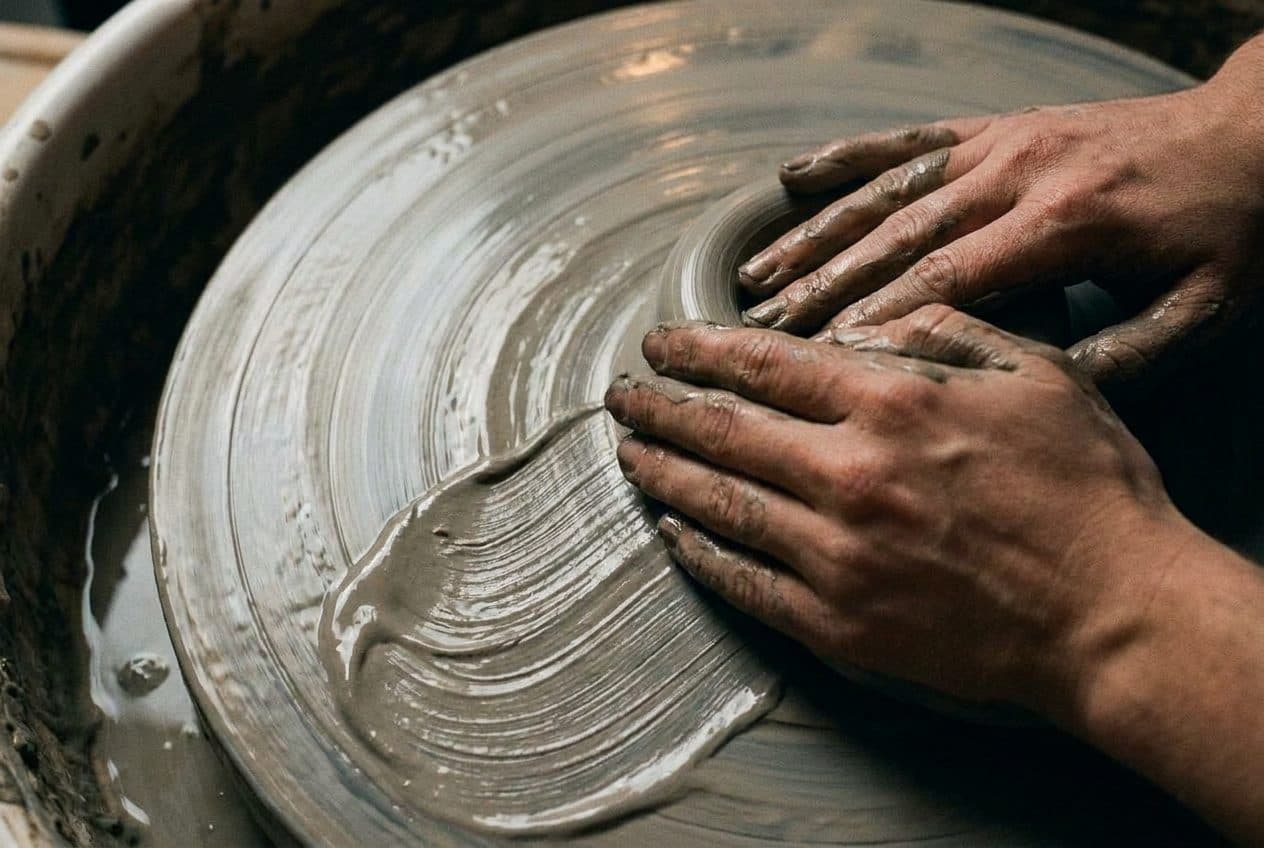
The wheel starts with a foot pedal—press gently and it hums to life. You're given a ball of gray stoneware clay, about the size of a grapefruit, already wedged to remove air bubbles. The instructor shows you how to slam it onto the wheel head, dead center, then wet your hands in a plastic basin of water that's already cloudy from everyone else's clay. Centering is the first battle. You press your palms against the spinning clay and it wobbles, lurches, resists. The instructor places her hands over yours for thirty seconds and suddenly the clay calms, rises into a smooth dome. When she pulls away, you try to hold that pressure, that angle, but the clay has opinions. It takes fifteen minutes before you feel it—the moment when the clay stops fighting and starts responding. Your shoulders are tight from hunching forward. There's slip splattered across your forearms in fine gray streaks.
The Sound of Ten Wheels Spinning at Once
The studio fills with a particular kind of quiet—not silence, but the absence of conversation. Ten wheels whir at different speeds, a low mechanical chorus. Water drips from fingertips. Someone's foot slips off a pedal and their wheel stops with a rubber squeak. The instructor moves between stations, crouching beside wheels, her voice low and specific: "More water on your left hand. Let the clay come to you." Across from you, a guy in paint-stained jeans is pulling up the walls of what might become a bowl. His movements are confident but not showy—he's been here before. Next to him, someone's cylinder collapses inward with a wet slap and they laugh, scraping the clay back into a ball to start over. Nobody's watching you. Everyone's too focused on their own spinning problems.
Wednesday Night Regulars and First-Timers Mix Without Ceremony
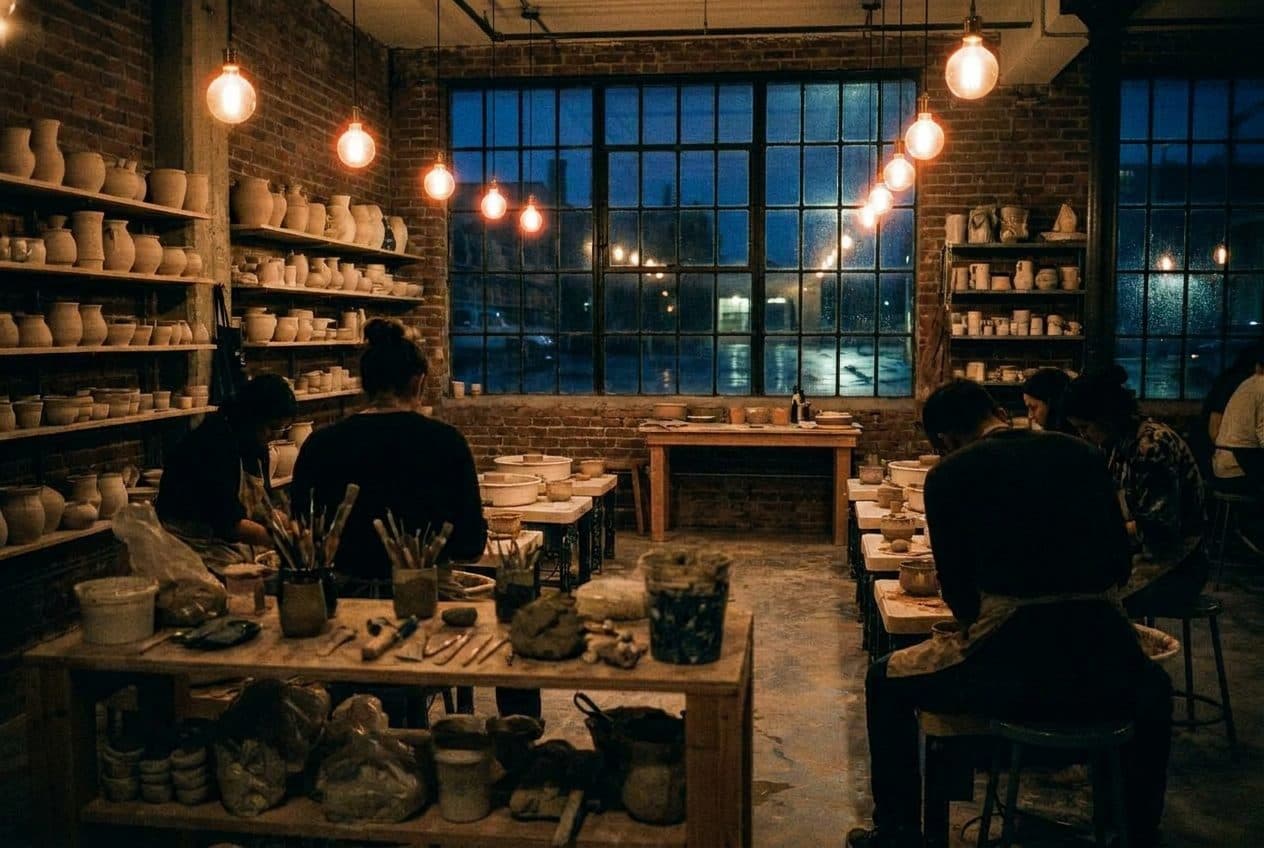
You start to notice who's who after the first hour. The regulars bring their own tools—wooden ribs, wire cutters, sponges on sticks. They know where the spray bottles live and which shelf holds the bat pins. First-timers like you are easy to spot: we use too much water, we're afraid to press hard enough, we forget to brace our elbows against our ribs for stability. But there's no hierarchy here, no performance. A woman with clay-caked glasses leans over during a water break and mentions that her first six bowls looked like ashtrays. She's been coming for five months. Her current piece—a wide, low vessel with thin walls—sits on the drying rack with a dozen others, each tagged with masking tape and a first name in Sharpie.
The Ritual of Cutting Your Piece Off the Wheel
When you're done—or when you've reached the limit of what you can fix without ruining it—you cut the piece free. The instructor hands you a wire with wooden toggles on each end. You hold it taut, pull it through the clay at the base, and your bowl or cup or lumpy cylinder separates from the wheel with a satisfying release. You lift it carefully with both hands, fingertips only, and carry it to the drying rack like you're holding a bird. It's heavier than it looks, still cold and wet. Your piece sits there among the others, anonymous and imperfect. In a week, it'll be bone-dry. In two weeks, bisque-fired. In three, glazed and fired again, if you come back to finish it. Most people do. There's something about leaving a piece halfway through the process that pulls you back.
Clay Under Your Nails and the Walk Back to the Canal
You wash your hands in the utility sink with a bar of brown soap that barely lathers. The water runs gray for a full minute. You scrub between your fingers, under your nails, but the clay doesn't fully come out—it stays in the cracks of your knuckles, in the beds of your nails, a fine gray line that'll last until tomorrow's shower. Outside, the Gowanus air hits cold after the studio's warmth. Your shoulders ache in a specific way, the kind of tired that comes from holding tension you didn't know you were holding. You walk past the canal, past the warehouses with lit windows, and your hands still feel the ghost memory of wet clay spinning under your palms. It's a strange, specific satisfaction—two hours where your phone stayed in your bag and your brain shut up long enough to let your hands figure something out.
Practical Notes
The drop-in wheel sessions run Wednesday evenings in a studio near the Third Avenue corridor of Gowanus, within walking distance of the Union Street subway stop. Sessions typically run a couple of hours in the early evening. Cost is reasonable for what you get—wheel time, clay, basic instruction, and kiln firing if you return to glaze. No reservation required for drop-ins, but arriving right at start time gets you first pick of wheels. Wear clothes you don't mind ruining. Aprons are provided but clay is ambitious. If you want to finish your piece, you'll need to come back for glazing once it's bisque-fired—the studio holds pieces for a few weeks. Check their current schedule online before you go.
Tags: #PotteryWheel #GowanusNYC #BrooklynArtStudio #CeramicsClass #DropInClass #WednesdayNight #HandsOnExperience #BrooklynMakers #NYCCreative #ClayWork #WheelThrowingNYC #GowanusCreative #BrooklynNights #MakeWithYourHands #NYCCeramics
Sources consulted: timeout.com · secretnyc.co · thrillist.com
All trademarks are the property of their respective owners.
Ask Karpo first
Want to know if Wednesday drop-ins fill up fast, whether you need to reserve a wheel ahead of time, and what to wear so the clay doesn't ruin your clothes?
Ask Karpo for drop-in availability and how early to arrive, wheel reservation policies, what to wear to a pottery session, and a live route around Gowanus before you head out.