Culture / Venue
The World's First Children's Museum, and the Rooftop It Took 118 Years to Build
Brooklyn Children's Museum has stood on the same Crown Heights corner since 1899. Its rooftop — a 20,000-square-foot terrace with a canopy like a settled butterfly — is the newest chapter in a very long argument about who museums are for.
 Agnes Galley
I have spent most of my working life at a copy desk, and before I agree to write about any place, I ask the same three questions I ask of every sentence that crosses my lamp. Is it true? Is it still true? And if you took it away, what would be missing? Brooklyn Children's Museum survives all three with room to spare. It is, verifiably, the first museum on earth founded for children. It is still open, still on the corner of Brooklyn Avenue and St. Marks Avenue in Crown Heights, now in its 127th year. And if you took it away, you would be removing not just a building but the original blueprint for an entire species of institution — every hands-on gallery, every "please touch" sign, every children's museum from Boston to Bangkok descends from this one address.
So this is a history piece, because with this museum the history is the point. But it ends, deliberately, on the roof — because that is where the institution's oldest idea is currently living.
Brooklyn, 1899: A Museum for the Borough's Newest Citizens
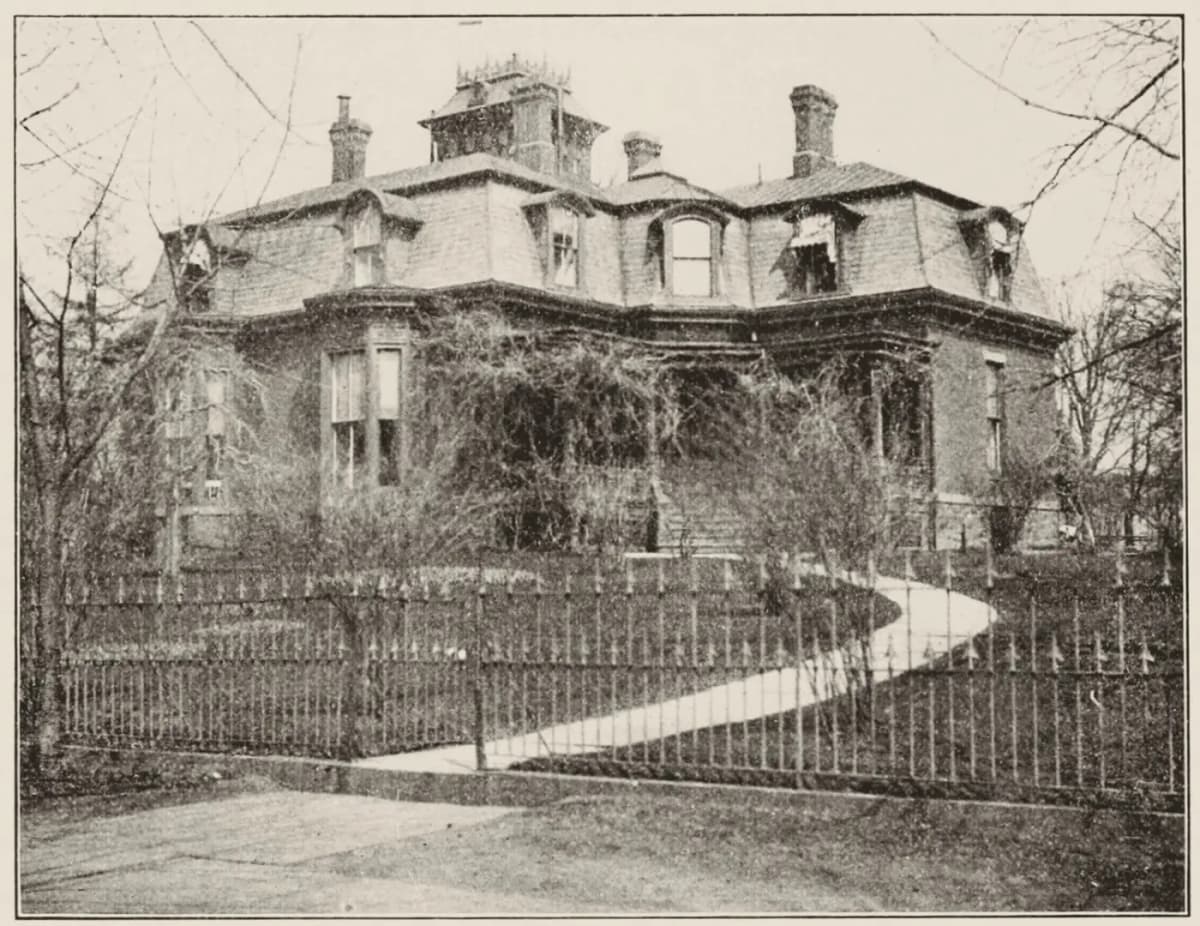
The dates matter, so let us set them down carefully. Brooklyn became a borough of New York City in 1898. The following year, on December 16, 1899, the Brooklyn Institute of Arts and Sciences — the body that would later become the Brooklyn Museum — opened a small museum for children inside the Adams House, a Victorian mansion in what was then called Bedford Park and is now Brower Park. Admission was free. Nothing quite like it existed anywhere.
It is worth pausing on how strange the idea was at the time. The great museums of the nineteenth century were built to impress adults: glass cases, Latin labels, silence enforced by guards. A museum designed around the height, patience, and curiosity of a seven-year-old was not a smaller version of that model. It was a repudiation of it. An early account of the new museum promised something no marble institution of the era would have said out loud:
Exhibits "attractive in appearance, simple in arrangement, and labeled with descriptions adapted to the needs of children, printed in clear readable type."
Clear readable type. I have edited copy for thirty years, and I can tell you that sentence was radical. It concedes that the reader — a child — is the authority the institution must answer to, not the other way around.
The neighborhood answered. By October 1905, monthly attendance had passed 13,000, and the little mansion museum was operating with annual support from the city on top of private donations.
The Gallup Years: The Woman Who Defined the Species
If the Brooklyn Institute supplied the idea, a schoolteacher named Anna Billings Gallup supplied the doctrine. Gallup — a nature-study advocate and a graduate of the Massachusetts Institute of Technology, which was not a common line on a woman's resume in 1902 — joined the museum that year as an assistant. Two years later she was curator-in-chief, and for the next three decades she ran the place and, in effect, wrote the operating manual for a field that did not yet exist.
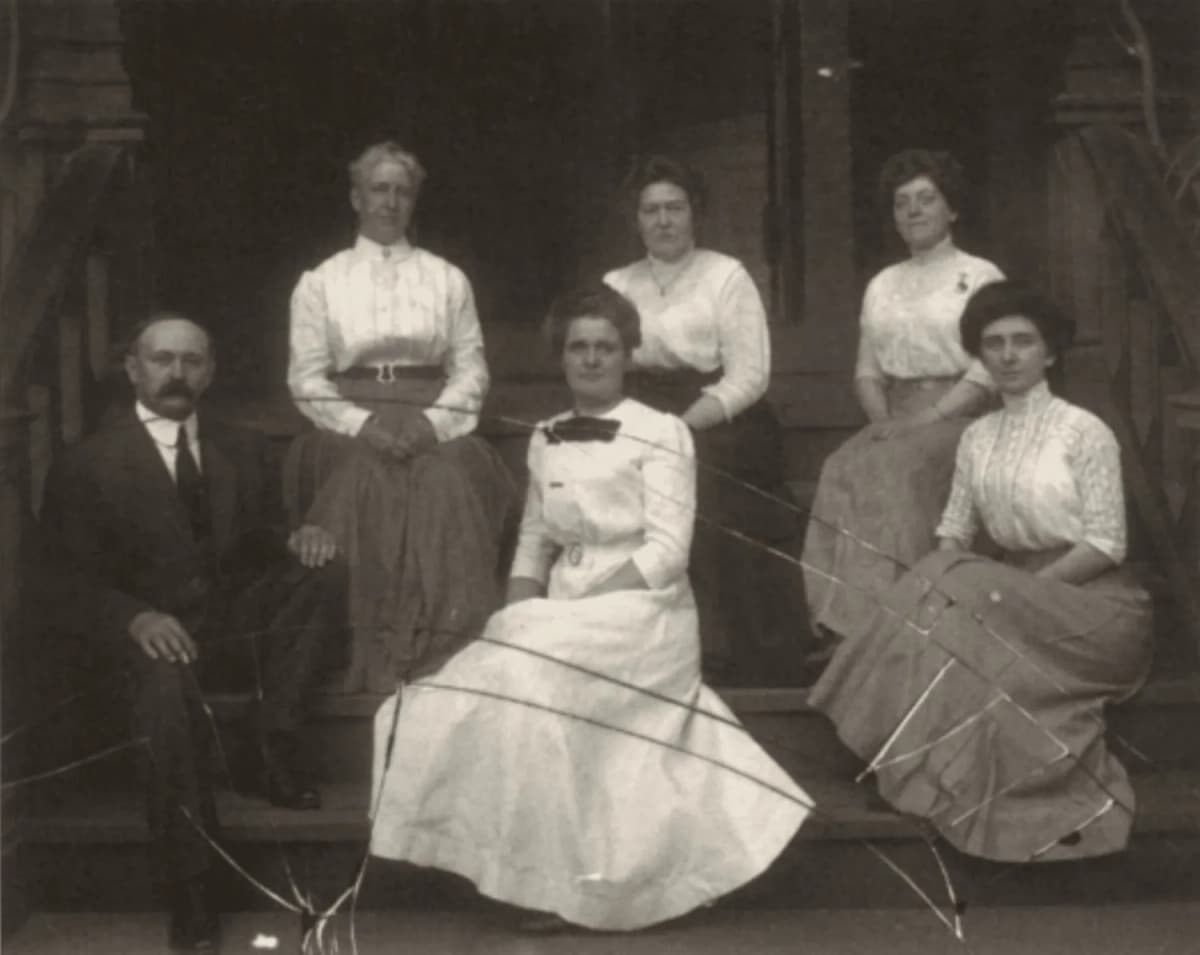
Under Gallup, the museum pioneered what we now shrug at as obvious: children handling specimens instead of viewing them through glass, field trips, live demonstrations, workshops, clubs. In 1907 she stood before the American Association of Museums and delivered a paper titled "The Work of a Children's Museum," effectively announcing the new species to the profession. When Mary Stewart Carey of Indianapolis wanted to found a children's museum of her own in 1924, she came to Brooklyn first to see how it was done. Boston and Detroit had done the same math earlier. The lineage is documented, not folklore: the first four children's museums in America all trace their method back through this building, and the first of the four was this one.
And here the roof enters the story earlier than you might expect. In 1908, Popular Science Monthly photographed the museum for a feature, and among the images is one of the mansion's mansard roof with figures working at wireless telegraphy equipment — children learning radio, on the rooftop, eighteen years before commercial broadcasting reached most American homes.
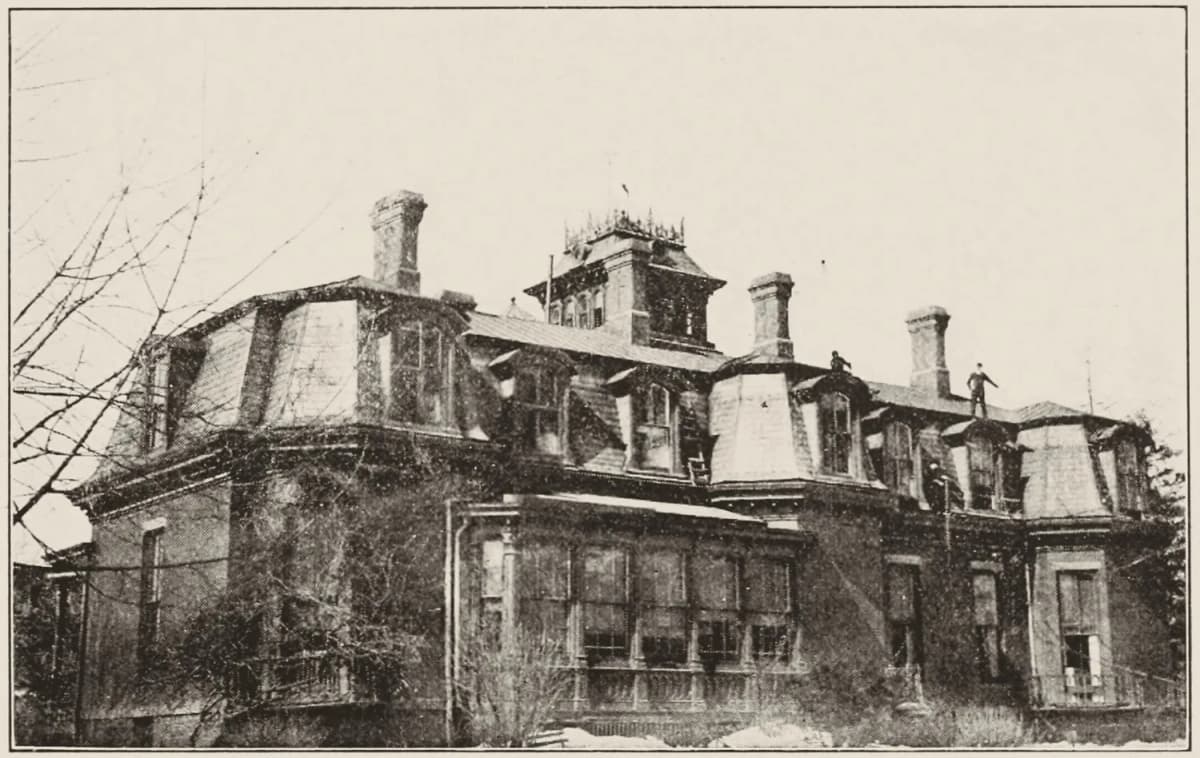
I want to be precise about what that photograph proves and what it does not. It does not prove a continuous rooftop program running from 1908 to today; the buildings themselves changed twice in between. What it proves is a disposition: from its first decade, this museum treated its roof as usable territory for children — a place to put the newest technology of the age and let young people climb up to meet it. Hold that thought.
Three Buildings, One Corner
The museum has never left its corner of Brower Park, but it has rebuilt itself around that corner more than once, and each rebuilding tells you what the era believed about children.
The Victorian mansions — the Adams House, joined later by the neighboring Smith House — carried the museum for nearly seven decades before they deteriorated beyond saving and were demolished. In 1977 the museum reopened in a building by Hardy Holzman Pfeiffer that critics greeted as one of the most inventive museum structures in the country: almost entirely underground, entered at the corner of St. Marks and Brooklyn Avenues, with rooftop gardens and an open-air amphitheater knitted into the topography of the park itself. Note the detail — even when the museum buried itself, it kept a green roof for the children above.
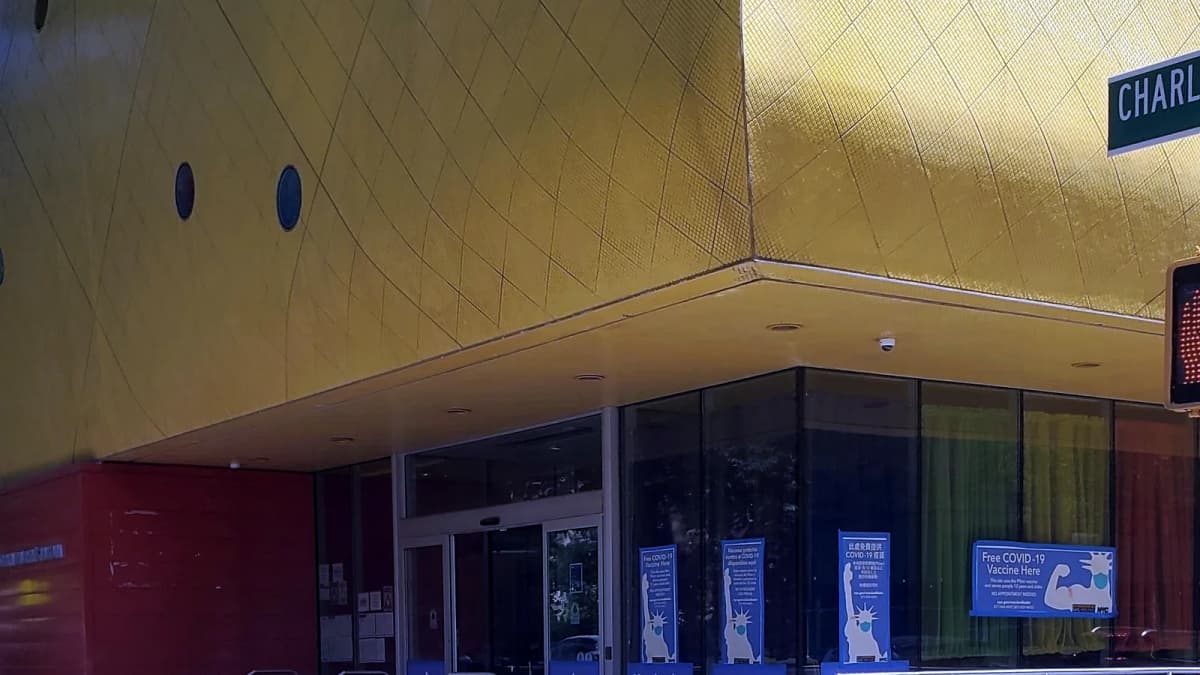
The third act is the one you see today. In 2008, after a design by Rafael Viñoly enclosed and expanded the 1977 structure, the museum reopened as the saffron-yellow landmark that now anchors the blocks around Brower Park — roughly double its previous size, and the first museum in New York City to earn green-building certification, with geothermal wells handling much of its heating and cooling. Whatever your feelings about bright yellow architecture in a brownstone neighborhood, it performs a civic function older than taste: a child can point at it from three blocks away.
The Rooftop, at Last
Which brings us to the roof itself — 118 years after those wireless antennas.
In August 2017 the museum opened a 20,000-square-foot rooftop terrace above the Viñoly building, and it is the rare institutional addition that reads as a public square rather than an amenity. Its centerpiece is a white steel canopy of about 7,255 square feet designed by architect Toshiko Mori — the museum has described her inspiration as a butterfly alighting on the roof — sheltering an open-air room that can seat three hundred people for concerts, film screenings, art classes, and neighborhood gatherings. Around the canopy, the landscape practice Future Green Studio divided the terrace into quadrants: a mini-woodland, a play zone, a lounge, and a dining area, connected by a planted boardwalk with Crown Heights rooftops and water towers on every horizon.
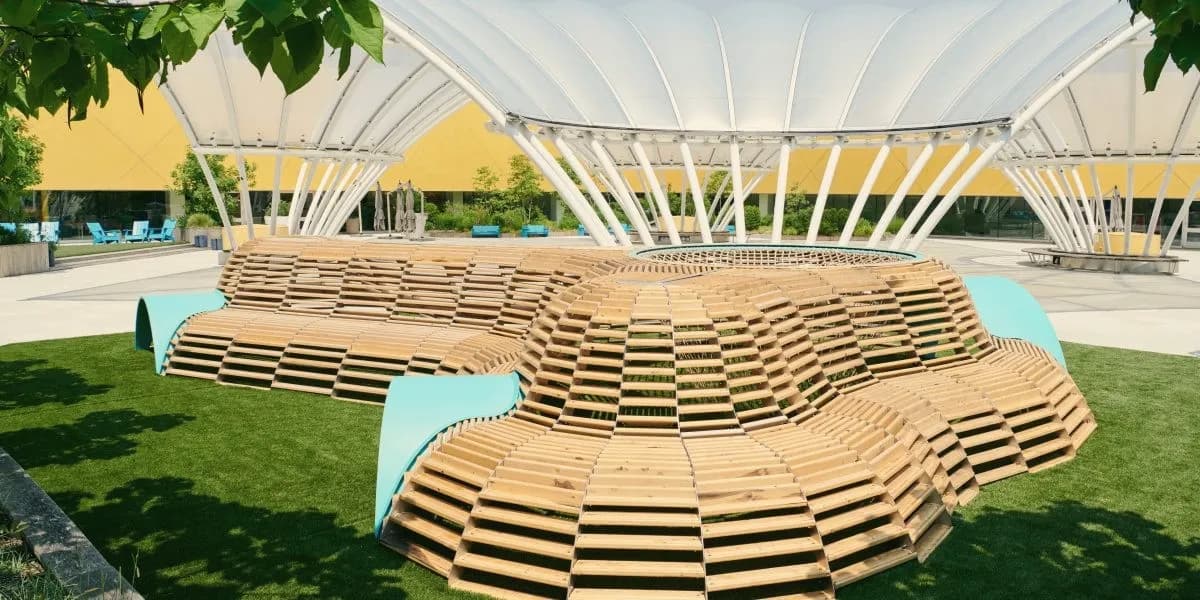
Then, in June 2019, the roof acquired its resident sculpture. The NEST, designed and built by the Brooklyn fabrication studio Tri-Lox, is an 1,800-square-foot climbable playscape woven from cedar reclaimed from dismantled New York City water towers, its form modeled on the hanging nests of the baya weaver bird — a specimen children can find in the museum's own collection downstairs. It has a climbable exterior, a circular hammock room, and a permeable interior with no instructions posted anywhere, which is the point. Tri-Lox co-founder Alexander Bender put the material's round trip better than any caption writer could:
"We quite literally brought the water tower back to the rooftop with this project — it just had to be turned into a giant nest first."
The NEST is open during regular museum hours, weather permitting — this is a New York rooftop, and the museum makes no promises against rain.
What I find worth recording is the rooftop's role in the neighborhood rather than just in the museum. Crown Heights is not a district of private terraces; open elevated space here is scarce and almost never public. The museum's roof functions as the block's shared upper floor — the place where the institution's programming spills outdoors in summer, where the borough's families get a horizon line, and where the museum's long partnership with Brower Park below continues at a new altitude. That relationship keeps deepening at street level too: in 2023 the museum brought a branch of Brooklyn Public Library inside its own walls, and in 2024 the city broke ground on a $15 million renovation of the museum's ground-level courtyards to add still more outdoor programming space. An institution does not make those moves because it wants more visitors. It makes them because it has decided to be infrastructure.
Before You Go
The facts below are the kind I check twice, so you may rely on them as of this writing — and confirm hours on the museum's site before a special trip, as holiday closures do occur.
Brooklyn Children's Museum stands at 145 Brooklyn Avenue, Brooklyn, NY 11213, at St. Marks Avenue on Brower Park. It is open Wednesday through Sunday, 10 am to 5 pm, with last entry at 4:50 pm; Mondays and Tuesdays it is closed. General admission is $15 per person — adults and children alike — and the museum offers free entry on Thursdays from 2 to 5 pm through its community access program. Tickets can be reserved online or bought at the door. The exhibits across its three floors are designed for children from six months to ten years, so this is a page for readers traveling with young people, not a solo gallery afternoon. By subway, take the 3 train to Kingston Avenue or the C to Kingston–Throop Avenues; the yellow tile does the rest of the wayfinding.
The Second Pass
My old rule is that the truth is in the second pass, and it applies to buildings as well as sentences. On a first pass, Brooklyn Children's Museum is a bright, loud, cheerfully sticky place to spend a morning with a four-year-old — true, and not the whole truth. On the second pass you see the longer sentence this corner has been writing since 1899: an institution invented here, largely built by a woman the profession had to catch up to, that has rebuilt itself three times without once moving away from its neighborhood, and that finally raised its oldest conviction — children deserve the best real estate in the building — up to the roofline, under a canopy shaped like a butterfly that decided to stay.
That is not a flashy conclusion. I don't write flashy conclusions. But it held up under checking, which is better.
Editor's note: This piece nearly repeated an error I see often in copy about the museum — attributing the rooftop terrace to the 2008 expansion. The yellow building and the rooftop are nine years apart: Viñoly's expansion opened in 2008, and the Toshiko Mori canopy and terrace did not open until August 2017, with the NEST following in 2019. The second pass caught it. It usually does.
Brooklyn Children's Museum, 145 Brooklyn Ave, Brooklyn, NY 11213