Sport / Venue
The Courts Are Only One Corner: How Prospect Park's Parade Ground Actually Runs
Nine clay courts, one enormous winter balloon, four backstops, and turf that never rests — a ground-level read of Brooklyn's hardest-working 40 acres, for anyone who still thinks a park is just lawn.
 Jonah Brooks
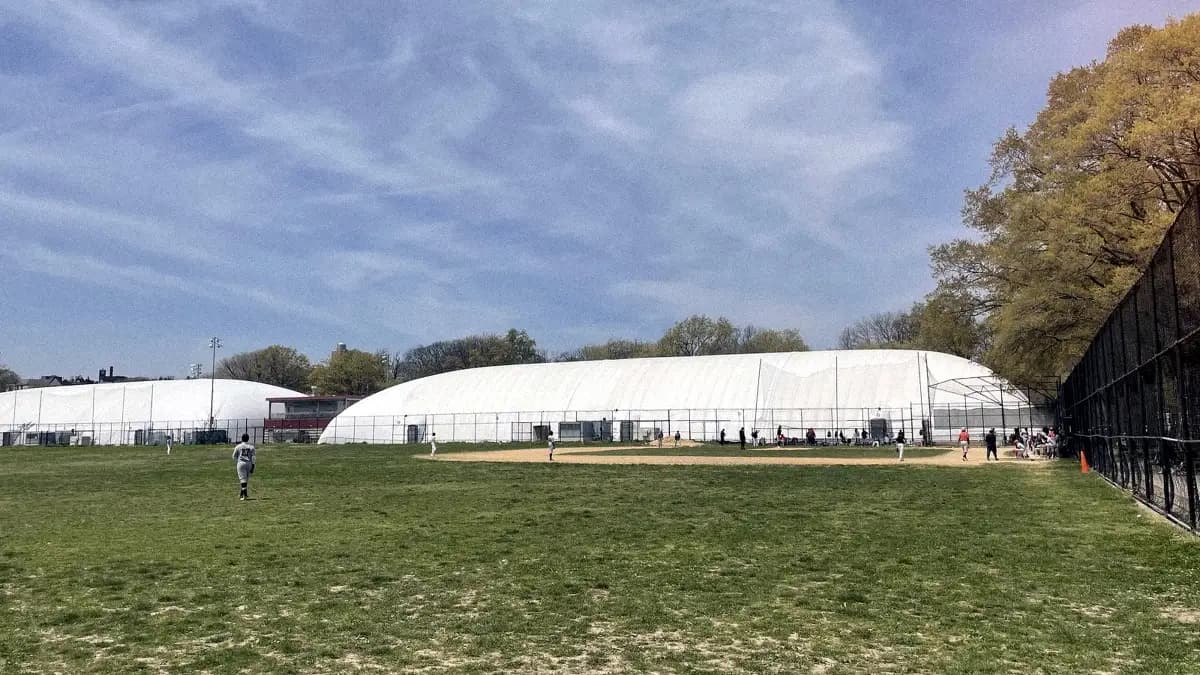
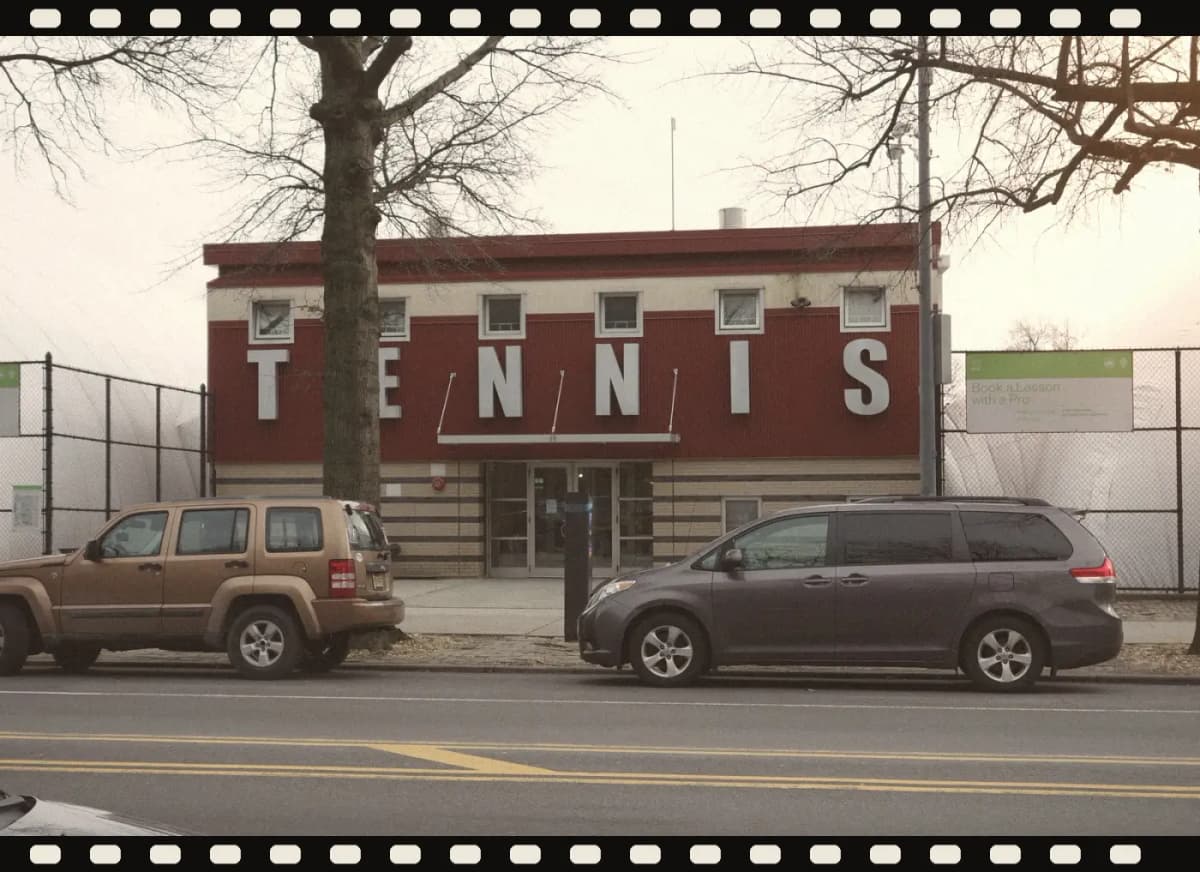
Stand at the corner of Parkside and Coney Island Avenues and you are technically at Prospect Park, but nothing in front of you looks like the postcard. No meadow, no lake, no picnic blankets. What you get instead is chain-link, backstops, floodlight poles, a low red clubhouse with TENNIS spelled out across its face, and — from late October to early May — a white vinyl dome the size of an airship hangar. This is the Parade Ground: 40 acres bolted onto the park's southern edge, open 6 am to 10 pm, and the single most misread piece of the whole Olmsted and Vaux composition.
Most people treat it as the part of the park you walk past. That is exactly backwards. The Parade Ground is where the park does its heaviest lifting, and the tennis center at 50 Parkside Avenue — the reason a lot of first-timers come down here at all — is only one tenant in a much larger operation. The courts are a corner. The ground is the story.
A park this size doesn't keep sports out of its landscape. It gives them their own address.
A Drill Field That Never Went Quiet
The arrangement is original to the design. When Frederick Law Olmsted and Calvert Vaux laid out Prospect Park, the land south of the main park was set aside — formally in 1868 — as a parade ground where Civil War veterans of New York's First Division could run military drills without trampling the park's carefully composed interior. Read that decision as zoning, because that is what it was: the loud, repetitive, turf-destroying activity got its own dedicated slab, and the meadows stayed meadows.
The military never really held the lease. By the late 1880s and 1890s the field was hosting archery, lawn bowling, and cricket whenever the regiments were elsewhere, and baseball, football, lacrosse, and soccer moved in behind them. By the late 1930s, the baseball diamonds here were drawing crowds that averaged around 20,000 spectators a day, watching kids who would shortly become famous — Sandy Koufax played on these fields before the Dodgers signed him. The ground's single biggest day wasn't a ballgame at all: on June 15, 1927, a crowd reported at more than 200,000 packed the field to welcome Charles Lindbergh a few weeks after his Atlantic flight.
The modern layout dates to a renovation funded in 2001 with $10.3 million from the borough president's office and completed a few years later: baseball fields, soccer fields, a multi-purpose field, basketball courts, and football fields with artificial turf. In the 1950s a recreation building here already housed indoor tennis courts alongside Parks Department offices — proof that the tennis-in-winter idea on this block is older than the bubble that now performs it.
The Tennis Corner: Eleven Courts and One Very Large Balloon
The Prospect Park Tennis Center occupies the Parkside Avenue side of the ground. The inventory: nine Har-Tru clay courts and two hard courts, run by the Prospect Park Alliance — the nonprofit that manages the park in partnership with the City of New York — with daily hours from 6 am to 11 pm. New York Magazine put it on its 2025 list of the best tennis courts in New York, which tells you the secret is out.
The clay matters more than it sounds. Har-Tru is the soft green surface that forgives your knees and slows the ball down, and public clay is scarce in this city; most NYC Parks courts are hard. Here you get nine of them, plus a clubhouse, a teaching staff running youth programs, adult group classes, doubles leagues, and a program of group instruction for children with special needs. This is not a pair of courts with a padlock. It is a small institution.
Then there is the bubble. Every fall — October 20 in the most recent cycle — the Alliance inflates a dome over a set of courts and the center switches to its indoor season, which runs to early May. From the ballfields it reads as a white whale beached at the tree line; from inside it means tennis at 8 pm in February, with the sound of the city replaced by that soft pressurized hum. The dome comes down in May, the sky comes back, and the same rectangle of Brooklyn becomes an outdoor club again. One footprint, two facilities, zero months off.
The bubble is the whole Parade Ground philosophy in one object: don't close the space, re-dress it.
How Booking Actually Works
This is where most first visits go sideways, so read the machinery before you show up with a racquet. The center runs on two overlapping systems — the city's and the Alliance's — and the time of day decides which one owns you.
Daytime in summer belongs to the city. During the outdoor season — roughly mid-May to early October — playing on an outdoor court between 6 am and 7 pm requires an NYC Parks tennis permit, the same permit that works at public courts citywide. For 2026, a full-season adult permit costs $100 (the citywide permit season runs April 4 to November 22), seniors 62 and over pay $20, kids and teens under 18 pay $10, and a one-hour single-play permit is $15. Bring the permit to the clubhouse once and they attach it to your online profile.
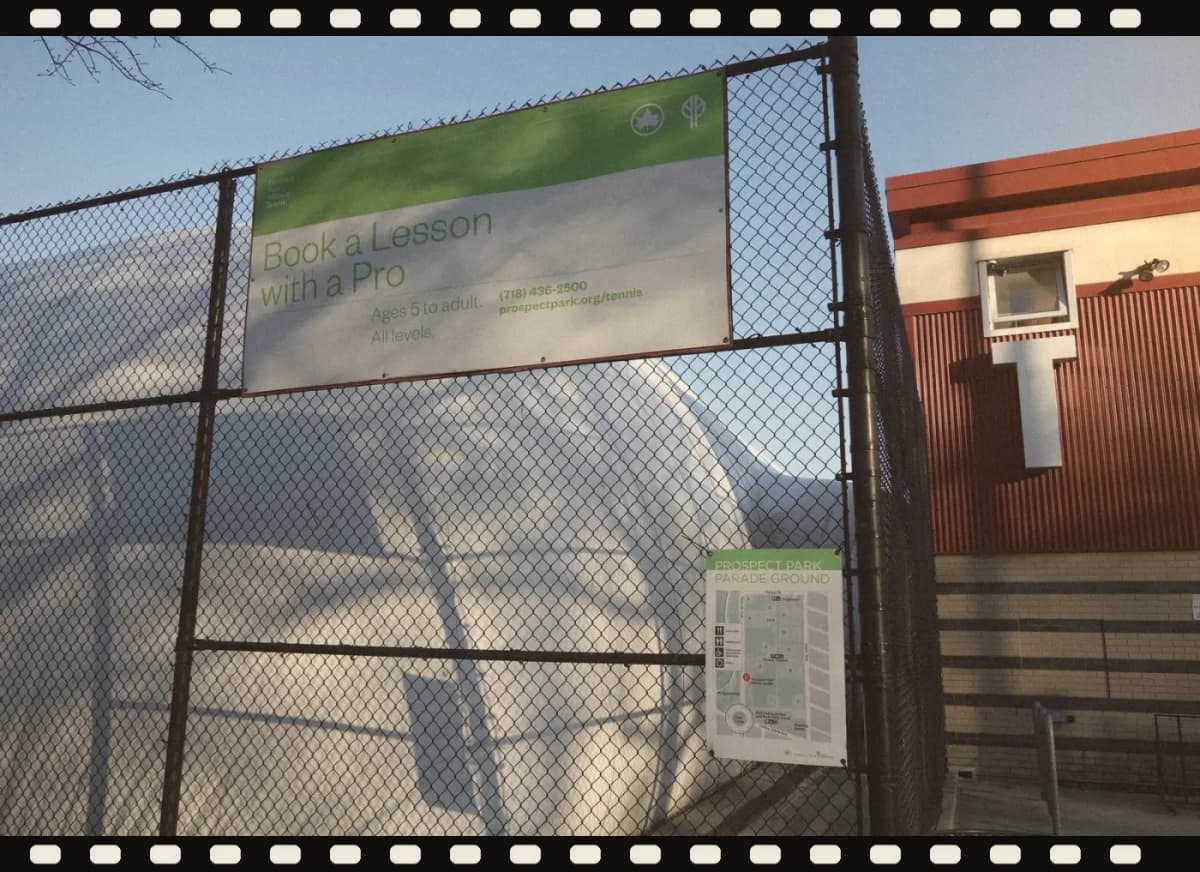
Evenings belong to the Alliance. From 7 pm to 11 pm, no city permit is needed — you simply book a court through the center's online reservation system and pay the hourly night rate, which in recent seasons has been posted at $40 an hour early in the week and $32 an hour Friday through Sunday. Court reservations, day or night, open one week in advance and carry a strict 24-hour cancellation policy; daytime advance reservations for permit holders have run $15 an hour. Indoors, in winter, the whole calculus changes again: bubble courts are booked hourly at rates that step up and down by time slot — from the mid-$40s at dawn to around $90 for a peak weekend morning in the most recent indoor season. Confirm current numbers on the Alliance's site or at (718) 436-2500 before you build a habit; the structure is stable, the digits move.
The pattern to internalize: the permit is your daytime key, the credit card is your nighttime key, and the seven-day window is when the good hours vanish. Brooklyn books fast.
The Fields That Set the Ground's Rhythm
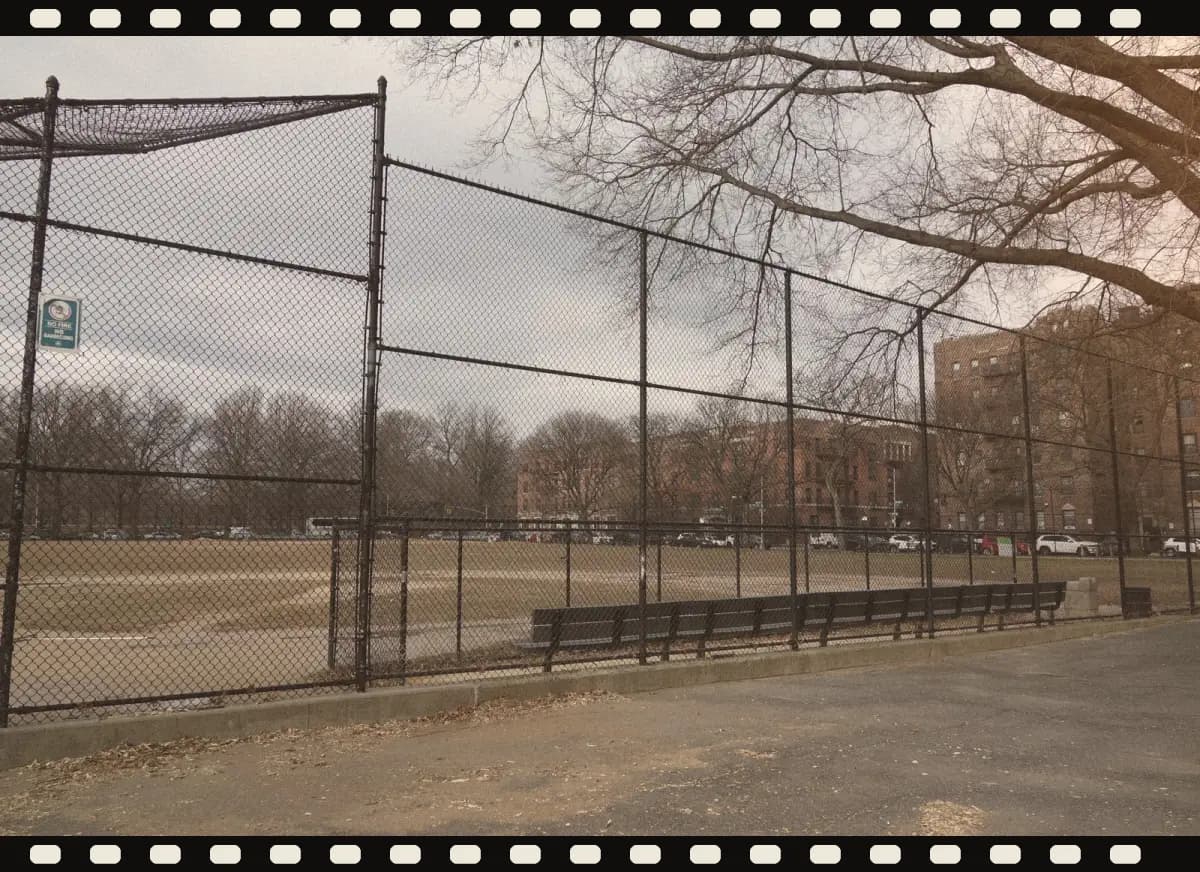
Walk east from the tennis center and the ground opens into its main business: a grid of baseball diamonds, artificial-turf soccer and football fields, plus basketball, netball, and volleyball courts, used continuously by local schools, leagues, and clubs for both children and adults. The turf conversion — part of the 2000s renovation — is why the soccer fields survive the kind of usage that would strip a grass meadow to dirt by June. Durability here is not a maintenance detail; it is the design principle. The Parade Ground absorbs the punishment so the rest of Prospect Park doesn't have to.
The scheduling logic mirrors the tennis center's split between permit and drop-in. Organized play with more than 20 people requires a NYC Parks permit, which is how the leagues carve up weekends months in advance. Below that threshold, the ground is opportunistic: a casual kickabout on an open field, a pickup shootaround, a netball drill on a weekday morning. If you want to understand a Brooklyn Saturday, the schedule board of youth baseball and adult soccer here is a better document than any brunch line.
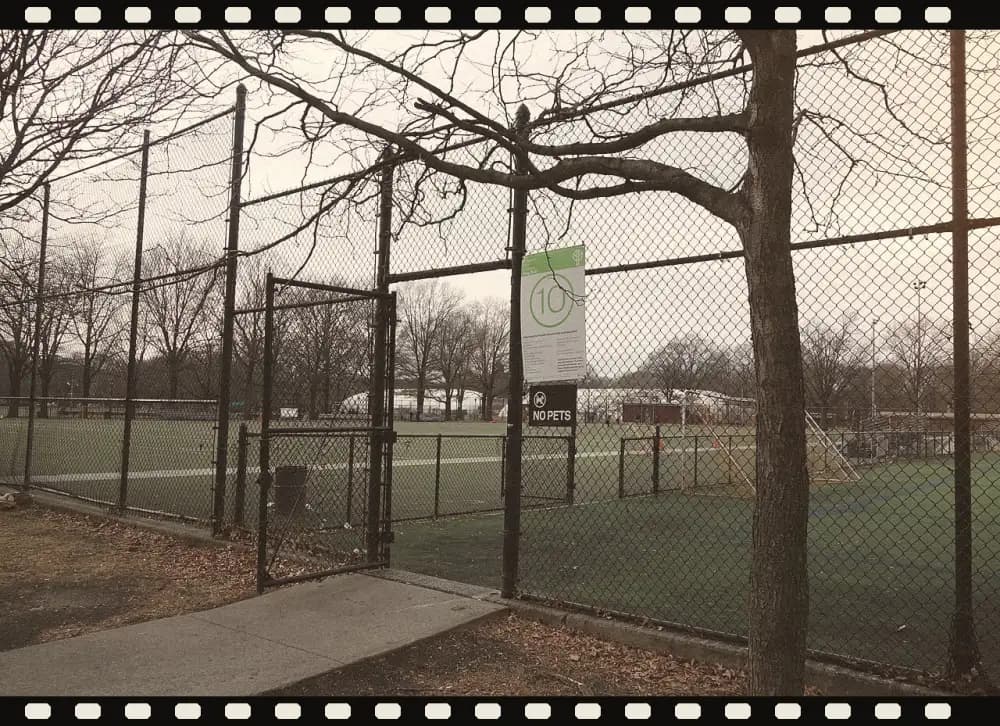
Every fence on this ground is a timetable. Read what's posted on it and you know who owns the next hour.
The Edges Do the Quiet Work
What keeps this from being a joyless sports depot is the perimeter. The Parade Ground's edges are lined with the small infrastructure that lets non-players spend an afternoon here: Stewart Playground for kids, the Kensington Dog Run toward the Coney Island Avenue side, an adult fitness area — a recent Alliance addition, opened with an accessibility-first design — and Lark by the Park, a seasonal café posted at daily hours of 8 am to 8 pm through the warm months. Benches and walking paths thread between the field fences.
This is the part the tennis center and the ballfields quietly depend on. A parent can watch one kid's baseball game while another climbs a play structure fifty yards away. A doubles foursome can debrief over coffee without leaving the block. The dog people, the stroller people, and the cleat people all cycle through the same 40 acres on different clocks — early dogs, mid-morning toddlers, after-school leagues, evening tennis — and the ground never really empties until the 10 pm close. The zoning that started in 1868 as "keep the drilling off the lawn" has matured into something better: a place where every kind of user has a slot, and each slot generates the foot traffic that keeps the next one feeling safe and alive.
When to Go, and Where to Stand
The ground is most honest on a weekend morning between nine and noon: leagues on every diamond, the tennis courts fully booked, the café line forming, and the whole machine running at capacity. Go then to understand the place. Go on a weekday just after opening if you want it to yourself — the 6 am clay-court crowd is small, devoted, and silent, and the light coming across the empty turf is the best thing this side of the park has to offer.
The best seat on the property is any bench on the interior path between the backstops, where you can watch two baseball games and a soccer match without turning your head more than ninety degrees. The worst place to be is the tennis center desk at 6:55 pm on a July weeknight, when the daytime permit players are coming off and the evening reservation players are pressing in — arrive fifteen minutes early or book the 8 pm slot instead. In high summer, treat the clay like a desert: midday courts are legal but punishing; mornings and the post-7 pm no-permit window are where the good tennis lives.
Who is this ground for? Anyone whose park needs involve a ball, obviously. But it earns a visit even if your racquet stays home: come for the Koufax-flavored history, stay for the anthropology, and leave understanding why Prospect Park's lawns are as calm as they are. Somebody in 1868 decided the noise deserved its own 40 acres. A century and a half later, the noise is still holding up its end of the deal.
Save this one for your Brooklyn list — and check the court map before your first booking, so the bubble doesn't surprise you in either direction.
Prospect Park Tennis Center(Parade Ground), 50 Parkside Ave, Brooklyn, NY 11218