

Tampa's Cigar Town on Foot, Starting at the Founder's Statue
A guided walk through the blond and red brick blocks that Cuban and Spanish cigar workers filled after 1886. It runs 105 minutes, and it begins and ends at a statue of the man who built the place.
Tampa did not spread out and absorb Ybor City. Ybor City was built beside Tampa, deliberately, to make cigars.
In 1885 Vicente Martinez Ybor and Ignacio Haya bought undeveloped land northeast of a town of about seven hundred people. The following year they oversaw the first 176 worker houses, for some of the 3,000 people already hand-rolling cigars in their new factories. Tampa annexed the place in 1887. By 1890 around six thousand people lived there: Cuban, Spanish, Italian, German, Chinese, Rumanian Jewish. The National Park Service calls that concentration of ethnic groups uncommon in the American South.
This walk covers that ground at street level, with a guide, in 105 minutes.
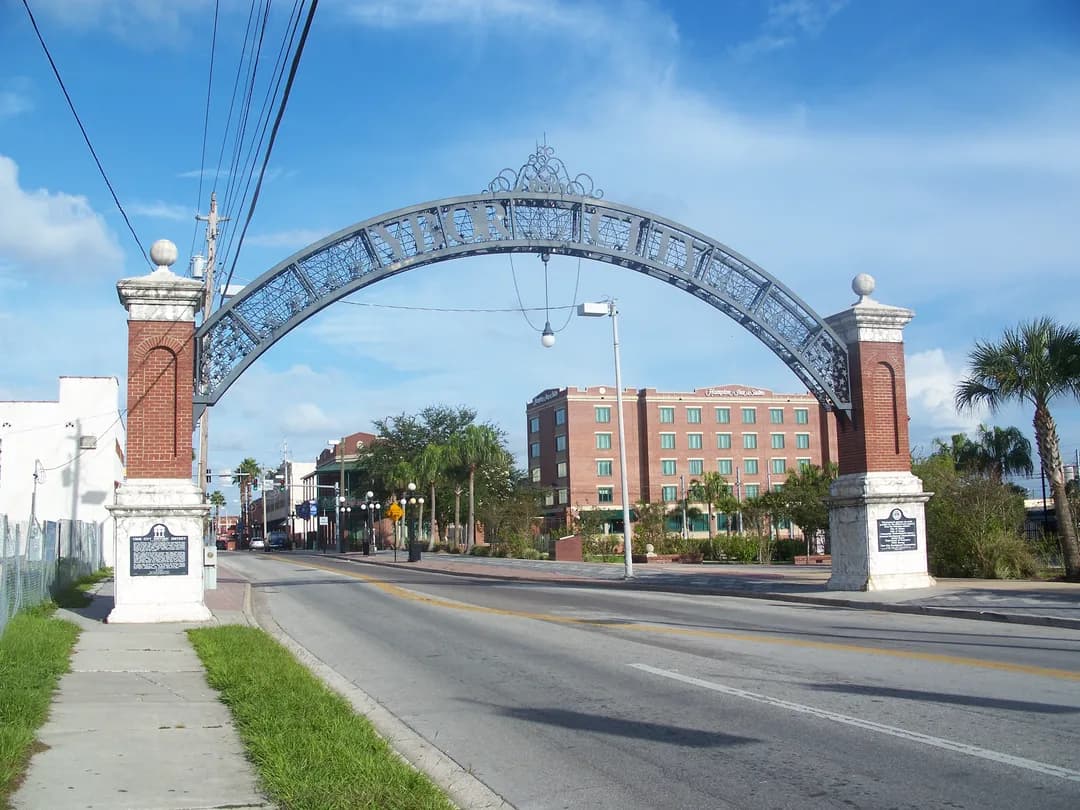

What survived is dense. The district holds more than 950 historic buildings and structures, most of them raised between 1886 and the First World War: factories, churches, social clubs, shops, public buildings. Seventh Avenue is the spine, eleven blocks of it, and the American Planning Association put that strip on its list of America's Greatest Streets in 2008.
Most of the buildings are blond or red brick. Many carry wrought iron balconies on the second floor. The detail sits at eye level and just above it. That is the argument for doing this on foot.
 Shared Ybor City Historic Walking Tour105 minutes on foot with an English-speaking guide through the Ybor City Historic District. Meets at the Vicente Martinez Ybor statue on 7th Avenue. Daily at 11:00 AM and 2:00 PM.www.viator.com
The Cuban Half of the Story Gets Its Own Twenty Minutes

The itinerary has two entries. One covers the neighborhood at large and carries ninety minutes. The other is a single twenty-minute stop, which the operator's itinerary describes as a visa-free visit to the only Cuban-owned land in America. Those two figures add up to more than the 105 minutes you book, so treat them as proportions.
The Cuban thread here is not decoration. Martinez Ybor was born in Valencia, spent fifteen years in Spanish Cuba, and left because he backed Cuban independence. He imported his tobacco from Cuba and hired Cuban exiles to roll it. Fifteen percent of that first wave was Afro-Cuban. Among the largest Hispanic clubs in Tampa between 1890 and 1920 was the Circulo Cubano. A street in the district still carries the name Avenida Republica de Cuba.
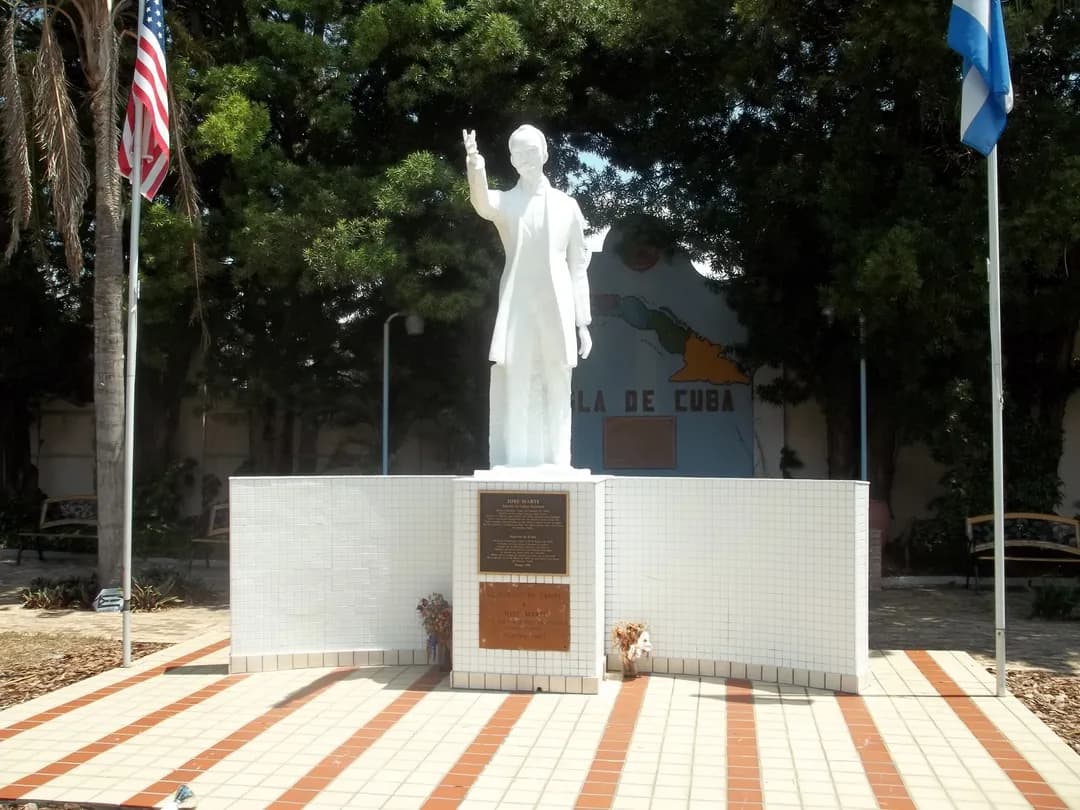
Jose Marti came to Ybor City before the 1895 Cuban War for Independence to gather support among those cigar workers. Inside the factories, readers hired by the workers themselves read aloud from patriotic newspapers and passed on news of the political situation. Marti's statue is still here, standing between a Cuban flag and a tiled map of the island.
One Guide, English Only, and the Same Corner at Both Ends
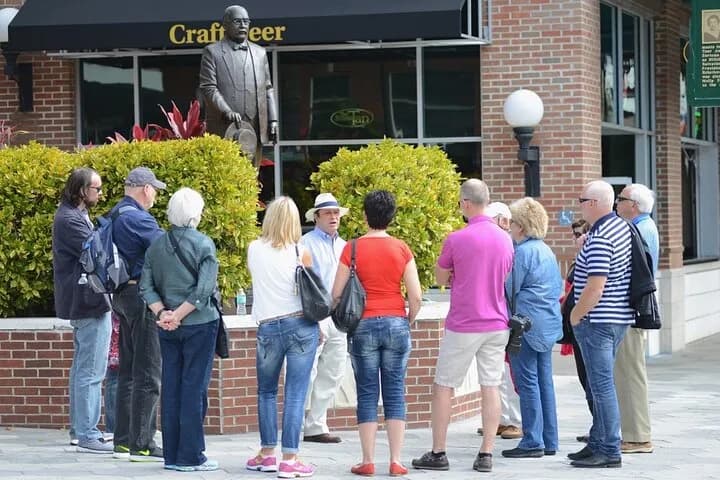
The itinerary's start point and its end point are the same line of text: the statue of Vicente Martinez Ybor at the 7th Avenue entrance to Centro Ybor, at 7th Avenue and 16th Street. You end the walk where you began it.
The booking record lists one language for the guide, English. There is no vehicle and no hotel pickup. Everyone meets at the statue.
The operator states one requirement, and it is about footwear. Its own words: wear comfortable shoes, the walk is NOT strenuous.
The walk holds 4.93 from 774 reviews.
Check the Ticket Types Before You Book for a Child
The booking form sells two ticket types and nothing else: a child ticket for ages 6 to 12, and an adult ticket from 13 up. There is no ticket for a child under six, and every booking has to include an adult.
The listing also ticks a row of standard accessibility boxes: wheelchair accessible, all areas and surfaces are wheelchair accessible, and that infants and small children can ride in a pram or stroller. Those boxes come from the booking platform's standard list, and the last one sits against a ticket table that has no band below six. The operator does not restate any of them in its own words.
One booking takes up to fifteen travelers. That caps your order. It does not cap the size of the group you will be standing in.
Two Departures a Day, and a Cutoff Two Hours Ahead
The walk runs every day of the week, twice: 11:00 AM and 2:00 PM. The published schedule currently extends to 31 May 2027.
Booking closes 120 minutes before the departure time, so the 2:00 PM walk stops selling at noon and the 11:00 AM walk stops selling at nine. Confirmation is instant. A mobile or paper ticket is accepted, one per booking.
Cancellation, in the operator's words: for a full refund, cancel at least 24 hours before the scheduled departure time.
The adult price on the current schedule is USD 35. A discounted starting price of USD 28 was showing on 30 September 2026.
The walk puts you back at the statue an hour and three quarters later, on the same eleven blocks you started on, with the brick and the iron work now attached to names and dates. An 11:00 AM start returns you at a quarter to one, in time for a long lunch. The 2:00 PM start returns you at a quarter to four, when the low sun does its best work on red brick.