

Real Beetles Arranged Into Kaleidoscopes on the Seattle Waterfront
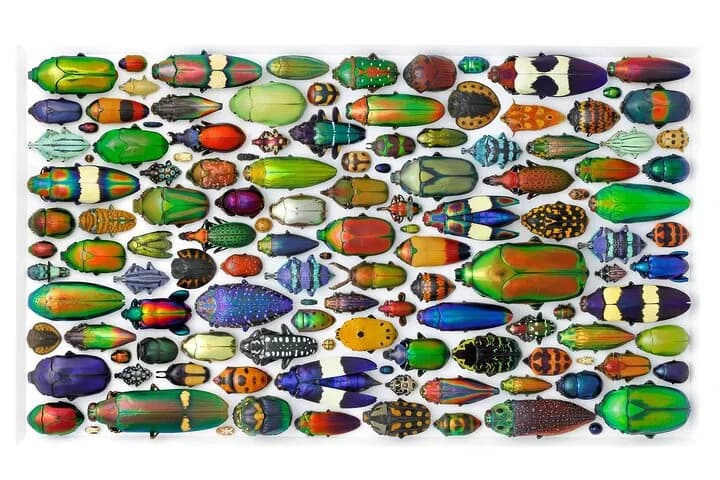
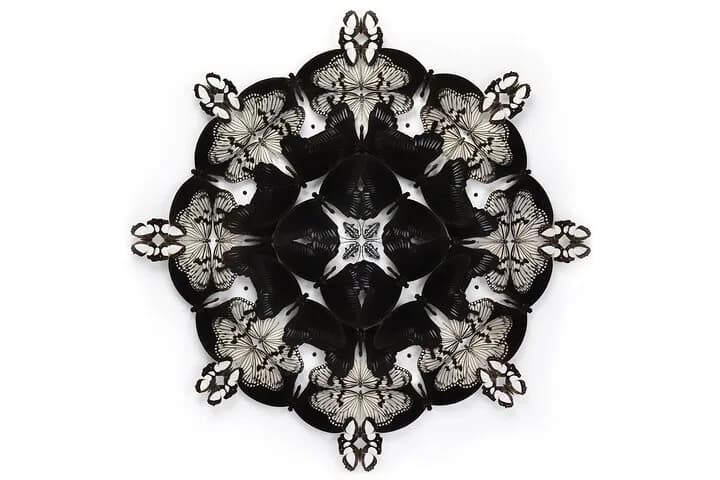
Christopher Marley builds wall pieces out of beetles, fish, orchids and minerals, sorted by colour and symmetry, with species mixed freely. The double take is the point: the colour looks printed, and it is not. His own FAQ puts it plainly, every specimen is a real animal or plant that was once alive.
The Maritime Building sits on the downtown waterfront, and the exhibit runs behind its glass front on Alaskan Way. Inside, the walls are dark and the frames are lit hard against them, so the first thing that registers is colour. A wheel of blue butterfly wings. A grid of jewel beetles laid out like a paint chart.
Look longer and the sorting logic shows. Pieces are built around hue and shape, so one frame can hold a dozen unrelated species that happen to share the same green. From across the room they read as pattern. From a foot away they separate back into animals.
The exhibit is closed on Wednesdays, and closed on Christmas and Thanksgiving. On every day it does open, the door opens at 10:00am.
Admission is what the listing covers, one ticket per traveller. Tickets are priced by age band: a child rate from four to twelve, an adult rate up to sixty-four, and a senior rate from sixty-five.
 Exquisite Creatures Exhibit By Christopher MarleyAdmission to the Seattle exhibit in the Maritime Building on Alaskan Way. Admission fees included, one ticket per traveller, 60 to 90 minutes.www.viator.com
Sharks and Sea Dragons Get the Same Treatment


The insect walls take the attention, and they are one part of the room. The listing describes exotic insects and fish, striking minerals, and delicate plants. In practice that means a pair of sharks up on stands, each one set against a lit slice of banded mineral, and a leafy sea dragon spread open like a pressed fern.
Marley's own FAQ is blunt about what you are looking at. He writes that every specimen he works with is a real, once-living animal or plant, and that there is virtually no taxidermy in the exhibit. He adds that the colours are true to life, with nothing done to visibly alter the specimen in about ninety-five percent of cases. Some reptiles, fish and plants get what he calls preventative maintenance or colour restoration.
One whole group is missing on purpose. He says he does not work with mammals, because familiar mammals sit too close to home to shift anyone's perspective.
The Room, and the Door on Alaskan Way

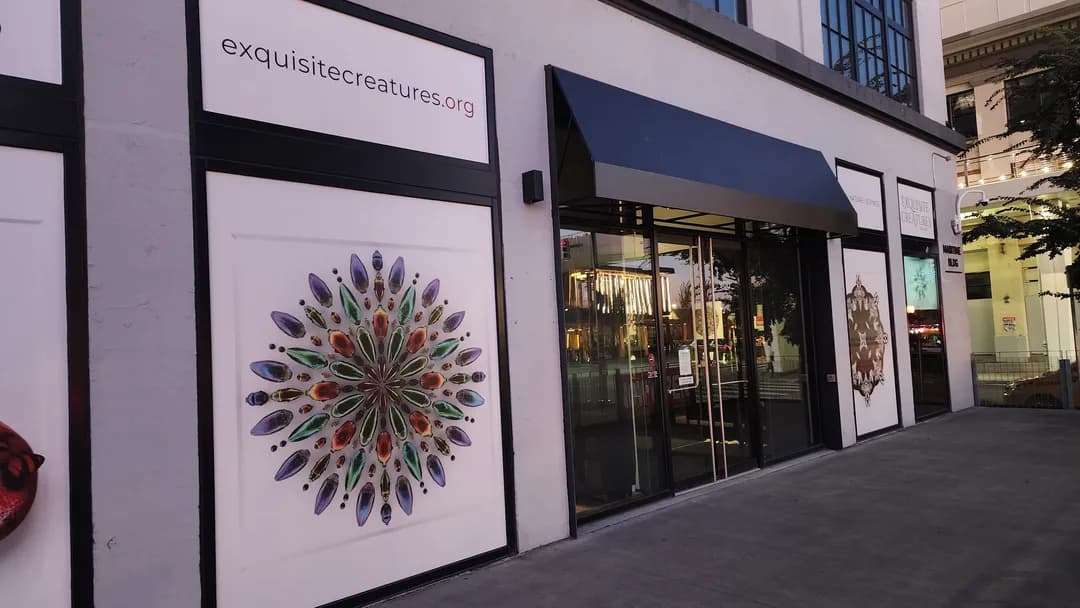
The door is at 900 Alaskan Way, in the Maritime Building, on the downtown Seattle waterfront. It is a glass front at street level, and the panels along the sidewalk carry blown-up versions of the work, so the building announces itself before you reach the handle.
Inside, the dark walls flatten the room and push the colour forward. Scale is the thing photographs get wrong. The long red wall is a single run of framed pieces set at adult eye level, with the smaller works hung low enough that a child can stand square in front of one.
The listing calls the space wheelchair accessible and says all areas and surfaces are accessible. Infants and small children can ride in a pram or stroller. Service animals are allowed, and there are public transport options nearby.
Where the Specimens Come From
Marley grew up in Oregon and, by his own account, spent over a decade working in dozens of countries in fashion advertising before this became the work. He keeps design studios in Oregon and Malaysia. Three books sit behind the exhibit: Pheromone, published by Pomegranate in 2008; Biophilia, published by Abrams in 2015; and Exquisite Creatures in 2023.
The sourcing is set out at length on his own conservation page, and it is worth reading before you decide how you feel about the room. He writes that vertebrates are reclaimed after dying naturally or incidentally, usually in captive settings, and that some oceanic vertebrates are fishing bycatch. Insects are farmed or wild-caught. Oceanic invertebrates come from bycatch, from fish markets, from beachcombing, and from divers.
He also states that he has been licensed by US Fish and Wildlife for the past twenty-five years, and that the oceanic invertebrates he works with are all legally acquired, with none of them endangered or protected species. Those are his claims about his own practice, published on his own site.
Seattle is a stop on a longer run. His visit page lists earlier stagings at the Oregon Museum of Science and Industry, Crystal Bridges Museum of American Art, the Science Museum of Minnesota, and the North Carolina Museum of Natural Sciences.
Hours, Tickets, and the Day It Is Shut
The published hours are 10:00am to 6:00pm on Sunday, Monday, Tuesday and Thursday, and 10:00am to 8:00pm on Friday and Saturday. Wednesday is a closed day, as are Christmas and Thanksgiving. The operator lists the Seattle run as open through March 2027.
The listing puts a visit at 60 to 90 minutes, which matches a room you can comfortably walk twice. Tickets are one per traveller. One booking can carry up to thirty travellers, and that is a cap on the order, not a statement about how many people are in the room at once.
Tickets are final. All sales are final and no refund is available for cancellations, so the date on the booking is the date you have.
The work rewards a second lap. Almost everything here reads as pattern from across the room and as an individual animal from a foot away, and the second pass is where the species start separating out of the design. Friday and Saturday stay open until 8:00pm, which is time enough to do both laps and still come back out with the waterfront evening in front of you.