Music / Venue
Nobody Cares That You Came Alone: The Tiny Cupboard Is Bushwick's Best Light Night Out
You don't want to drink. You don't want to stay home. A 9:30 pm small-room comedy show at Brooklyn's pink comedy club is the third option nobody tells you about — under $20, about two hours door to door, and I scored the social pressure myself.
 Kate Mercer
Can you go to a comedy club alone, on a Tuesday, sober, and have it count as an actual night out? Absolutely. I've done it enough times now to have a routine, a preferred seat, and one incident I'll get to later that taught me where NOT to sit.
Here's the situation this page is for. It's 8 pm on a weeknight. You've been home since 6:30. The group chat is dead, you don't feel like a bar, and you can feel the evening about to dissolve into your phone. What you want is something with a start time and an end time — a night out in the smallest possible dose. Bushwick has an answer to this, and it's painted bubblegum pink.
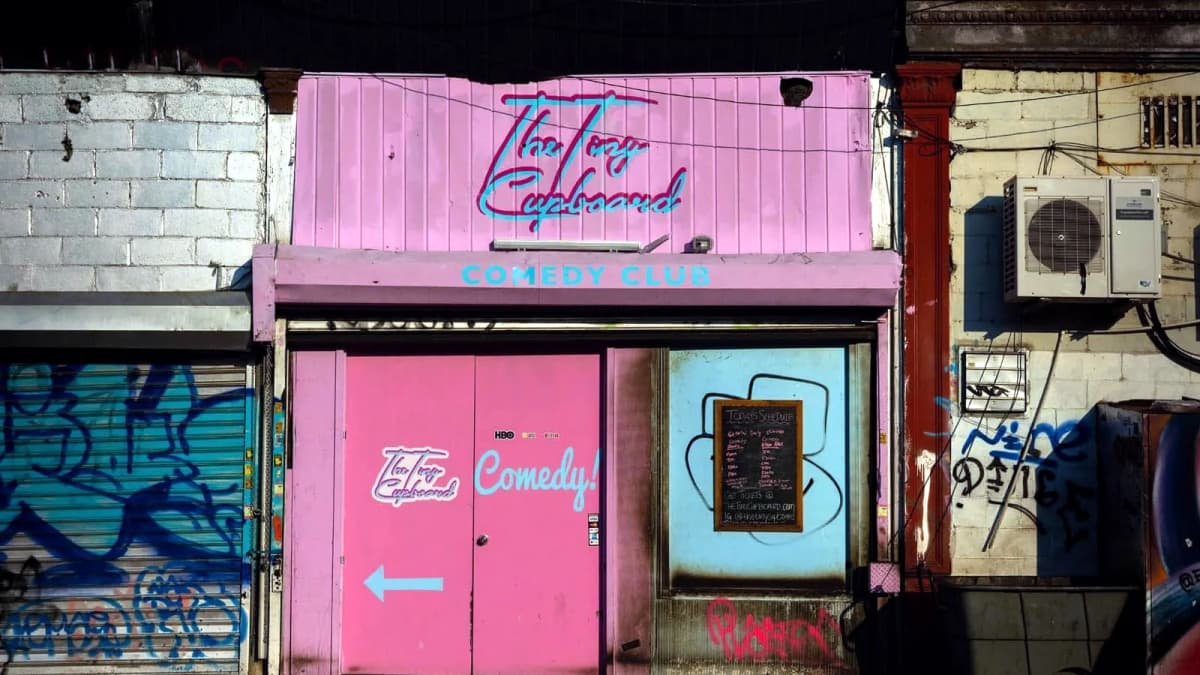
The Tiny Cupboard sits at 10 Cooper Street, on the eastern edge of Bushwick, two minutes' walk from the Chauncey Street J/Z stop. It runs stand-up every single night of the week — weeknights included — and the late weeknight show starts at 9:30 pm. It is, on the numbers and on the vibe, the most solo-friendly room I've found in New York. This is the full breakdown: what it costs, how long it takes, and exactly how much social pressure you're signing up for. (Spoiler on that last one: almost none, and I'll show my scoring.)
A 9:30 pm show is smaller than a night out — that's the whole trick
Most plans fail because they're too big. Dinner plus drinks plus the subway home is a four-hour commitment, and at 8 pm on a Tuesday you don't have four hours of social energy left. You have about two.
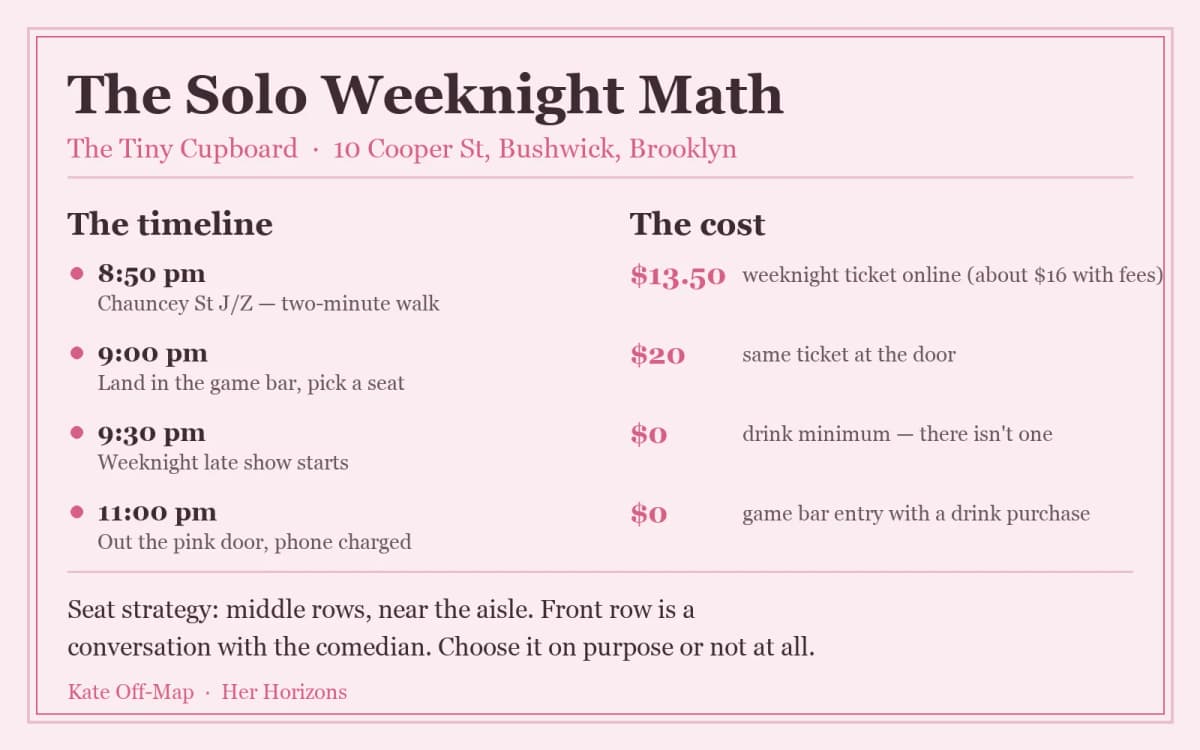
A small-room comedy show is built to that exact size. On Sunday through Wednesday nights, The Tiny Cupboard runs shows at 8:00 and 9:30 pm; Thursdays shift to 8:30 and 10:00, and weekends stack three shows from 7:00 pm. The 9:30 weeknight slot is the one I keep coming back to. It's late enough that you can decide at dinner, alone, with zero planning. It's early enough that you're back on the J before midnight. Door to door from most of north Brooklyn, the whole thing fits inside two and a half hours.
And if the night surprises you and you want MORE night — one ticket lets you stay for multiple shows, and there's a new-talent open mic at 11 pm. The commitment scales up only if you ask it to. That's the definition of a light night out: a small plan with an exit and an extension built in.
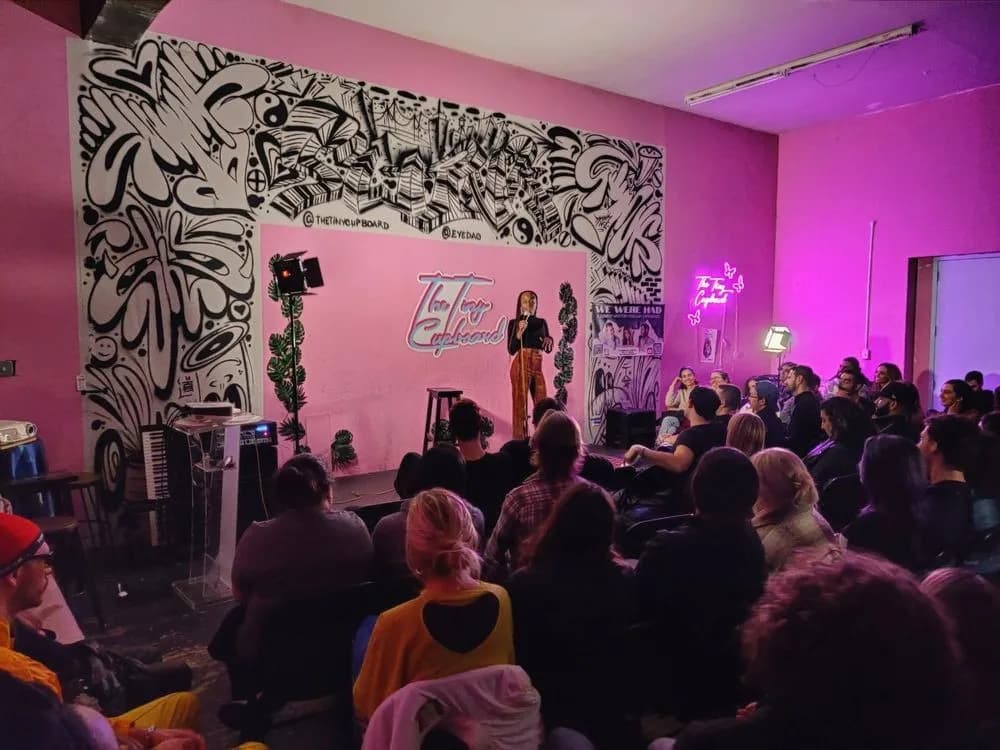
The room itself works in your favor. The main stage is a former church — legally speaking, a church, as the owners like to point out — repainted in loud pink, with a mural wall behind the stage and a neon sign that makes everyone's phone photos look the same shade of magenta. It's small enough that the comedians don't need the audience to be loud to feel a room, which matters when you're an audience of one.
The math stays under $20, and there's no drink minimum
I keep a private rule for solo nights: if the evening costs more than a paperback and a car home, it needs to earn it. The Tiny Cupboard passes without trying.
Weeknight tickets for the nightly stand-up showcase are listed at $13.50 online — about $16 once fees are added — or $20 at the door. Weekends run $19.50 online, $25 at the door. Compare that with Manhattan clubs where the ticket is the cheap part and the two-item minimum is the real bill, and the gap gets embarrassing.
Because here's the structural difference: there is no drink minimum. None. No two-item minimum either — the club states it plainly, and it changes the entire economics of going alone. At a traditional club, a solo sober visitor is a problem customer; the minimum exists to extract a bar tab from you whether you want one or not. Here, if you want a soda or nothing at all, the total cost of your Tuesday night is the ticket. The club was built grassroots — two comedians, Amy Wong and Matt Rosenblum, started it in a 153-square-foot art studio in 2019 with a few hundred dollars and no investors — and the honest pricing reads like a founding principle rather than a promotion.
A weeknight at The Tiny Cupboard, fully loaded: $16 ticket, $2.90 subway ride each way, zero obligatory drinks. Under $22 for a night that has a beginning, a middle, and a punchline.
One planning note: this is an independent club with a busy calendar — special shows, festivals, the occasional themed night — so check the events page before you swipe. The nightly showcase pattern above has been steady, but I'd never promise you a schedule I didn't re-check that morning, and neither should anyone else.
Nobody cares that you came alone — my social pressure score: 2 out of 10
This is the section I was assigned to write, because I'm the one on this desk who goes places alone for a living. So let's score it honestly, category by category.
Buying one ticket: 0 pressure. It's an online checkout. Nobody sees the quantity field but you.
Walking in alone: 1 point. There's a moment at any venue door where you scan for the eyes. Here the room is dim, seats are unassigned general admission, and half the crowd is looking at their phones until the lights drop. Aim for the middle rows, near the aisle. You'll be invisible in the best way.
Sitting through the show: 0 pressure. This is the quiet superpower of stand-up as a solo format. At a bar, being alone is a state you have to manage. In a comedy audience, everyone faces forward in the dark and laughs at the same things. You're not a woman alone at a table; you're row four. For roughly an hour, your only job is to be an audience. I've written before that alone is a skill, not a sentence — this room barely asks you to use the skill.
Crowd work: 1 point, entirely positional. Comedians talk to the front row. That's the trade of sitting there. If being asked "what do you do?" by a stranger with a microphone sounds like your nightmare, the middle of the room solves it completely. If it sounds fun, the front row is right there. The point is that the pressure is opt-in, which is more than I can say for most social settings in this city.
Total: 2 out of 10. For calibration, I'd score a trendy cocktail bar a 6 for a solo woman on a weeknight, and a group dinner where you only know one person an 8.
There's also a pressure-release valve most clubs don't have: a board game bar attached, with free entry when you buy a drink and a shelf of 500-plus board and video games. If you arrive at 9:00 for a 9:30 show, that's your landing zone — you can sit at a table with a stack of cards and adult coloring books and look extremely occupied, because you are. A solo person with a game in front of them is a person mid-activity, not a person waiting. It's the best waiting room in Bushwick.
What went wrong
Every place I recommend gets this section, because a page without the bad night is an ad.
My first visit, I arrived four minutes before showtime. The middle rows were gone, and the only easy seat was front and center. I told myself it was fine. It was not fine. Within ten minutes a comic had my job, my borough, and my relationship status woven into a running bit that resurfaced every time a new performer took the stage. Was it mean? No — the room's whole culture is more playful than predatory, and the crowd was laughing with me by the end. But I had come for an anonymous night, and instead I was unpaid cast. The fix costs nothing: arrive twenty minutes early, take the middle, and the show happens to other people.
Second thing: I once stayed for the 11 pm open mic thinking it would be the same show, cheaper. It is not the same show. Open mics are where jokes go to be tested, and some of them fail loudly. Some nights that's its own entertainment; on a work night it can turn a clean two-hour plan into a 1 am regret. Know which night you're having before you stay.
Third, the practical one, because I write safety like I mean it. Cooper Street at 11 pm is a quiet block — murals, roll-down gates, not much foot traffic. The good news is the geometry: the Chauncey Street J/Z entrance is about two minutes from the door, one short and straight stretch. I walk it without drama, but I walk it with my headphones out and my exit already decided, which is how I walk everywhere after dark. If you'd rather not, order the car while you're still inside the pink room and wait where the staff can see you. That's not fear — that's information, applied.
Fear is information, not instruction. The instruction part is yours: middle seat, early arrival, headphones out on the walk to Chauncey Street.
The first-timer's solo checklist
If this is your first solo show anywhere, let this room be the training ground. It's the lowest-stakes version of the exercise that exists in New York.
• Book the 9:30 pm weeknight show online — cheaper than the door, and having the ticket kills the last-minute talk-yourself-out-of-it window.
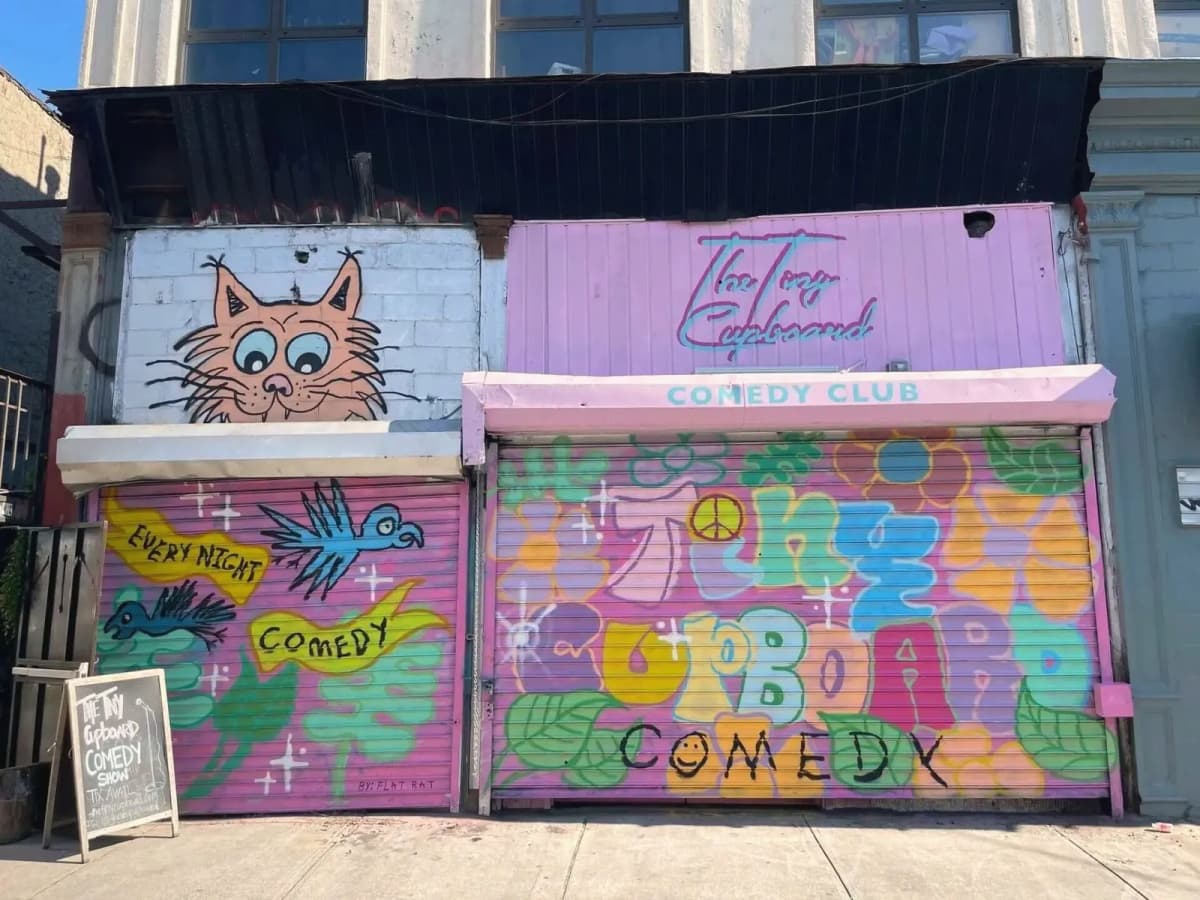
• Take the J/Z to Chauncey St — two minutes to the pink door at 10 Cooper Street. Look for the cat mural.
• Arrive by 9:10. Early enough for a middle seat, late enough that you're not filling time.
• Use the game bar as your airlock. One drink of any kind buys you a table, a game, and something to do with your hands.
• Middle rows, near the aisle. Front row only if you WANT the microphone to know your name.
• Phone away during sets. Not for etiquette points — because the entire value of this night is 60 minutes where nothing is asking you for anything.
• Decide about the 11 pm open mic in advance. Staying is free-spirited; leaving is also free. One ticket covers both answers.
The verdict
The Tiny Cupboard started in a cupboard-sized studio, survived 2020 by moving the entire operation to its rooftop, and grew into the pink church room where it now runs comedy every night of the week — with the rooftop and the original tiny room still in the building's repertoire. It has been written up by the big outlets and it still prices a Tuesday like it remembers being broke. That history matters to this page for one reason: a club built by people with no money stays kind to people who don't want to spend much, and a club built on community stays kind to people who show up alone.
You don't need a drink to justify leaving the house, and you don't need a second person to justify a ticket. You need ninety minutes, twenty dollars, and a seat in the fourth row of a very pink room.
So here's my question, and I actually want answers: what's YOUR version of the light night out — the plan small enough that you'll actually do it on a Tuesday? Tell me. I'm building a list.
The Tiny Cupboard Comedy Club & Board Game Bar, 10 Cooper St, Brooklyn, NY 11207