
An Hour on Summit Avenue, Starting Where the Lantern Is
A guide with a lantern walks a group along a mile of Summit Avenue after dark, stopping outside the big nineteenth-century houses and talking. Nobody goes inside. The hour is local history with the hauntings attached. Two things are worth deciding before you book: which departure you take, and which side of the street you wait on.
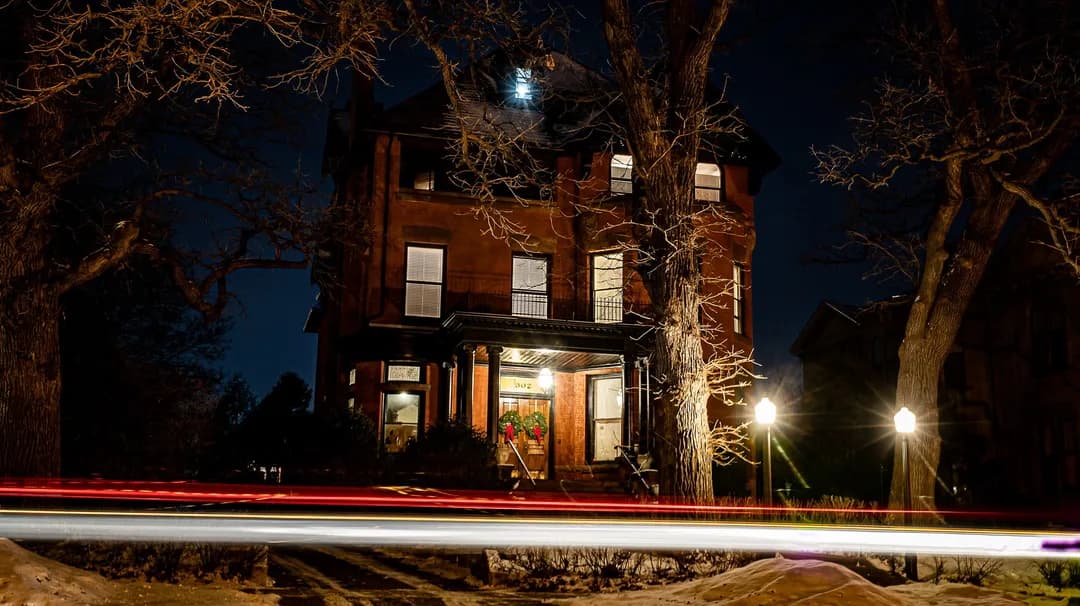
Summit Avenue runs west from the bluff above downtown St. Paul, and for about a mile of it the houses are nineteenth-century stone and brick, built large. This walk covers that mile in an hour, after dark, on foot.
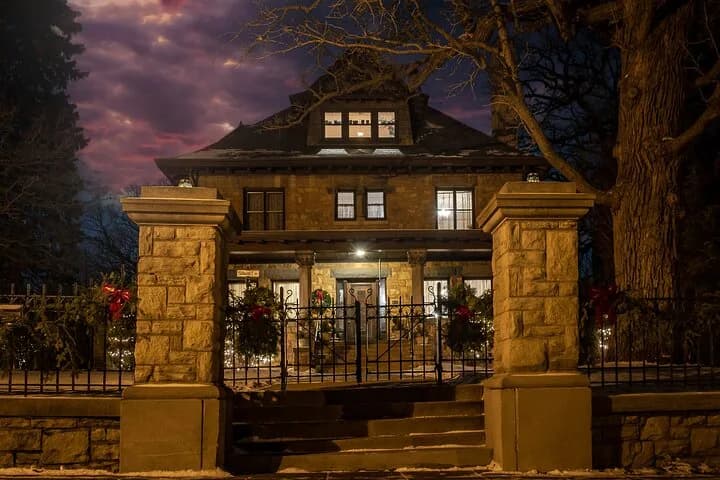
Nobody goes inside. The operator's own terms say it plainly: this is a walking tour and it does not enter privately owned buildings or private property. The group stands on the public sidewalk while the guide talks, then moves to the next address. Most of the houses are still lived in, and some have passed to clubs and institutions, with their lights on.

Departures run every night of the year at eight and at nine, rain or shine, and the booking takes one person as easily as a group. Online sales for a given departure close three hours before it starts. The price covers all fees and taxes. Snacks are not included, and there is nothing else to buy once you are walking.
 St Paul Ghost Tours: Sinister Sins & Shadows Ghost TourSixty minutes on foot along Summit Avenue with a guide carrying a lantern. Nightly departures at eight and nine, all fees and taxes included, free cancellation up to twenty-four hours before.www.viator.com
Nine Stops Are Listed, and the Stop Times Fill the Hour

The booking page prints a numbered route: Forepaugh's, the Stuart House, Cochran Park, the Nathan Hale statue, the Burbank-Livingston-Griggs house, the Nina Clifford monument, the Chauncey Griggs mansion, the William Butler house, and the F. Scott Fitzgerald house. Each one carries its own stated length, six or seven minutes. Add those nine figures together and they come to fifty-eight of the sixty minutes, which leaves nothing for the walking between them. The operator's own page is more careful and promises six or more locations.
One traveler in September 2026 wrote that their walk finished at the Burbank-Livingston-Griggs house with, in their words, four more addresses left. Read the nine as the pool the guide draws from on the night, and treat anything past the sixth as a bonus.
The list is loose on its own details, too. It dates the Chauncey Griggs mansion to 1885 and credits a Clarence Johnson; the National Register paperwork for 476 Summit has it built in 1883 to 1884 to designs by C. H. Johnston Sr. The booking data also hangs two of the nine stops on one map pin, though they are 432 and 476 Summit, two decades and two building styles apart. Neither slip changes the hour you get. Both tell you where the value sits, which is the guide talking and not the itinerary as printed.
The walking itself is about a mile at what the operator calls a relaxed pace, with frequent stops. Summit Avenue is a sidewalk the whole way. The booking page ticks every wheelchair box it has while also stating that travelers should have at least a moderate level of physical fitness and that the walk is not recommended for anyone with poor cardiovascular health. Those statements sit in the same list and do not agree with each other. The operator's own answer is narrower: not all of its tours are wheelchair accessible, and it asks you to confirm accessibility for the specific tour you want before you book.
At Eight in Midsummer You Are Walking in Daylight

Two departures go out an hour apart, every night, all year. In the short days they are both night walks. In June and July the earlier one is not. A traveler who took the eight o'clock slot in July 2026 wrote that it was, in their words, far from night time when the walk began.
Official sunset times for St. Paul show how wide that gap runs. At the June solstice the sun sets at 9:03 PM and civil twilight holds until 9:40, so even the nine o'clock group starts in dusk. By mid-August the sun is down at 8:18 PM and the light is gone by 8:50. By late October it sets at 6:11 PM, and in late December at 4:34.
The stories do not change between the two departures. The light does, and so does the point of walking a dim avenue after dark. In June and July neither slot gets you a dark walk, and nine is the closer of the two. From mid-August the nine o'clock departure is the one that gets you what you came for. From late October it stops mattering.
History First, With the Ghost Stories Hung On It
The operator is direct about the register. Its own answer to the question of whether the walk is frightening says the tour is designed to be more eerie than terrifying, with the focus on history, atmosphere and real accounts. Jump scares are not part of it. There are no actors, no effects and nothing jumps out; the hour is a guide talking on a sidewalk.
That matches what travelers say, in both directions. Several who came expecting a haunted attraction said so afterwards and were disappointed. Others came for the houses and the local history and got exactly that. The guide carries a lantern, wears a company shirt, and tells the stories standing still.
What varies is the guide. Across the reviews on this listing, the strongest praise and the sharpest complaints are both about delivery. Two reviewers describe a guide reading from a script. Many more name a guide who made the hour. It is the same route either way.
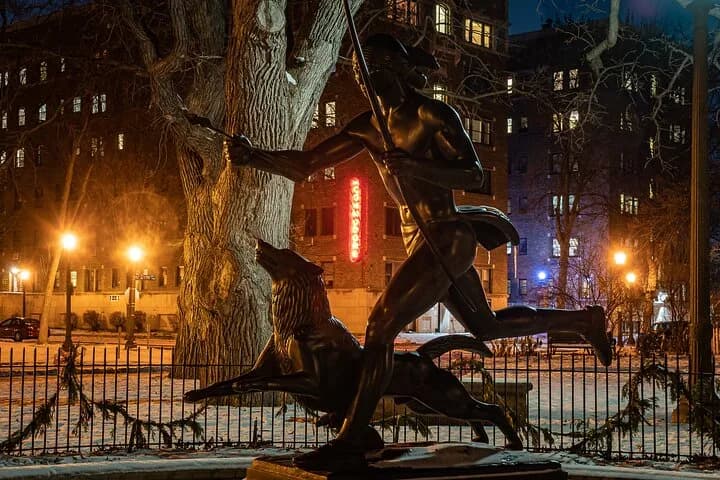
The history underneath the stories holds up, and it is on the public record. The oldest building on the avenue is 312 Summit, an Italian Villa that the Historic Hill nomination dates to 1856. The second-oldest is the limestone house at 432, designed by the Chicago architect Otis L. Wheelock in 1862; it was a house museum for years and was divided into private apartments in 1996. The bronze in Cochran Park is Paul Manship's Indian Hunter and His Dog, made in 1926 and standing in a circular tiled pool, and it is the original rather than the copy: the city sent it to Como Park after repeated vandalism, then cleaned it and brought it back here in 1996, leaving the replica behind. And 599 Summit, where the route ends, is a National Historic Landmark. Fitzgerald came back to his parents' unit there in July 1919 and, in the words of the landmark nomination, created his first published novel, This Side of Paradise.
One stop is not the thing its name promises. The Nina Clifford monument is not a monument; it is a figure carved out of a tree stump on the front lawn of a private house at 435 Summit. Clifford was real and is well documented. The state historical society calls her a legendary madam of St. Paul and records that she was named the richest woman in the underworld. But she neither lived nor worked on this avenue. She ran her house on Washington Street downtown until her death in 1929, the building came down in the 1930s, and the Science Museum of Minnesota stands on the site now. A 1997 dig there found none of the tunnels the legend promised. The same account puts the rest plainly: her notoriety survives on lore and continued storytelling rather than on remaining physical artifacts from her life. It is a fine stop and a fine story. It is also somebody's garden, so look from the sidewalk.
Two Addresses, One Lantern
The booking page says to meet outside Forepaugh's 2nd Mansion at 302 Summit Avenue, and the operator's own marketing page says the same. The operator's own reservation system gives a different address: outside the Germanic-American Institute at 301 Summit Avenue, directly across the street. The two addresses are about nineteen metres apart, across Summit Avenue.
A September 2026 traveler record describes being sent to 302, finding no guide there fifteen minutes before the eight o'clock departure, and then locating the group across the street.
One thing to settle before you go looking for the name. The restaurant called Forepaugh's is not at the meeting point. It trades from the family's first house at 276 Exchange Street South, a little under half a mile away, and 302 Summit is the second house the Forepaughs bought in 1889. Navigating to the restaurant will not bring you to this walk.
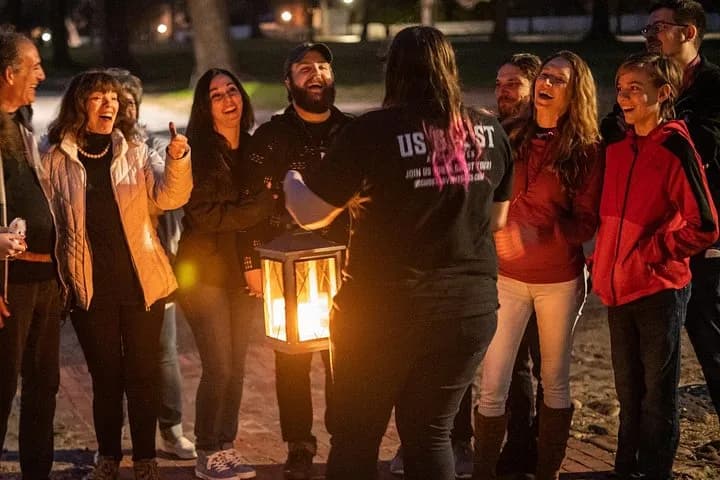
Arrive fifteen minutes early, as both sources ask, and stand where you can see both sides of the avenue. The marker is the person, not the building: a lantern and a US Ghost Adventures shirt. Your voucher is shown to the guide at the start. Nothing about the hour happens indoors, so there is no lobby to wait in and no door to knock on.
Dress for a St. Paul night, whatever the afternoon looked like. The walks go out rain or shine and the operator cancels only when it decides a departure cannot run, in which case it contacts you. Its own list of what to bring is short: walking shoes, water, and cash if you want to tip the guide. Smoking is not allowed on the walk, and the guide asks for quiet while a story is being told. Dogs are welcome if they are not disruptive, which is unusual for a tour of this kind. Photographs are encouraged as long as they do not interrupt the walk, and the operator asks you not to shoot video. Snacks are not included. On this booking, cancelling more than twenty-four hours before the departure returns the full price.
Then the practical part is over and you are standing on Summit Avenue at nine at night, which is quiet, and lit from inside the windows, and the best argument the tour makes for itself.